Q.1.
In a power supply, the output voltage can vary due to multiple reasons. Which of these is not true if it is found that the output voltage is constant?
- a) The voltage stability factor is very high
- b) The output resistance is zero
- c) The temperature coefficient is zero
- d) The voltage stability factor is very small
Q.2.
Consider the op-amp circuit shown.
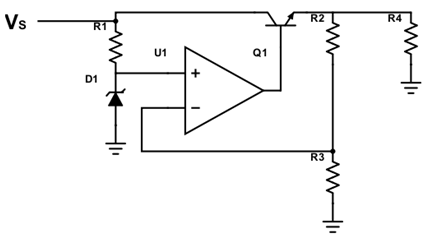
- a) 20V
- b) 30V
- c) 5V
- d) 50V
Q.3.
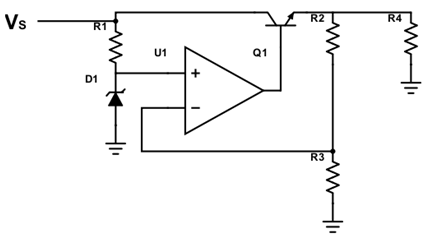
Consider the following circuit. Find the power dissipation of the transistor given that the diode breakdown voltage is 5V, R1=20kΩ, R2=100kΩ, R3=200kΩ, R4=10Ω. The source voltage VS=20V.
- a) 12.12W
- b) 9.375W
- c) 9.27W
- d) 10.575W
Q.4.
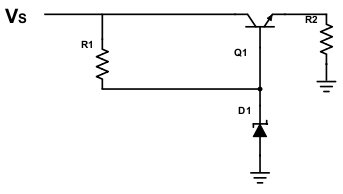
In the Zener controlled series regulator shown below, find the current through the Zener diode.
- a) 5.05 mA
- b) 4.95 mA
- c) 3.33 mA
- d) 0
Q.5.
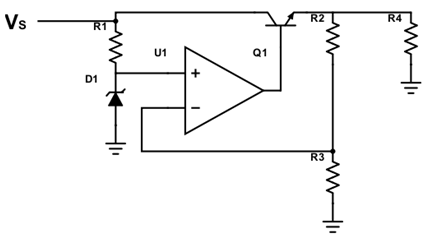
Consider the circuit shown and find the percentage increase in power dissipation of the transistor if the source voltage increases by 10%.
- a) 10%
- b) 20.22%
- c) 14.28%
- d) 15.66%
Q.6.
The following is a shunt regulator. Find maximum power dissipation of the Zener diode and transistor, given that the source voltage varies from 20-40V, the Zener breakdown voltage is 5V, the output voltage is 10V, the resistance R1=50Ω, R2=20kΩ, β=VBE=0.5V.
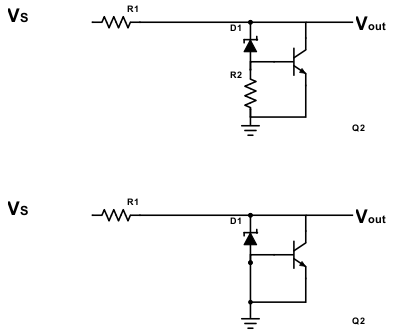
- a) PTransistor = 5.12 W, PZener = 0.051 W
- b) PTransistor = 0.41 W, PZener = 0.57 W
- c) PTransistor = 5.94 W, PZener = 0.057 W
- d) PTransistor = 6.22 W, PZener = 5.66 W
Q.7.
What is not related to a transistorized series regulator?
- a) The output can be varied by using a variable resistor
- b) The output is independent of temperature
- c) The overload and short circuit protection is not required
- d) The circuit has negative feedback responsible for regulation
Q.8.
In a transistorized series regulator, how is the overload and short-circuit protection provided?
- a) By the use of a thermistor
- b) By using two additional diodes and a current sensing resistor to protect the series transistor
- c) By using a diode and an additional resistor to protect the transistor
- d) By using a diode along with a capacitor of a small capacitance value in series
Q.9.
What is the output of the IC 7924?
- a) 12V
- b) -12V
- c) 24V
- d) -24V
Q.10.
In the ICwhat is the minimum input voltage for proper functioning?
- a) 5V
- b) 6V
- c) 7V
- d) 8V