The dispersion number of perfect mixed flow is
-
0 -
> 150 -
∞ -
< 2100
Half life period of decomposition of a liquid 'A' by irreversible first order reaction isminutes. The time required forconversion of 'A' is __________ minutes.
-
18 -
24 -
6 -
12
The reactions with low activation energy are
-
always spantaneous -
slow -
fast -
non-spontaneous
Oil is hydrogenated using nickel catalyst in a __________ reactor.
-
batch -
slurry -
fluidised bed -
fixed bed
Pick out the wrong statement.
-
For a first order consecutive reaction, a tubular flow reactor as compared to a stirred tank reactor provides higher overall selectivity. -
For an ideal mixed reactor at steady state, the exit stream has the same composition as fluid within the reactor and the space time is equivalent to holding time for constant density system. -
Plug flow reactor (PFR) is always smaller than mixed reactor for all positive reaction orders for a particular duty. -
Reaction rate does not decrease appreciably as the reaction proceeds in case of an autocatalytic reaction.
B.E.T. method of finding out surface area of a catalyst, uses the extension of __________ isotherm.
-
Langmuir -
Freundlich -
Tempkin -
none of these
In case of calcination of limestone, CaCO3 CaO + CO2, the addition of more of CaO will result in __________ in the concentration of CO2.
-
no change -
increase -
decrease -
unpredictable from the data
Which of the following is not endothermic in nature ?
-
Combustion of sulphur. -
Gasification of carbon. -
Thermal cracking of fuel oil. -
Steam reforming of naphtha.
The performance equations for constant density systems are identical for
-
P.F.R. and backmix reactor. -
P.F.R. and batch reactor. -
P.F.R, batch reactor and backmix reactor. -
batch reactor and backmix reactor.
Arhenious equation shows the variation of __________ with temperature.
-
reaction rate -
rate constant -
energy of activation -
frequency factor
When a catalyst increases the rate of chemical reaction, the rate constant
-
decreases -
increases -
remains constant -
becomes infinite
Catalyst is a substance, which __________ chemical reaction.
-
increases the speed of a -
decreases the speed of a -
can either increase or decrease the speed of a -
alters the value of equilibrium constant in a reversible
Pick out the correct statement.
-
A catalyst speeds up the forward reaction but slows shown the reverse reaction. -
Addition of catalyst changes the equilibrium constant. -
Pressure changes do not change the equilibrium concentrations. -
The composition of equilibrium is changed by catalyst.
The rate of a gas phase reaction is given by K . CA . CB. If the volume of the reaction vessel is reduced to l/4th of its initial volume, then the reaction rate compared to the original rate will be __________ times.
-
4 -
16 -
8 -
2
The rate of a homogeneous reaction is a function of
-
temperature and pressure only. -
temperature and composition only. -
pressure and composition only. -
all temperature, pressure and composition.
In the fluid catalytic cracker (FCC), the cracking reaction is __________ (A) and the regeneration is___(B) __________
-
(A) exothermic (B) endothermic -
(A) exothermic (B) exothermic -
(A) endothermic (B) enodthermic -
(A) endothermic (B) exothermic
The residence time distribution of an ideal CSTR is
-

-
τ exp (-t/τ) 
-
exp(-t/τ)
-

With increase in the space time of an irreversible isothermal reaction being carried out in a P.F. reactor, the conversion will
-
increase -
decrease -
remain same -
data in insufficient; can't be predicted
Reaction rate of a first order reaction, which is half completed inminutes will be
-
0.03 sec-1 -
0.03 min-1 -
0.03 hr-1 -
0.05 min-1
The rate of an autocatalytic reaction, 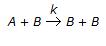 , is given by -rA = k . CA . CB. In this case, the
-
plot of - rA Vs CA is a straight line with slope k. -
plot of - rA Vs CA is a hyperbola. -
rate of disappearance of reactant A is maximum, where CA = CB -
both 'b' & 'c'
The extent of a reaction is
-
different for reactants and products. -
dimensionless. -
depends on the stoichiometric co-efficient. -
all of the above.
The catalyst in a first order chemical reaction changes the
-
equilibrium constant -
activation energy -
heat of formation of the product -
heat of reaction
An example of autothermal reactor operation is
-
sulphur dioxide oxidation -
ethylene oxidation -
benzene oxidation -
ammonia synthesis
With increase in initial concentration, the fractional conversion of a first order reaction in a given time
-
increases -
decreases -
remains constant -
unpredictable
In an ideal mixed reactor (at steady state), the
-
space time is equivalent to holding time for constant density systems. -
composition throughout the reactor remains same. -
exit stream has the same composition as the fluid within the reactor. -
all (a), (b) and (c).
A rise in temperature
-
normally tends to increase the reaction rate. -
does not affect a catalysed reaction. -
does not affect photo-chemical reaction rates. -
all (a), (b) and (c).
Rate of a chemical reaction is not affected by the
-
catalyst. -
temperature. -
reactant's concentration. -
number of molecules of reactants taking part in the reaction.
Overall rate of reaction in a heterogenous catalytic reaction depends upon the mass and energy transfer from the fluid to solid surface and its rate of reaction is usually __________ the concentration of catalyst, if it does not entail a chain mechanism.
-
proportional to -
independent of -
inversely proportional to -
proportional to the square of
What is the dispersion number for a CSTR?
-
0 -
1 -
< 1 -
∞
Rate of a chemical reaction is independent of the concentration of the reactants for a __________ reaction.
-
zero order -
third order -
consecutive -
none of these
Pick out the correct statement.
-
A catalyst does not change AH of the reaction. -
A catalyst changes the equilibrium point. -
Law of mass action was suggested by Le-Chatelier. -
The difference between the energy of reactants and that of the products is the activation energy.
Velocity of a chemical reaction
-
decreases with increase in temperature. -
increases with increase of pressure of reactants for all reactions. -
decreases with increase of reactant concentration. -
none of these.
The space time is equivalent to the holding time in a steady state mixed reactor for
-
non-isothermal gas reaction. -
variable fluid density systems. -
constant fluid density systems. -
gas reactions with changing no. of moles.
Rate of a chemical reaction is independent of the concentration of the reactants for a __________ reaction.
-
zero order -
third order -
consecutive -
none of these
Which of the following is the optimum operating condition for an exothermic reversible reaction taking place in a plug-flow reactor ?
-
Temperature should be high in the beginning and decreased towards the end of the reaction. -
Very low temperature should be used throughout the reaction. -
Very high temperature should be used throughout the reaction. -
none of these.
Half life period of a first order irreversible reaction A  B is
B is
-
k/2 -
ln k/2 -
ln 2/k -
ln 0.5/k
Half life period of a first order irreversible reaction A B is
-
k/2 -
ln k/2 -
ln 2/k -
ln 0.5/k
Higher free energy of activation of a chemical reaction (at a given temperature) implies
-
slower rate of reaction. -
higher rate of reaction. -
higher equilibrium conversion. -
both (b) and (c).
For a packed bed reactor; the presence of a long tail in the residence time distribution curve is an indication of
-
ideal plug flow -
bypass -
dead zone -
chanelling
Reactions with high activation energy are
-
very temperature sensitive -
temperature insensitive -
always irreversible -
always reversible
The rate of reaction of a/an __________ reaction is not affected by temperature rise.
-
autocatalytic -
photochemical -
consecutive -
zero order.
A space velocity of 5 hr-1 means that
-
five reactor volumes of feed (at specified conditions) are being fed into the reactor per hour. -
after every 5 hours, reactor is being filled with the feed. -
cent per cent conversion can be achieved in at least 5 hours. -
a fixed conversion of a given batch of feed takes 5 hours.
The knowledge of initial concentration and rate constant is necessary to determine the half life time of a reaction of __________ order.
-
zero -
first -
second -
none of these
The catalyst in a first order chemical reaction changes the
-
equilibrium constant -
activation energy -
heat of formation of the product -
heat of reaction
The enzyme which can catalyse the conversion of glucose to ethyl alcohol is
-
invertase -
maltase -
diastase -
zymase
Integral method for analysing the kinetic data is used
-
when the data are scattered. -
for testing specific mechanisms with simple rate expressions. -
both (a) and (b). -
none of these.
Collision theory gives the rate constant for bimolecular reaction as
-
K α T.e-E/RT -
K α eE/RT -
K α e-E/RT -
none of these
__________ resistance is not involved in the combustion of a carbon particle.
-
Gas film -
Ash -
Chemical reaction -
none of these
In an ideal P.F.R. at steady state conditions
-
the composition of reactants remains constant along a flow path. -
the conversion of the reactant varies from point to point along a flow path. -
there is no lateral mixing of fluid. -
there may be diffusion along the flow path.
With increase in temperature, the rate constant obeying Arhenious equation
-
increases. -
decreases. -
decreases exponentially. -
can either increase or decrease ; depends on the frequency factor.