Which of the following has maximum thermal conductivity ?
-
Iron -
Coal -
Nitrogen -
Tar
It is not recommended to use a 1-2 shell and tube heat exchanger for a particular heat duty, whenever the LMTD correction factor is
-
> 0.75 -
< 0.75 -
< 0.50 -
< 0.25
Pick out the wrong statement.
-
Economy of a multiple effect evaporator is not influenced by the boiling point elevation. -
Two identical cubes of iron and copper will have the same heat content under the same conditions of temperature. -
Double pipe heat exchangers are mostly used in the field of refrigeration. -
Finned tube heat exchangers are suitable for heating air by steam.
Heat sensitive materials can be concentrated in an evaporator employing
-
vacuum -
high pressure -
high residence time -
none of these
A steel sphere of radius 0.1 m at 400°K is immersed in an oil at 300°K. If the centre of the sphere reaches 350°K inminutes, how long will it take for a 0.m radius steel sphere to reach the same temperature (at the centre) under identical conditions ? Assume that the conductive heat transfer co-efficient is infinitely large.
-
5 minutes -
10 minutes -
20 minutes -
40 minutes
Pick out the correct statement.
-
1 kcal/hr.m.°C is equal to 1 BTU/hr. ft.°F. -
In steady state heat conduction, the only property of the substance which determines the temperature distribution, is the thermal conductivity. -
In unsteady state heat conduction, heat flows in the direction of temperature rise. -
In heat transfer by forced convection, Grashoff number is very important.
Critical value of the __________ number governs the transition from laminar to turbulent flow in free convection heat transfer.
-
Grashoff -
Reynolds -
both 'a' & 'b' -
Prandtl & Grashoff
Kirchoff's law is applicable to
-
monochromatic radiation only -
total radiation only -
both (a) and (b) -
only volumes and not to surfaces
The Stefan-Boltzman constant depends on the
-
medium -
temperature -
surface -
none of these
The units of resistance to heat transfer is
-
J.m-2.K-1 -
J.m-1.K-1 -
W.m-2.K-1 -
W-1m2K
A hollow sphere and a solid sphere of the same material and equal radii are heated to the same temperature. In this case,
-
the cooling rate will be the same for the two spheres and hence the two spheres will have equal temperatures at any instant. -
both the spheres will emit equal amount of radiation per unit time in the beginning. -
both will absorb equal amount of radiation from the surrounding in the beginning. -
both(b) & (c).
Corrosiveness of steam condensate is due to the presence of
-
CO2 -
dissolved O2 -
both (a) & (b) -
neither (a) nor (b)
In a boiling curve, the peak heat flux is called the __________ point.
-
Nusselt -
Leidenfrost -
boiling -
burnout
Three material A, B and C of equal thick-nes and of thermal conductivity of&kcal/hr. m. °C respectively are joined together. The temperature outside of A and C are 30°C and 100°C respectively. The interface between B and C will be at a temperature of __________ °C.
-
40 -
95 -
70 -
50
Conduction occurs in the buffer zone for a fluid flowing through a heated pipe, only when Prandtl number is
-
0.1 -
>1 -
< 1 -
l
A multiple effect evaporator as compared to a single effect evaporator of the same capacity has
-
lower heat transfer area. -
lower steam economy. -
higher steam economy. -
higher solute concentration in the product.
Thermal diffusivity of a material
-
has the unit m2 /sec. -
is defined as K/ρ . Cp. -
is the ratio of thermal conductivity to thermal capacity. -
all (a), (b) and (c).
A wall has two layers of materials A and B; each made of a different material. Both the layers have the same thickness. The thermal conductivity of materialA is twice that of B. Under the equilibrium, the temperature difference across the wall is 36°C. The temperature difference across the layer A is __________ °C.
-
6 -
12 -
18 -
24
At steady state the temperature variation in a plane wall, made of two different solids I & II is shown below :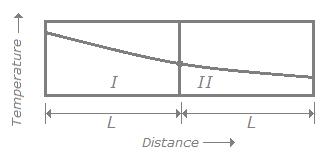
The thermal conductivity of material I
-
is smaller than that of II. -
is greater than that of II. -
is equal to that of II. -
can be greater than or smaller than that of II.
In sub-cooled boiling,
-
temperature of the heating surface is less than the boiling point of the liquid. -
temperature of the heating surface is more than the boiling point of the liquid. -
bubbles from heating surface are absorbed by the mass of the liquid. -
very large vapour space is necessary.
A concentric double pipe heat exchanger as compared to the shell and tube heat exchanger for the same heat load requires
-
less heating surface. -
more space. -
lower maintenance cost. -
none of these.
Open pan evaporators are preferred to be used, when the solution to be concentrated is
-
scaling -
highly viscous -
corrosive -
salty
Three material A, B and C of equal thick-nes and of thermal conductivity of&kcal/hr. m. °C respectively are joined together. The temperature outside of A and C are 30°C and 100°C respectively. The interface between B and C will be at a temperature of __________ °C.
-
40 -
95 -
70 -
50
The thermal boundary layer at NPr > 1
-
is thicker than hydrodynamic boundary layer. -
is thinner than hydrodynamic boundary layer. -
and the hydrodynamic boundary layer are identical. -
disappears.
In a forward feed multiple effect evaporator, the pressure is
-
highest in last effect -
lowest in last effect -
same in all effects -
dependent on the number of effects
Thermal conductivity of a gas at low density, __________ with increase in temperature.
-
decreases -
increases -
remains unchanged -
may increase or decrease; depends on the gas
Condensing film co-efficient for steam on horizontal tubes ranges fromtoKcal/hr.m2 .°C. Condensation of vapor is carried out inside the tube in a shell and tube heat exchanger, when the
-
higher condensing film co-efficient is desired. -
condensate is corrosive in nature. -
lower pressure drop through the exchanger is desired. -
temperature of the incoming vapor is very high.
The equation, (NSt x N2/3Pr) = f/is the __________ analogy.
-
Colburn -
Reynolds -
Prandtl -
none of these.
Pick out the wrong statement.
-
Heat transfer from a hot body to cold body by the emission of heat waves is called radiation: -
Filmwise condensation takes place on non-wettable surfaces. -
The boiling point of a solution is affected by liquid head as well as boiling point elevation. -
none of these.
The film co-efficient between condensing vapour and metal wall increases with
-
increasing temperature of the vapour. -
decreasing temperature of the vapour. -
increasing viscosity of the film of condensate. -
increasing temperature drop.
With increase in temperature, the thermal conductivity of a gas
-
increases. -
decreases. -
remains same. -
may increase or decrease depending on the type of gas.
In a shell and tube heat exchanger, floating head is used for
-
large temperature differentials. -
high heat transfer co-efficient. -
low pressure drop. -
less corrosion of tubes.
In the free convection regime of pool boiling, the heat flux is proportional to
-
Δt1/2 -
Δt2 -
Δt5/4 -
Δt
In a co-current double pipe heat exchanger used for condensing saturated steam over the inner tube, if the entrance and exit conditions of the coolant are interchanged, then the rate of condensation will
-
increase -
decrease -
remain unchanged -
either increase or decrease; depends on the coolant flow rate
Nusselt number is a function of Prandtl number and __________ number of fluid in natural convection heat transfer.
-
Grashoff -
Biot -
Stantan -
Reynolds
The driving potential for the crystal growth during crystallisation is the __________ of the solution.
-
concentration -
viscosity -
super-saturation -
density
Steam trap is used to
-
condense the steam flowing in the pipeline. -
remove water resulting from partial condensation of steam. -
stop the supply of steam. -
none of these.
The maximum heat transfer co-efficient from steam heating will be attained when the steam is
-
supersaturated -
saturated -
wet -
none of these
With increase in temperature, the thermal conductivity of fresh lubricating oil
-
increases -
decreases -
remains unchanged -
may increase or decrease; depends on its composition
Pick out the wrong statement.
-
Heat transfer from a hot body to cold body by the emission of heat waves is called radiation: -
Filmwise condensation takes place on non-wettable surfaces. -
The boiling point of a solution is affected by liquid head as well as boiling point elevation. -
none of these.
Which of the following situations can be approximated to a steady state heat transfer system ?
-
A red hot steel slab (having outside surface temperature as 1300°C) exposed to the atmosheric air at 35°C. -
10 kg of dry saturated steam at 8 kgf/cm2 flowing through a short length of stainless steel pipe exposed to atmospheric air at 35°C. -
Boiling brine kept in open vessel when the bottom surface temperature of the vessel is maintained constant at 180°C. -
A sub-cooled refrigerant liquid at 8°C flowing at the rate of 6 Kg/minute through a copper pipe exposed to atmospheric air at 35°C.
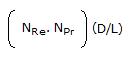 is called the __________ number
-
Peclet -
Stanton -
Graetz -
none of these
jH factor for heat transfer depends upon the __________ number.
-
Biot -
Nusselt -
Reynolds -
Prandtl
Fresh orange juice contains(by weight) solids and the rest waterof the fresh juice is sent to an evaporator to remove water and subsequently mixed with the remainingof fresh juice. The resultant product containssolids. The kg of water removed from 1 kg fresh juice is
-
0.4 -
0.5 -
0.6 -
0.7
Sensible heat absorbed by 1 lb of water when it is heated fromto 212°F may be around __________ BTU.
-
180 -
970 -
3.97 -
data insufficient, can't be predicted
The maximum heat transfer co-efficient from steam heating will be attained when the steam is
-
supersaturated -
saturated -
wet -
none of these