The portion of a brick cut across the width, is called
-
closer -
half brick -
bed -
bat.
The entrained concrete is used in lining walls and roofs for making
-
heat insulated -
sound insulated -
neither (a) nor (b) -
both (a) and (b).
The Auger borings are not common
-
in soils that require lateral support -
in cohesive soils -
in soft soils -
none of the above.
The raft slab is projected beyond the outer walls of the structure by
-
5 to 10 cm -
15 to 20 cm -
25 to 30 cm -
30 to 45 cm -
60 cm.
The piece of a brick cut with its one corner equivalent to half the length and half the width of a full brick, is known as
-
queen closer -
bevelled closer -
king closer -
half king closer.
Pick up the commonly adopted geophysical method in civil engineering from the following :
-
the seisomic method -
electrical resistivity method -
gravitational method -
magnetic method -
both (a) and (b) of the above.
In English garden wall bond
-
one course of headers to three or five course of stretchers -
queen closer in provided in each heading course -
the middle course of stretchers is started with a header to give proper vertical joints -
all the above.
Which one of the following factors is considered for the orientation of buildings :
-
the direction of the prevailing winds in the area -
the exposure of the walls and roof of the buildings to the rays of sun -
the extent up to which the sunrays penetrate with the verandah. -
all the above.
In jack arch floor, the rise is kept
-
1/6th of the span -
1/8th of the span -
1/10th of the span -
1/12th of the span -
1/15th of the span.
The concrete slump recommended for beams and slabs ; is
-
25 to 50 mm -
25 to 75 mm -
30 to 125 mm -
50 to 100 mm -
none of these.
The pile which is provided with a bulb filled with concrete at its lower end, is known as
-
Simplex pile -
Mac-Arthur pile -
Raymond pile -
Franki pile -
none of these.
The form work from the underside of slabs, can be removed only after
-
1 day -
4 days -
7 days -
14 days.
The process of making the back ground rough, before plastering, is
-
dubbing -
hacking -
blistering -
peeling.
The brick laid with its breadth parallel to the face of a wall, is known as
-
header -
stretcher -
closer -
none of these.
To ensure that supporting area of an offset footing of a boundary wall is fully compressive, the C.G. of load must act
-
at the centre of the base -
within the middle third of the base -
within the middle fifth of the base -
neither (a), (b) nor (c).
A projecting piece usually provided to support a truss, is
-
cornice -
coping -
frieze -
lintal.
Pick up the incorrect statement from the following :
-
Cement is added to lime mortar to increase its hydraulic properties only -
Lime surkhi mortar is used for pointing the walls -
Lime should be slaked before preparing lime mortar -
High early strength concrete is generally used in cold weather.
While designing a stair, the product of rise and going is approximately kept equal to
-
350 -
420 -
450 -
500 -
600.
The member which is placed horizontally to support common rafter of a sloping roof, is
-
purlin -
cleat -
batten -
strut.
In case of multi-storeyed buildings, the forms to be removed first are
-
sides of beams and girders -
column forms -
bottom of beams and girders -
all the above at the same time.
Arches in the form of masonry arcs struck from more than four centres, are called
-
two curved arches -
gothic arches -
ogee arches -
drop gothic arches.
Black cotton soil is unsuitable for foundations because its
-
bearing capacity is low -
permeability is uncertain -
particles are cohesive -
property to undergo a volumetric change due to variation of moisture content.
A wooden block hinged on post outside a door, is known
-
stop -
cleat -
horn -
none of these.
The 9 cm x 9 cm side of a brick as seen in the wall face, is generally known as
-
stretcher -
face -
front -
header -
side.
The line of intersection of the surfaces of a sloping roof forming an external angle exceeding 180°, is
-
ridge -
hip -
valley -
none of these.
Which one of the following rocks is used for monumental buildings :
-
granite -
marble -
sand stone -
slate.
For constructing a terrazo floor. Pick up the incorrect statement from the following :
-
a base course is prepared as in cement concrete flooring -
a 32 mm thick layer of cement concrete (1 : 2 : 4) is laid on the base course and the surface is made smooth by trowelling -
glass strips are driven into the layer according to the pattern required -
after final grinding is over, oxalic acid mixed with water is spread over and rubbed hard with soft material -
none of these.
Pick up the correct statement from the following:
-
Louvered door is generally provided in bath rooms -
Flush door is generally provided in dinning room -
Revolving door is generally provided in cinema halls -
Sliding door is generally provided in show rooms -
All the above.
For providing a raft foundation, the following activities are involved
- ramming the foundation bed
- excavation of the soil upto required depth
- laying the reinforcement over the foundation bed
- curing the cement concrete placed over reinforcement
- pouring the cement concrete over the reinforcement.
The correct sequence is
-
1, 2, 3, 4, 5 -
5, 4, 3, 2, 1 -
2, 1, 3, 5, 4 -
3, 2, 5, 1, 4.
The maximum permissible deflection of a timber beam supporting a roof, is
-
L/100 -
L/150 -
L/260 -
L/360 -
none of these.
According to Rankine's formula, minimum depth of foundations, is
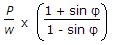
According to Rankine's formula, minimum depth of foundations, is
The type of pointing in which upper side of mortar joints is kept aboutmm inside the face of the masonry and bottom is kept flushed with face of wall, is
-
truck pointing -
recessed pointing -
struck pointing -
grooved pointing.
Open test pit is only suitable upto a depth of
-
2 metres -
2.5 metres -
3 metres -
none of the above.
Pick up the incorrect statement from the following :
-
Horizontal D.P.C. is provided at plinth level in internal walls -
D.P.C. is provided under door and verandah openings -
Vertical D.P.C. is not provided in internal walls -
Cement concrete is a rigid damp-proofing material.
The steel pile which is generally sunk in soft clay or loose sand of low bearing capacity, is
-
H-pile -
pipe pile -
screw pile -
disc pile -
none of these.
Pick up the correct statement from the following :
-
English bond is used for brick masonry to support heavy loads -
Double-flemish bond is suitable for brick masonry to give uniform face appearance -
The double-flemish bond is used for the construction of single brick residential building -
The stretcher bond is used for the construction of half brick masonry brick -
all the above.
For plastering the exposed brick walls, the cement sand mortar should be
-
1:2 -
1:3 -
1:4 -
1:6 -
1:8.
The stepped structure provided for lateral support of a structure, is
-
retaining wall -
breast wall -
buttress -
parapet wall.
The projections of head or sill of a door or window frame, are
-
transoms -
horns -
stops -
chocks.
The construction joints in buildings are provided after
-
10 m -
15 m -
20 m -
40 m -
60 m.
In the method of tube boring of soil investigation, the following is essential :
-
a tube of about 2 metres length and 20 cm diameter with a cutting edge -
a flap valve at the bottom of tube is provided to extract the soil sample -
the tube is raised and lowered by 4 thick rope moving over a pulley suspended on a tripod stand -
the tube is dropped to fall under gravity in side a metalic casing pipe which is driven as the depth of excavation proceeds. -
all the above.
Pick up the correct statement from the following :
-
the first coat of stucco plaster is called scratch coat -
the second coat of stucco plaster is called brown coat -
the third coat of stucco plaster is called white coat -
all the above.
The arrangement made to support an unsafe structure temporarily, is known as
-
shoring -
scaffolding -
underpinning -
jacking -
none of these.
For each storey of a building, the depth of exploration should be
-
1 metre -
2 metres -
3 metres -
4 metres.
The local swelling of a finished plaster, is termed
-
cracking -
dubbing -
blistering -
hacking.
Pick up the correct statement from the following :
-
D.P.C. should be continuous -
D.P.C. should be of good impervious material -
D.P.C. may be horizontal or vertical -
All the above.
For a rectangular foundation of width b, eccentricity of load should not exceed
-
b/2 -
b/3 -
b/4 -
b/5 -
b/6.
Which one of the following piles has a cast iron shoe even after removal of the hollow cylindrical steel casing
-
simplex pile -
pedastal pile -
Franki pile -
vibro pile -
both (a) and (d) of the above.
The additional piles which are driven to increase the capacity of supporting loads on vertical piles, are known
-
construction piles -
raking piles -
eccentric piles -
sinking piles -
none of these.