For a properly designed vehicle, the resistance generally ignored, is
-
wind resistance -
rolling resistance -
grade resistance -
axle resistance -
none of these.
The camber on pavements, is provided by
-
elliptical method -
straight line method -
parabolic method -
straight line and parabolic at crown -
circular method.
Reduction of load capacity in a ruling gradient of
-
1 in 10, is 10% -
1 in 15, is 15% -
1 in 20, is 10% -
1 in 25, is 25% -
none of these.
An ideal vertical curve is
-
true spiral -
cubic spiral -
cubic parabala -
lamniscate -
none of these.
A subsidiary area in a carriageway placed so as to control the movement of the traffic, is
-
median strip -
island -
flower bed -
refuge.
The top height of a route marker above crown level is
-
1.50 m -
1.75 m -
2.00 m -
2.25 m
Over taking time required for a vehicle with design speedkm ph and overtaking acceleration 1.m/sec2 to overtake a vehicle moving at a speedkm ph, is
-
5.0 secs -
6.12 secs -
225.48 secs -
30 secs
At a road junction,cross conflict points are severe, if
-
both are one-way roads -
both are two-way roads -
one is two-way road and other is one-way road -
none of these.
Pick up the incorrect statement from the following. If water cement ratio is
-
increased, strength of concrete increases -
decreased, strength of concrete increases -
increased, strength of concrete is not affected -
none of these.
Pick up the correct statement from the following:
-
Borrow pits are located out side the right of way -
Borrow pits may be located on either side of the right of way -
Spoil bank is located on one side of the right of way -
All the above.
The maximum radial distance of a Lemniscate curve, having maximum polar angle a, is
-
3 R sin α -
3 R sin2α -
3 R sin 2α -
3 R sin α/2 -
none of these.
The maximum comfortable retardation applied to moving vehicles, is
-
3.42 m/sec2 -
4.42 m/sec2 -
5.56 m/sec2 -
7.80 m/sec2 -
10 m/sec2
To ensure that bullock carts may not overturn on curves, the maximum value of super-elevation, recommended by I.R.C., is
-
1 in 10 -
1 in 12 -
1 in 15 -
1 in 20 -
1 in 25
Ruling gradient on hill roadsm above M.S.L. is kept
-
4% -
5% -
6% -
7% -
8%
The maximum radial distance of a Lemniscate curve, having maximum polar angle a, is
-
3 R sin α -
3 R sin2α -
3 R sin 2α -
3 R sin α/2 -
none of these.
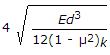
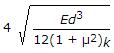
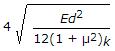
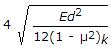
If E is the modulus of elasticity of the concrete in kg/cm2, d is the slab thickness in cm, is the Poisson's ratio for the concrete, k is the sub-grade modulus kg/cm3, the radius r of relative stiffness in cm,
If no super elevation is provided on a road along curves, pot holes may develop at
-
inner edge of the road -
outer edge of the road -
centre of the road -
no where on the road.
Curves in the same direction separated by short tangents, are called
-
simple circular curves -
compound curves -
transition curves -
broken-back curves. -
None of these.
Speed regulations on roads is decided on the basis of
-
60 percentile cumulative frequency -
75 percentile cumulative frequency -
80 percentile cumulative frequency -
85 percentile cumulative frequency.
Minimum thickness of the base of a flexible pavement, is
-
10 cm -
15 cm -
20 cm -
25 cm -
30 cm.
Enoscope is used to determine
-
spot speed -
average speed -
travel time -
none of these.
When an up gradient of a highway meets a downgrade, the vertical curve provided, is known as
-
valley curve -
sag curve -
summit curve -
all the above.
Reconnaissance is best done with the help of
-
aerial photographic survey -
condastral surveys -
topographical surveys -
triangulation surveys -
none of these.
One-way streets are generally provided in crowded cities as, these
-
are inexpensive means of traffic flow -
reduce delays to vehicles -
permit higher speed -
reduce the number of accidents -
all the above.
The width of road pavements, depends upon
-
width of traffic lane -
number of traffic -
width of median strip -
all the above.
If the coefficient of friction on the road surface is 0.and a maximum super-elevation 1 inis provided, the maximum speed of the vehicles on a curve ofmetre radius, is
-
32.44 km/hour -
42.44 kg/hour -
52.44 km/hour -
62.44 km/hour -
72.44 km/hour
The usual width of side drains along Highways in hilly region, is
-
50 cm -
60 cm -
70 cm -
80 cm -
100 cm
The perpendicular offset from the tan-get to the central point of the circular curve, is
-
R sin θ/2 -
R cos θ/2 -
R (1 - cos θ/2) -
R (1 - sin θ/2) -
none of these.
Normal formation width of a hill road for one-way traffic, is
-
3.6 m -
4.8 m -
6.6 m -
7.2 m -
8 m
An Executive Engineer of roads, executes works under direct control of
-
Superintending Engineer -
Secretary to the Govt -
Chief Engineer -
None of these.