The pH value of water fit for drinking, is
-
13 -
11 -
9 -
7 -
5
Bacterias which can survive with or without free oxygen, are known
-
aerobic bacterias -
anerobic bacterias -
facultative bacterias -
none of these.
To remove very fine suspended particles from water, the method adopted is
-
screening -
sedimentation -
boiling -
filtration.
The average domestic consumption under normal conditions in an Indian city per day per person, is
-
105 litres -
115 litres -
125 litres -
135 litres -
150 litres.
Pick up the incorrect statement from the following :
-
Iron salts produce heavy flocs and hence remove more suspended matter -
Iron salts remove hydrogen sulphides -
Iron salts can be used over a limited range of pH values -
Iron salts impart corrosiveness to water.
Open channels supported over tres-les, are generally known as
-
raised canals -
acqueducts -
syphons -
flumes.
For 3.x 10-2 cumecs discharging from a well, a pump is installed to lift water against a total head ofm. The minimum required horse power, is
-
10 H.P. -
15 H.P. -
18 H.P. -
20 H.P. -
25 H.P.
Perched acquifers generally occur
-
below water table -
above water table -
in acquicludes -
in artesian acquifers -
none of these.
Pick up the correct statement from the following :
-
If ports are closed, the dry intake towers will not have any water -
Even if ports are closed, the wet intake tower will have water filled up to reservoir level -
The dry intake towers are generally constructed with heavier construction to resist buoyant forces -
No buoyant force acts on wet intake towers -
All the above.
The level of underground water is called
-
water level -
water table -
negative level -
invert level.
At break point of chlorination,
-
chlorine is used to oxidise -
residual chloride is zero -
residual chloride is maximum -
residual chlorine reappears.
Plain chlorination is used for water
-
with turbidities less than 20 mg/litre -
obtained from clear lakes -
consumed during emergencies -
supplies to armies during war -
all the above.
Pick up the incorrect statement from the following :
-
The water entering the slow sand filters should be treated by 9.386 coagulants -
The depth of water on the filter should be twice the depth of the filter sand -
When the filter head is 0.75 times the depth of filter sand, the water obtained is purest -
The cleaning of slow sand filters is done by back washing -
All the above.
From the surface of reservoir, evaporation may be minimised by sprinkling
-
Spirit -
Hydrochloric acid -
Cetyl alcohol -
Methane -
None of these.
Run off is the quantity of water which flows
-
in sewer pipes -
due to leakage in pipes -
in rivers -
none of these.
The pH value of water fit for drinking, is
-
13 -
11 -
9 -
7 -
5
The percentage of chlorine in fresh bleaching powder is roughly
-
50 to 60 -
30 to 35 -
40 to 50 -
20 to 25
For least effect on the water table, the tube wells must be dug one in every
-
0.5 sq km -
0.75 sq km -
1.0 sq km -
1.25 sq km -
1.5 sq km.
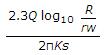
S1 and S2 are the draw downs in an observation well at times t1 and t2 after pumping. For discharge Q and coefficient of transmissibility T, the relationship, is
Silt storage is the same as
-
dead storage -
live storage -
effective storage -
none of these.
While designing a water supply of an industrial township, industrial and commercial water demand of total supply, is assumed
-
10% -
10 to 15% -
15 to 20% -
20 to 25%.
Per capita demand of water is calculated in litres
-
per person per day -
per person per month -
per person per year -
none of these.
The difference in the reservoir level and the lowest point of the water mains ism. The expected pressure due to water hammer is 7.5 kg/cm2 in a pressure conduit of diameter 1 m. Assuming the efficiency of the riveted joints of the pipe as 0.6 and minimum cover 3 mm for corrosion, the thickness of the pipe materials, is
-
10 mm -
15 mm -
20 mm -
25 mm -
30 mm.
The head against which the motor works for lifting water, is
-
maximum depth of water table below ground level -
maximum depression head -
velocity head -
frictional losses in the delivery pipe -
all the above.
Underground water is obtained from
-
rains -
rivers -
lakes -
reservoirs -
springs.
m and n are monsoon duration factor and catchment factor respectively. If P is yearly rainfall in cm, runoff can be calculated by
-
velocity area method -
weir or spillway method -
use of venturi-meter -
using power plant consumption -
none of these.
Gravity conduits are generally in the form of
-
canals -
flumes -
aqueduct -
tunnels -
all the above.
The head against which the motor works for lifting water, is
-
maximum depth of water table below ground level -
maximum depression head -
velocity head -
frictional losses in the delivery pipe -
all the above.
Higher yield may be expected from
-
gravity springs -
surface springs -
artesian springs -
all the above.
In plain sedimentation tanks under normal conditions, impurities are removed upto
-
60% -
70% -
80% -
90%.