MCQGeeks
CBSE
JEE
NTSE
NEET
English
UK Quiz
Quiz
Driving Test
Practice
Games
Driving Test
Alabama
Alabama Car Driving Permit Test-18
Answers
Q.1.
You should increase the distance between your vehicle and the vehicle ahead when you:
Are following a small passenger vehicle.
Are being tailgated by another driver.
Are driving more slowly than the posted speed limit.
Q.2.
When driving in fog, it is best to drive with:
High beam headlights.
Low beam headlights.
Four-way flashers.
Q.3.
A blood alcohol concentration of 0.percent:
Won't have any effect on your driving.
Won't put other drivers at risk.
Will double your chances of having an accident.
Q.4.
If you become drowsy while driving, you should:
Try to fight it.
Take a break.
Take some caffeine pills.
Q.5.
Make room for cars that are entering the freeway by:
Slowing down.
Merging into a different lane.
Maintaining your speed and position.
Q.6.
A curb painted red means:
Loading zone.
The area is reserved for picking up or dropping off passengers.
No parking, standing, or stopping.
Q.7.
If you want to pass a pedestrian who is walking along the roadway and an oncoming vehicle is approaching, you should:
Slow down and let the oncoming vehicle pass before you pass the pedestrian.
Keep driving at a steady speed. The oncoming vehicle must stop for you.
Honk your horn to get the pedestrian to move over.
Q.8.
If it feels like your tires have lost contact with the surface of the road, you should:
Slow down by shifting into a lower gear.
Ease your foot off the gas pedal.
Slow down by pumping the brakes quickly and firmly.
Q.9.
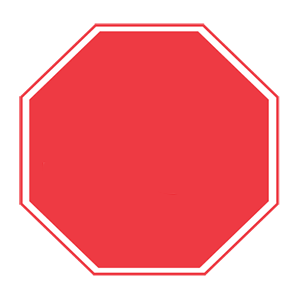
When you approach an octagonal sign, you must:
Slow.
Stop.
Turn.
Q.10.
If there is a deep puddle on the road ahead, you should:
Maintain the posted speed to make it through the water.
Avoid the puddle if possible.
Shift into neutral as you drive through the water.
Q.11.
A sign with this shape means:
No passing zone.
Right turn permitted on red.
Yield right-of-way.
Q.12.
What does a traffic signal with a yellow left arrow indicate?
Drivers should prepare to yield to oncoming traffic.
The protected left turn is about to end.
Both of the above.
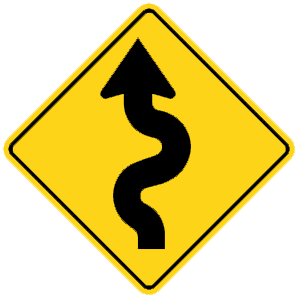
Q.13.
This road sign means:
Sharp turn to the right ahead.
Upcoming sharp left and right turns.
Winding road ahead.
Q.14.
You hit a parked vehicle and can't find the owner. What must you do?
Call your insurance company when you get home.
Wait for the owner to return.
Leave a note with your name and address on the parked vehicle.
Q.15.
Roads with double solid yellow line markings down the center indicate that passing is:
Allowed from both directions.
Allowed only from your direction of travel.
Not allowed from either direction.
Q.16.
If your vehicle has a mechanical problem:
Signal and pull into the slow lane.
Stop in your lane and put on your hazard lights.
Put on your hazard lights and pull off the road.
Q.17.
When approaching an intersection that is controlled by a flashing red traffic signal, you must:
Come to a complete stop, yield to oncoming traffic or pedestrians, then proceed.
Reduce your speed and proceed with caution.
Come to a complete stop and remain stopped as long as the light is red.
Q.18.
When parking next to a curb, you should use your turn signals:
Only when pulling away from the curb.
When pulling next to, but not away from, the curb.
When pulling next to or away from the curb.
Q.19.
When you see this black and yellow sign, it means:
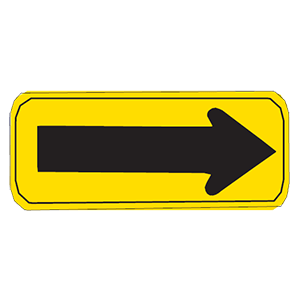
The road to the right is for one-way traffic only.
There is a detour to the right due to road construction.
The road ahead changes direction at an extreme angle.
Q.20.
Accruing ____ points on your license within a two-year period will result in suspension of your license for one year.
18 to 20
21 to 23
24 or more
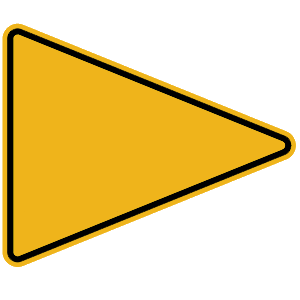
Q.21.
What message will be found on this yellow pennant-shaped sign?
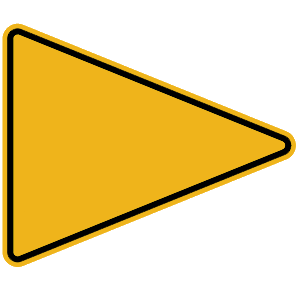
Right turns only.
Right turns permitted.
No passing zone.
Q.22.
You may cross double yellow lines to pass another vehicle if the:
Vehicle in front of you moves to the right to let you pass.
Yellow line next to your side of the road is broken.
Yellow line next to the opposite side of the road is broken.
Q.23.
When changing lanes:
Rely on the rearview mirror.
Look over your shoulder in the direction you plan to move.
Rely on the left side mirror.
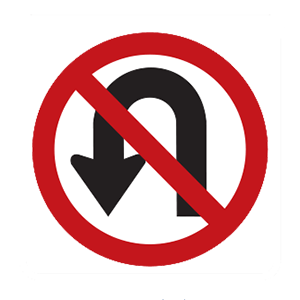
Q.24.
This road sign means:
Do not enter.
Roundabout ahead.
No U-turns.
Q.25.
A green traffic signal indicates that approaching drivers should:
Come to a complete stop.
Increase their speed to quickly clear the intersection.
Continue driving straight through the intersection, turn left, or turn right.
Q.26.
Winter driving is more dangerous than driving during other seasons because:
Road conditions can be affected by freezing temperatures, ice, snow, and fog.
There are increased hours of darkness.
Both of the above.
Q.27.
When a gate at a railroad crossing is lowering, you should:
Speed up and cross the tracks before the gate lowers completely.
Come to a complete stop and wait.
Drive around the gate.
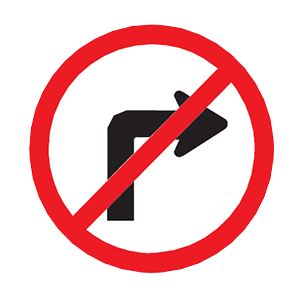
Q.28.
This sign means:
No right turn.
Right turn on red light permitted with caution.
All traffic must turn right at next intersection.
Q.29.
Motorcycles, scooters, and mopeds are not easy to see; therefore, you should:
Slow down when driving.
Make constant visual checks.
Share a lane with a motorcycle.
Q.30.
After you have passed a vehicle moving in the same direction, it is safe to move back into the right lane:
After about three seconds.
When you can no longer see the passed vehicle over your right shoulder.
When you can see the entire front of the passed vehicle in your rearview mirror.
Q.31.
Large trucks are likely to lose speed when:
Driving up long or steep hills.
Driving in long, gradual curves.
Driving down long, gradual hills.
Q.32.
Driving under the influence of any medication which impairs your driving is permitted:
Under no circumstances.
If you don't feel drowsy.
If it is prescribed by a physician.
Q.33.
On a multilane road, a dashed yellow line next to a solid yellow line means:
Passing is prohibited from both directions.
Passing is permitted from both directions.
Passing is permitted only from the direction next to the dashed line.
Q.34.
This sign means:
Road construction/maintenance area.
Side road.
Railroad ahead.
Q.35.
This red and white sign means you should:
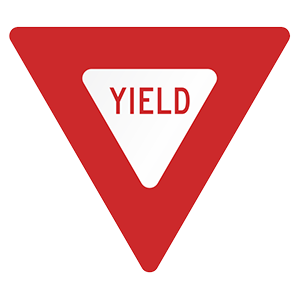
Stop and check for traffic coming from both directions before proceeding.
Give the right-of-way to traffic on the road you wish to enter or cross.
Maintain a steady speed and check for traffic coming from all directions.
Q.36.
When entering the interstate, check for a gap in traffic in the nearest lane, adjust your speed to match traffic, signal, and:
Expect traffic to allow you to proceed into the lane, since you have the right-of-way.
Merge carefully into the gap.
Wait for the lane to clear before merging.
Q.37.
If you find yourself in a skid:
Brake lightly.
Stay off the brakes.
Brake abruptly.
Q.38.
Interstate driving requires drivers to:
Have the ability to safely drive at increased speeds.
Be constantly alert.
Both of the above.
Q.39.
If it is necessary to make an emergency stop while driving on an interstate, you should:
Sound your horn at passing cars to get their attention.
Get out of your vehicle and flag down the first vehicle that passes.
Pull off the road, turn on your emergency flashers, and stay in your vehicle, if you can.
Q.40.
Construction zone signs are generally:
Square or rectangular with white and red coloring.
Round or octagonal with black and yellow coloring.
Diamond-shaped or rectangular with orange and black coloring.
Support mcqgeeks.com by disabling your adblocker.
×
Please disable the adBlock and continue.
Thank you.
Reload page