MCQGeeks
CBSE
JEE
NTSE
NEET
English
UK Quiz
Quiz
Driving Test
Practice
Games
Driving Test
Alabama
Alabama Car Driving Permit Test-20
Answers
Q.1.
If you approach a traffic light with a red signal and a police officer directs you to go through the intersection without stopping, you should:
Stop until the light turns green.
Go through the intersection without stopping.
Come to a complete stop before proceeding.
Q.2.
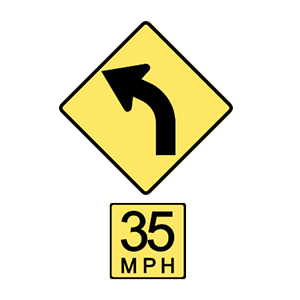
This sign means:
There is a 35 mph speed zone after the curve ahead.
Drive no slower than 35 mph around the upcoming curve.
Approach the upcoming curve at a speed of 35 mph or slower.
Q.3.
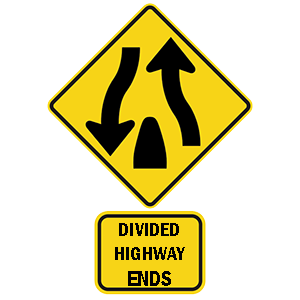
This sign means:
Curves ahead.
Divided highway starts.
Divided highway ends.
Q.4.
You must show proof of insurance to law enforcement:
Only if you are involved in a collision.
If you are involved in a collision or stopped for a citation.
Only if you are stopped and cited.
Q.5.
What is a crosswalk?
Another name for a four-way intersection.
An area designated for road construction workers.
The area where pedestrians may cross the roadway.
Q.6.
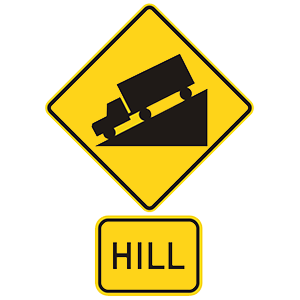
This sign means:
Trucks under 18,000 pounds are allowed.
Hill ahead.
Truck stop ahead.
Q.7.
If a road is slippery, maintain a following distance that is:
No different than normal.
Farther from the car ahead than normal.
Closer to the car ahead than normal.
Q.8.
Remove all snow, frost, and ice from:
Just the windshield.
All windows.
Just the windshield and passenger window.
Q.9.
A dashed yellow line down the center of a two-lane road indicates that:
Lanes are moving in opposite directions and drivers are not permitted to pass.
Lanes are moving in opposite directions and drivers are permitted to pass.
Lanes are moving in the same direction and drivers are not permitted to pass.
Q.10.
Blue traffic signs offer information on:

Motorist services.
Construction and maintenance.
Mileage information, such as distances to specific locations.
Q.11.
Which of the following describes the thinking of defensive drivers?
They know other drivers will do the right thing.
They consider what other drivers might do and are prepared to react.
They expect no breaks and give none.
Q.12.
You should drive on the shoulder to pass a car:
If the vehicle ahead of you is turning left.
Under no circumstances.
If the shoulder is wide enough.
Q.13.
Any amount of alcohol in the blood may affect a driver's:
Right-of-way privileges.
Judgment and physical coordination.
Knowledge.
Q.14.
When preparing to make a left turn from a two-way street, you should drive:
Near the right-hand side of the road.
Near the centerline.
On the left of the centerline.
Q.15.
Regulatory signs are usually ____ and should always be obeyed.
White
Blue
Green
Q.16.
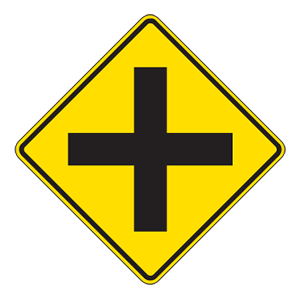
This sign shows one type of:
Intersection.
Road curve.
Right turn.
Q.17.
To improve visibility lowered by rain or fog, drivers should use their:
Low beam headlights.
High beam headlights.
Parking lights.
Q.18.
Temporary signs used in construction and maintenance work areas:
Have a red background with green writing.
Have an orange background with black writing.
Have a yellow background with blue writing.
Q.19.
If you plan to pass another vehicle, you should:
Not assume the other driver will make space for you to return to your lane.
Assume the other driver will let you pass if you use your turn signal.
Assume the other driver will maintain a constant speed.
Q.20.
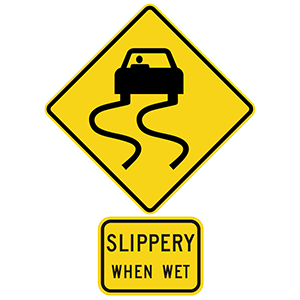
What does this road sign mean?
Winding road
Loose gravel
Slippery when wet
Q.21.
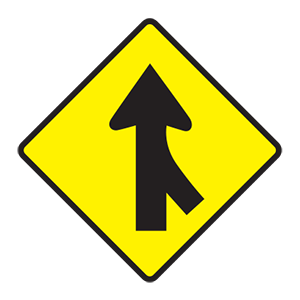
This sign means:
You should stop for other traffic.
Traffic is entering from another road and you should allow additional space for drivers to merge safely into the flow of traffic.
Traffic is entering from another road and you should keep right.
Q.22.
Before returning to your original lane after passing another vehicle, you should:
Beep your horn.
See both headlights of the passed vehicle in your rearview mirror.
Flash your headlights.
Q.23.
You can drive off the road to pass another vehicle:
If the vehicle ahead is turning left.
If there are two or more lanes traveling in your direction.
Under no circumstances.
Q.24.
A large truck is ahead of you and is turning right onto a street with two lanes in each direction. The truck:
May complete its turn in either of the two lanes.
May have to swing wide to complete the right turn.
Must stay in the right lane at all times while turning.
Q.25.
This sign means you are approaching a railroad crossing that does not have a signal. You should:
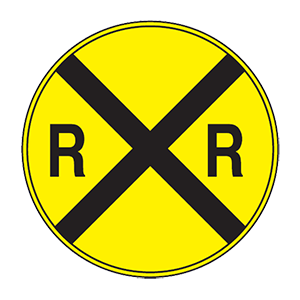
Come to a complete stop.
Proceed at a consistent speed while looking and listening for approaching trains.
Slow down, look both ways, listen for any trains, and be prepared to stop if any trains are nearby.
Q.26.
What is the only effective way to remove alcohol from the body?
Drink strong coffee.
Wait.
Take a cold shower.
Q.27.
Hydroplaning occurs when tires ride on a thin film of water instead of on the road. To prevent hydroplaning in wet weather, you should:
Put on your cruise control to maintain a constant speed.
Slow down.
Move to the shoulder of the road as soon as it starts to rain.
Q.28.
If you are being followed too closely on a two-lane road:
Reduce your speed slowly to encourage the tailgater to drive around you.
Speed up to increase the distance between you and the other car.
Apply your brakes to slow down, then resume your original speed.
Q.29.
A flashing red traffic light at an intersection means:
The same thing as a yield sign.
The light is about to turn green.
The same thing as a stop sign.
Q.30.
When driving on an interstate, to avoid traffic merging from on-ramps to your right, the best thing to do is to:
Change lanes to the left.
Slow down.
Maintain your speed and position.
Q.31.
Which lane must you be in before making a left turn from a one-way street?
The lane nearest the left curb.
The lane nearest the center of the street.
The lane nearest the right curb.
Q.32.
Before stopping your vehicle at a traffic signal or sign, you should:
Press down hard on the accelerator.
Check your mirrors for surrounding traffic.
Set the parking brake.
Q.33.
Trucks' blind spots are:
Directly behind the body.
On the immediate left of the cab.
Both on the immediate left of the cab and directly behind the body.
Q.34.
When a school bus is stopped ahead on your side of the road with its red lights flashing, you must:
Slow to a speed no faster than 10 mph.
Stop until the lights stop flashing.
Change lanes and pass cautiously.
Q.35.
You may be able to identify an aggressive driver by:
Their erratic and improper lane changes.
The number of passengers in their car.
Their tendency to drive slowly.
Q.36.
Which of the following driving skills is/are affected by the use of alcohol and/or drugs?
Alertness.
Coordination.
Both of the above.
Q.37.
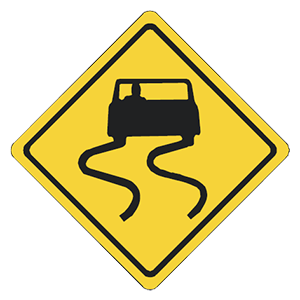
This sign means:
Slippery when wet.
Stop sign ahead.
No U-turn.
Q.38.
A broken yellow line beside a solid yellow line indicates that:
Passing is permitted from the lane next to the solid yellow line.
Passing is not permitted from either direction.
Passing is permitted from the lane next to the broken yellow line.
Q.39.
To pass on a two-lane road, you should:
Sound your horn as you pass.
Flash your headlights as you pass.
Judge the distance to any oncoming vehicles.
Q.40.
You should use your horn when:
Another vehicle is in your way.
It may help prevent a collision.
Another driver makes a mistake.
Support mcqgeeks.com by disabling your adblocker.
×
Please disable the adBlock and continue.
Thank you.
Reload page