MCQGeeks
CBSE
JEE
NTSE
NEET
English
UK Quiz
Quiz
Driving Test
Practice
Games
Driving Test
Alabama
Alabama Car Driving Permit Test-21
Answers
Q.1.
This sign means:
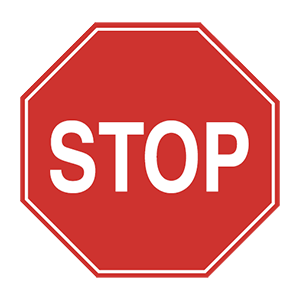
Stop.
Merge.
Upcoming change in direction.
Q.2.
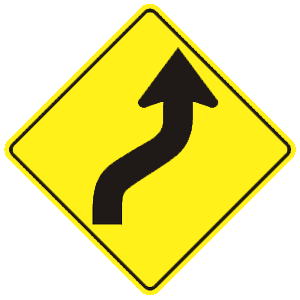
This road sign means:
Road construction ahead.
The road ahead curves left then right.
The road ahead curves right then left.
Q.3.
Which of these statements is true about changing lanes?
You only need to turn and look over your right shoulder for lane changes to the right or left.
Look over your right shoulder for a right lane change and your left shoulder for a left lane change.
Vehicles with two outside mirrors do not have blind spots.
Q.4.
At a railroad crossing, you must:
Watch for vehicles that must stop at all railroad crossings (school buses, trucks carrying hazardous materials, etc.).
Watch for multiple trains.
Both of the above.
Q.5.
If you come to an intersection controlled by a flashing yellow light, you must:
Wait for the green light before proceeding.
Slow down and cross the intersection carefully.
Stop before crossing the intersection.
Q.6.
A solid yellow line next to a broken yellow line means that vehicles:
Driving in both directions may pass.
Next to the broken line may pass.
Next to the solid line may pass.
Q.7.
At an intersection with stop signs on all corners, yield the right-of-way to any driver:
On your left.
Who arrived before you.
Across from your vehicle.
Q.8.
If you come to an intersection and your view to the side is blocked, you should:
Slow down and look both ways.
Maintain your speed and look both ways.
Stop, then inch forward until you can see clearly in both directions.
Q.9.
Yellow lines separate:
Traffic lanes on one-way streets.
Traffic moving in opposite directions on two-way roads.
All carpool lanes from regular traffic lanes.
Q.10.
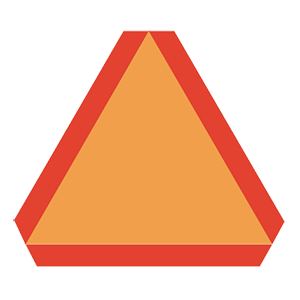
This symbol is used for:
Dangerous intersections.
Slow-moving vehicles.
Yield signs.
Q.11.
When merging onto the freeway, you should be driving:
At or near the speed of the freeway traffic.
At the legal speed limit.
More slowly than the freeway traffic.
Q.12.
When arriving to an uncontrolled intersection at the same time as vehicles to your right and left, you should:
Yield the right-of-way to the vehicle on your left.
Yield the right-of-way to the vehicle on your right.
Wait until there are no vehicles at the intersection before proceeding.
Q.13.
The driver ahead of you stops at a crosswalk. What should you do?
Cautiously pass the vehicle at 10 mph or slower.
Stop, proceeding only when all the pedestrians have crossed.
Change lanes, look carefully, and pass the stopped vehicle.
Q.14.
As you approach the top of a hill, you should:
Speed up slightly.
Prepare to stop, if needed.
Maintain a steady speed.
Q.15.
Which of the following statements is true?
Driving too slowly is not an unsafe practice.
Driving too slowly on certain highways can be dangerous.
The speed at which you drive a vehicle does not affect safety.
Q.16.
Motorcycles are entitled to:
The same full lane width as other motor vehicles.
The width of the sidewalk.
One-half of the width of a lane.
Q.17.
Which of the following statements about driving speed is true?
As your speed increases, the chance of a fatality increases.
As your speed increases, so should your following distance.
Both of the above.
Q.18.
Having a driver license is a:
Requirement.
Privilege.
Right.
Q.19.
As you enter into a roundabout, you should slow down and:
Yield to any crossing pedestrians and bicyclists.
Yield to any car already within the roundabout.
Both of the above.
Q.20.
If you experience a tire blowout:
Tap or pump the brakes.
Slow down gradually and use your brakes lightly.
Apply the brakes firmly and quickly.
Q.21.
Before you change lanes, you should check your mirrors and:
Never look over your right shoulder.
Always slow down in your traffic lane.
Glance over your shoulder.
Q.22.
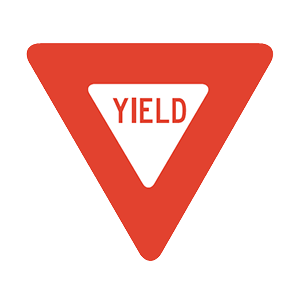
This sign means:
Cars on the right move first.
You have the right-of-way.
Let cross traffic pass before proceeding.
Q.23.
When driving at night, you should:
Always use your high beams.
Look directly at the headlights of an oncoming vehicle.
Increase your following distance.
Q.24.
Before switching on the ignition, you should:
Buckle your safety belt.
Be sure all passengers have buckled their safety belts.
Both of the above.
Q.25.
Which of the following is not a safe driving practice when driving on the interstate?
Slower traffic must keep to the right.
Change lanes without signaling.
If you miss your exit, you must go to the next exit.
Q.26.
Sudden wind gusts on highways:
Generally affect only the movement of large vehicles.
Only cause visibility problems.
Can cause problems for all vehicles.
Q.27.
You are driving on the freeway behind a large truck. You should drive:
Closer behind the truck than you would if following a passenger vehicle.
Farther behind the truck than you would if following a passenger vehicle.
To the right side of the truck and wait to pass.
Q.28.
If your vehicle begins to skid, you should:
Ease up on the gas pedal.
Brake as hard as possible.
Turn off the ignition.
Q.29.
Which of the following is a dangerous habit when driving in work zones?
Tailgating another vehicle
Failing to carefully watch for workers and moving equipment
Both of the above
Q.30.
Vehicles stopped behind a school bus with its red lights flashing must remain stopped until:
All students are off the bus.
The stop arm is retracted.
The stop arm is retracted and the bus resumes motion.
Q.31.
The best way to avoid a dangerous situation while driving is to:
Know what is happening around your vehicle.
Turn off the radio.
Always keep your eyes focused ahead of your car.
Q.32.
Which of the following is most likely to be slippery in cold weather after snow or rain?
A hilly, open road
A residential road
A road in a shaded area
Q.33.
If you see orange construction signs and cones on a freeway, you must:
Slow down because the lane ends ahead.
Be prepared for workers and equipment ahead.
Change lanes and maintain your current speed.
Q.34.
What is a potential effect of taking a prescription drug while drinking alcohol?
There will likely be no effect.
It will make you more alert.
It can make you unfit to drive.
Q.35.
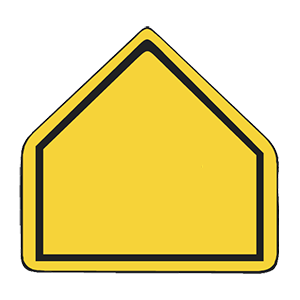
A pentagon-shaped sign is a:
Stop sign.
Regulatory sign.
School zone or school crossing sign.
Q.36.
You must yield to a pedestrian using a white cane or guide dog:
Only when the guide dog is leading the person across the street.
At all times.
Only if a crossing guard is present.
Q.37.
Water on the road can cause a vehicle to hydroplane. Your car may hydroplane at speeds as low as:
45 miles per hour.
35 miles per hour.
40 miles per hour.
Q.38.
Having a driver license is a:
Right, not a privilege.
Privilege, not a right.
Requirement.
Q.39.
What should you do when you see this sign?
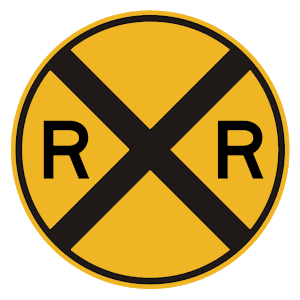
Look for a train station ahead.
Signal before going any further.
Slow down and yield to trains.
Q.40.
Various traffic control devices in construction and maintenance work areas are the color:
Red.
Orange.
Yellow.
Support mcqgeeks.com by disabling your adblocker.
×
Please disable the adBlock and continue.
Thank you.
Reload page