MCQGeeks
CBSE
JEE
NTSE
NEET
English
UK Quiz
Quiz
Driving Test
Practice
Games
Driving Test
Alabama
Alabama Car Driving Permit Test-6
Answers
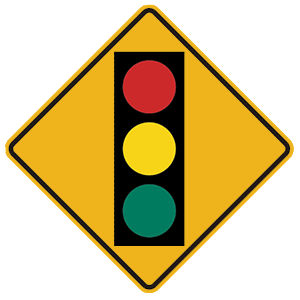
Q.1.
This sign means:
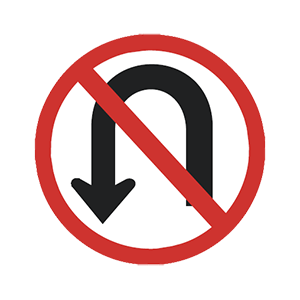
No U-turn.
Traffic signal ahead.
Railroad ahead.
Q.2.
Children on bicycles should be given extra space by motor vehicle operators because:
They do not have the same physical reflexes as adults.
They are smaller and more difficult to see than adults.
Both of the above.
Q.3.
Vehicles are required to be covered by liability insurance:
Only when used on an interstate.
Only when operated by a minor.
At all times.
Q.4.
Which of these statements is true about drugs and driving?
Any prescription drug is safe to use if you don't feel drowsy.
Even over-the-counter drugs can impair your driving.
Only illegal drugs can impair your driving.
Q.5.
To enter a gap in highway traffic:
Watch only the vehicles behind the gap.
Check behind you, then watch the vehicle ahead.
Speed up and let the other vehicles make way.
Q.6.
"No zones" are areas around trucks where cars:
Disappear into blind spots or are so close that they restrict the truck driver's ability to stop and maneuver safely.
Have sufficient space to travel behind the truck.
Have several car lengths between their vehicle and the truck.
Q.7.
When driving behind another vehicle at night, you should:
Keep your headlights on the low beam setting.
Use your high beam headlights until you are within 10 feet of the vehicle ahead.
Use your high beam headlights.
Q.8.
A large truck is ahead of you and is turning right onto a street with two lanes in each direction. The truck:
May complete its turn in either of the two lanes.
May have to swing wide to complete the right turn.
Must stay in the right lane at all times while turning.
Q.9.
You drive defensively when you:
Put one car length between you and the car ahead.
Look only at the car in front of you while driving.
Keep your eyes moving to look for possible hazards.
Q.10.
You should drive on the shoulder to pass a car:
If the vehicle ahead of you is turning left.
Under no circumstances.
If the shoulder is wide enough.
Q.11.
This white sign means you should not pass other vehicles:
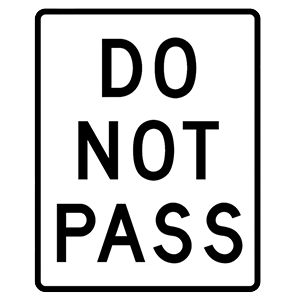
Until after you pass the sign.
Unless it seems safe to do so.
For any reason.
Q.12.
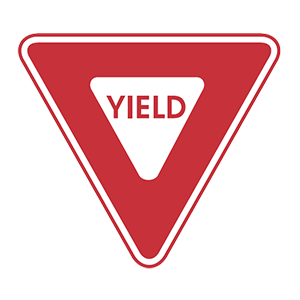
This sign means:
Traffic signal ahead.
Stop.
Yield the right-of-way.
Q.13.
You are driving behind a motorcycle and want to pass. You must:
Stay in the right lane as much as possible because the motorcycle is small and doesn't use all of the lane.
Blow your horn to make the motorcycle move onto the shoulder so that you can pass.
Have your vehicle entirely in the left lane before and during the pass.
Q.14.
If it feels like your tires have lost contact with the surface of the road, you should:
Slow down by shifting into a lower gear.
Ease your foot off the gas pedal.
Slow down by pumping the brakes quickly and firmly.
Q.15.
If worried, nervous, or angry, drivers:
Should let someone else drive.
Are more in touch with their senses and will be more precise drivers.
Will drive no differently than they would if they were thinking clearly.
Q.16.
When approaching an intersection with a flashing red light, you must:
Come to a complete stop, yield to oncoming traffic and pedestrians, then proceed.
Reduce your speed and proceed with caution.
Come to a complete stop and remain stopped as long as the light is red.
Q.17.
Accruing ____ points on your license within a two-year period will result in suspension of your license for one year.
18 to 20
21 to 23
24 or more
Q.18.
You should use your horn when:
Another vehicle is in your way.
It may help prevent a collision.
Another driver makes a mistake.
Q.19.
Drivers turning left must yield to:
Oncoming vehicles traveling straight or turning right.
Passing cars.
No one in particular.
Q.20.
You are coming to an intersection with a flashing red light. You should:
Slow down and yield the right-of-way.
Slow down and drive carefully through the intersection.
Come to a complete stop, check the traffic, and go when it is safe to do so.
Q.21.
Allow extra space in front of your vehicle when following a:
Station wagon.
Passenger vehicle.
Motorcycle.
Q.22.
A broken yellow centerline indicates that:
Passing is not permitted.
Passing on the right is permitted when the way ahead is clear.
Passing on the left is permitted when the way ahead is clear.
Q.23.
Changing from one lane to another is best done:
Quickly and often.
When a car is in your blind spot.
Gradually and carefully.
Q.24.
Streets and highways are most slippery:
When it has been raining hard for several hours.
When they are clean and dry.
Just after it starts to rain.
Q.25.
If you park facing uphill where there is no curb, set the parking brake and:
Turn your wheels toward the edge of the road.
Turn your wheels away from the edge of the road.
Keep your wheels facing straight.
Q.26.
When entering the interstate, check for a gap in traffic in the nearest lane, adjust your speed to match traffic, signal, and:
Expect traffic to allow you to proceed into the lane, since you have the right-of-way.
Merge carefully into the gap.
Wait for the lane to clear before merging.
Q.27.
A solid yellow line on your side of the centerline means:
Reduce your speed.
Traffic light ahead.
Do not pass.
Q.28.
When driving on the highway, consistently looking far ahead of your vehicle:
Helps you keep up with traffic.
Reduces the need for last-minute braking or turning.
Allows you to spot upcoming police officers.
Q.29.
When passing another vehicle, you should return to your original lane when:
You can see both headlights of the passed vehicle in your rearview mirror.
You have cleared the front bumper of the passed vehicle.
You are 50 feet in front of the passed vehicle.
Q.30.
Which of the following blocks the smooth flow of traffic?
Slowing down to look at collision scene.
Avoiding unnecessary lane changes.
Using public transportation instead of your vehicle.
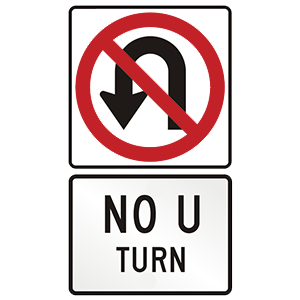
Q.31.
This road sign means:
Do not enter.
No parking.
No U-turn.
Q.32.
Signs with orange backgrounds are:
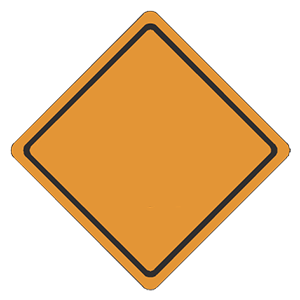
General warning signs.
Construction and maintenance warning signs.
Regulatory signs.
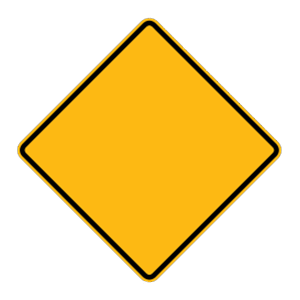
Q.33.
A sign with this shape means:
Railroad crossing.
Warning.
Signal ahead.
Q.34.
Only ____ can reduce blood alcohol content (BAC) and alcohol's effects on the body.
Drinking caffeine
Eating foods high in fat
Time
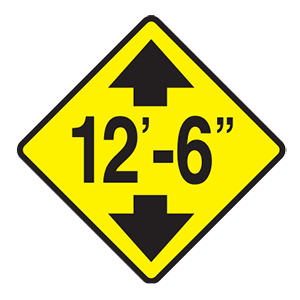
Q.35.
This sign indicates:
The distance from road surface to a bridge or overpass.
The maximum legal height of a vehicle allowed in this state.
The maximum width of a vehicle allowed on the highway.
Q.36.
This sign is a:
Yield sign.
School crossing sign.
Stop sign.
Q.37.
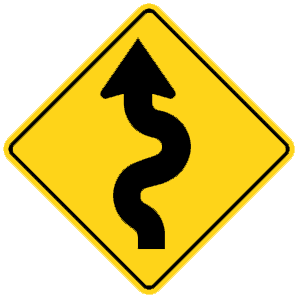
This sign tells you that:
No turns are allowed on the road.
The road narrows ahead.
There is a series of curves ahead.
Q.38.
When driving under snowy or icy conditions:
It is safe to use your cruise control.
Make speed and directional changes more gradually than you would otherwise.
Drive as you would under normal conditions.
Q.39.
You want to park uphill on a two-way road and there is no curb. Which direction do you turn your front wheels?
Straight ahead
Right, toward the side of the road
Left, toward the center of the road
Q.40.
You may be able to identify an aggressive driver by:
Their erratic and improper lane changes.
The number of passengers in their car.
Their tendency to drive slowly.
Support mcqgeeks.com by disabling your adblocker.
×
Please disable the adBlock and continue.
Thank you.
Reload page