MCQGeeks
CBSE
JEE
NTSE
NEET
English
UK Quiz
Quiz
Driving Test
Practice
Games
Driving Test
Alabama
Alabama Car Driving Permit Test-7
Answers
Q.1.
What should a driver do when approaching a traffic control signal that is not in operation?
Come to a full stop and yield the right-of-way before entering the intersection.
If the intersection is clear, the driver does not need to stop.
Drive quickly through the intersection to get out of the way of other vehicles.
Q.2.
When being passed by another vehicle:
Brake hard.
Maintain a constant speed.
Speed up.
Q.3.
If you are driving and you see animals standing near the roadway:
Speed up to scare them away.
Slow down and proceed with caution.
Quickly swerve into the next lane.
Q.4.
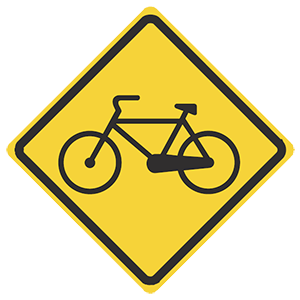
This sign means:
Watch for bicycles.
Bicycles not allowed.
Bicycle repair shop ahead.
Q.5.
If you are being passed in a no passing zone, you should:
Pull off the road.
Maintain your speed and position.
Slow down and let the other driver safely return to the drive lane.
Q.6.
When turning left from a two-way street onto a one-way street, you should:
Turn into any lane.
Turn into first lane.
Turn into second lane.
Q.7.
Slowing down just to look at collisions or anything else out-of-the-ordinary:
Causes traffic congestion.
Prevents rear-end collisions.
Improves traffic flow by preventing collisions.
Q.8.
What should you do when an emergency vehicle is approaching you while using its flashing red or blue lights?
Pull over to the side of the road and come to a complete stop.
Continue driving, but try to stay out of its way.
See if you can reach your destination before the emergency vehicle catches up to you.
Q.9.
As you approach the top of a hill, you should:
Speed up slightly.
Prepare to stop, if needed.
Maintain a steady speed.
Q.10.
It is unlawful to:
Pass another vehicle in any marked no passing zone.
Pass another vehicle over a railroad crossing.
Both of the above.
Q.11.
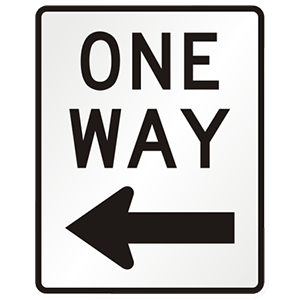
This road sign means:
No right turn.
Drive only in the direction of the arrow.
Curve ahead.
Q.12.
You are involved in a minor collision at an intersection. There are no injuries and there is very little vehicle damage. You should:
Leave your vehicle in the traffic lane until law enforcement arrives.
Move your vehicle out of the traffic lane, if possible.
Not move your vehicle for any reason.
Q.13.
When driving at night on a dimly lit street, you should:
Drive slowly enough that you can stop within the area illuminated by your headlights.
Turn on your high beam headlights to better see the vehicles ahead of you.
Keep the instrument panel lights bright to be more visible to other drivers.
Q.14.
You may legally block an intersection:
If you entered the intersection on the green light.
During rush hour traffic.
Under no circumstances.
Q.15.
When driving in fog, it is best to drive with:
High beam headlights.
Low beam headlights.
Four-way flashers.
Q.16.
Driving more slowly than surrounding traffic is:
A good idea if the weather is bad.
Appropriate if you don’t know the speed limit.
Often a hazard because other drivers may become frustrated and try to pass you.
Q.17.
To avoid glare from the headlights of an approaching car:
Look briefly toward the right side of the road.
Stay focused on the centerline on the road.
Flash your high beams.
Q.18.
At an intersection with stop signs on all corners, yield the right-of-way to any driver:
On your left.
Who arrived before you.
Across from your vehicle.
Q.19.
You should not use your horn:
When visibility ahead is limited.
If you might hit another vehicle.
Near blind pedestrians.
Q.20.
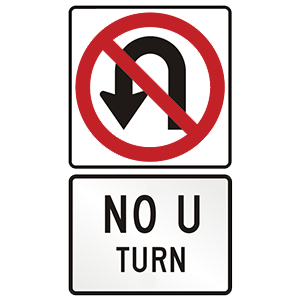
This sign means:
No U-turn.
No turning.
No left turn.
Q.21.
If the roadway is wet or icy, you should:
Reduce your speed.
Drive at the posted speed.
Speed up.
Q.22.
This red and white sign means you should:
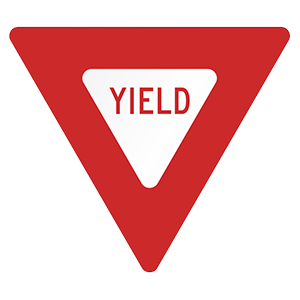
Stop and check for traffic coming from both directions before proceeding.
Give the right-of-way to traffic on the road you wish to enter or cross.
Maintain a steady speed and check for traffic coming from all directions.
Q.23.
If your wheels drop off the roadway or pavement edge, you should:
Wait until it is safe to do so, then gradually re-enter the roadway.
Turn back onto the roadway immediately.
Stop.
Q.24.
If your vehicle starts to lose traction because of water on the road, you should:
Drive at a constant speed to gain better traction.
Apply the brakes firmly to prevent your vehicle from sliding.
Slow down gradually and not apply the brakes.
Q.25.
When you want to change lanes, you should never:
Move into another lane while within an intersection.
Check your blind spot by looking over your shoulder.
Check for other drivers moving into the same lane.
Q.26.
What should you do when approaching a pedestrian who is being led by a guide dog or using a white cane?
Honk so they know to clear the way.
Yield the right-of-way.
Swerve quickly around them.
Q.27.
When you see a flashing yellow light at an intersection, you should:
Yield to all traffic before crossing the intersection.
Stop, then enter the intersection when it is safe to do so.
Slow down and cross the intersection carefully.
Q.28.
When you are facing a green light and there are pedestrians in the intersection:
You must yield the right-of-way to pedestrians.
You have the right-of-way over pedestrians.
Pedestrians must wait for you to cross.
Q.29.
From top to bottom, the following is the proper order for traffic lights:
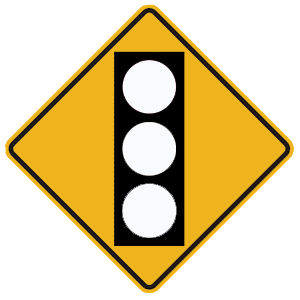
Red, yellow, green.
Red, green, yellow.
Green, red, yellow.
Q.30.
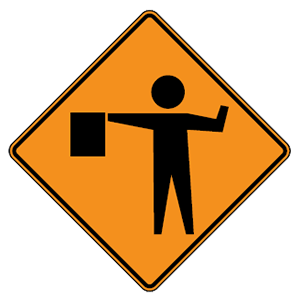
This road sign means:
Flagger ahead.
Turn left at the intersection.
Last turn before a toll road.
Q.31.
You must show proof of insurance to law enforcement:
Only if you are involved in a collision.
If you are involved in a collision or stopped for a citation.
Only if you are stopped and cited.
Q.32.
This sign means:
Yield the right-of-way.
No passing zone.
Reduction in lanes.
Q.33.
You are approaching an intersection with a steady yellow traffic light. If you have not already entered the intersection, you should:
Speed up to beat the red light.
Reduce you speed and proceed carefully through the intersection.
Come to a safe stop.
Q.34.
What does this road sign indicate?
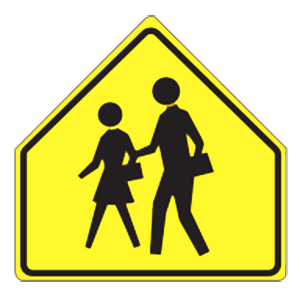
Directions for children
School zone ahead
Playground area ahead
Q.35.
When passing, you should move back into the right lane when:
You are one vehicle length ahead of the passed vehicle.
You can see both headlights of the passed vehicle in your rearview mirror.
You are 50 feet ahead of the passed vehicle.
Q.36.
When crossing a sidewalk to enter traffic from an alley or driveway, drivers should:
Stop only if pedestrians are on the sidewalk.
Stop before driving onto the sidewalk or sidewalk area.
Expect pedestrians on the sidewalk to yield the right-of-way.
Q.37.
This road sign means:
You are about to enter a one-way street from the wrong direction.
U-turns are prohibited.
You may proceed if the way is clear.
Q.38.
If weather or light conditions require you to have your lights on while driving:
Use your parking lights.
Use your high beams.
Use your low beams.
Q.39.
The best thing to do if you become tired while driving is to:
Stop to rest or change drivers.
Drink coffee.
Open a window.
Q.40.
You are driving on a city street and see an emergency vehicle with flashing lights behind you. What should you do?
Drive to the right edge of the road and slow down.
Drive to the right edge of the road and stop.
Stay in your lane, slow down, and let it pass.
Support mcqgeeks.com by disabling your adblocker.
×
Please disable the adBlock and continue.
Thank you.
Reload page