MCQGeeks
CBSE
JEE
NTSE
NEET
English
UK Quiz
Quiz
Driving Test
Practice
Games
Driving Test
Alabama
Alabama Car Driving Permit Test-9
Answers
Q.1.
Should you always drive more slowly than other traffic?
No, you can block traffic when you drive too slowly.
Yes, it is a good defensive driving technique.
Yes, it is always safer than driving faster than other traffic.
Q.2.
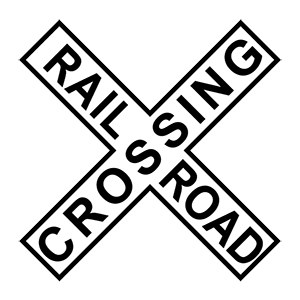
This white sign means:
The railroad crossing is controlled. Continue at your regular speed.
Look, listen, and prepare to stop at the crossing if necessary.
Stop at the railroad tracks and wait for a signal before crossing.
Q.3.
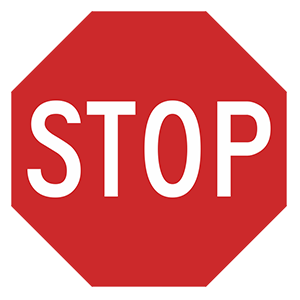
This road sign means:
Slow down or stop.
Stop if necessary.
You must come to a complete stop.
Q.4.
When may you legally drive around or under a railroad crossing gate?
Never.
When you can see clearly in both directions.
When the warning lights are not flashing.
Q.5.
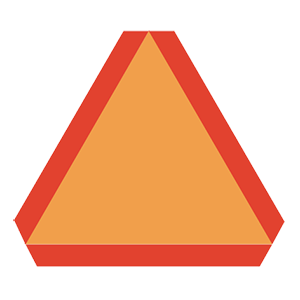
This symbol is used for:
Dangerous intersections.
Slow-moving vehicles.
Yield signs.
Q.6.
Before switching on the ignition, you should:
Buckle your safety belt.
Be sure all passengers have buckled their safety belts.
Both of the above.
Q.7.
When should drivers yield the right-of-way to pedestrians in a crosswalk?
Only if the pedestrians first wave to the driver.
Only if the pedestrians are not texting while walking.
At all times.
Q.8.
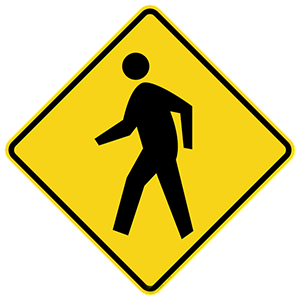
This sign means:
Pedestrian crossing.
Side road.
Railroad ahead.
Q.9.
Regulatory signs are:
Green.
Yellow.
White.
Q.10.
Alcohol in any concentration is:
A stimulant.
A depressant.
Neither of the above.
Q.11.
Which of the following is most likely to be slippery in cold weather after snow or rain?
A hilly, open road
A residential road
A road in a shaded area
Q.12.
A broken yellow line down the center of a road indicates that:
A construction zone is ahead.
Passing is not permitted from either direction.
Passing is permitted from either direction.
Q.13.
When passing a large truck, you should:
Re-enter your original lane and immediately slow down.
Give the truck plenty of space before re-entering the lane.
Re-enter the lane whenever you feel like it.
Q.14.
At intersections, crosswalks, and railroad crossings, you should always:
Stop, listen, and proceed cautiously.
Look to the sides of your vehicle to see what is coming.
Slowly pass vehicles that seem to be stopped for no reason.
Q.15.
If you find yourself in a skid:
Brake lightly.
Stay off the brakes.
Brake abruptly.
Q.16.
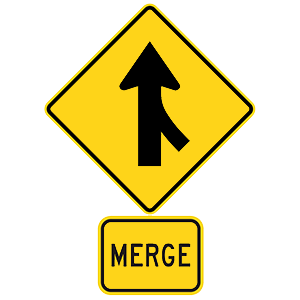
What does this road sign mean?
Be ready to merge with traffic entering your lane.
Always stop.
Divided highway ahead.
Q.17.
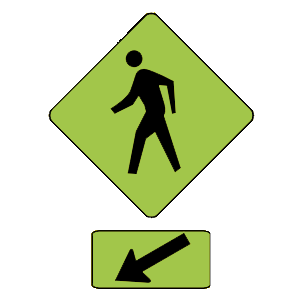
This road sign means:
School crossing.
Pedestrian crossing.
Jogging trail.
Q.18.
A sign with this shape means:
No passing zone.
Right turn permitted on red.
Yield right-of-way.
Q.19.
At intersections with a "Yield" sign, you must:
Yield the right-of-way to cross traffic that is near enough to cause conflict.
Yield the right-of-way only to vehicles on your right.
Always slow down and proceed without stopping.
Q.20.
When driving in fog, you should:
Slow down and use your low beam headlights.
Slow down and use your high beam headlights.
Turn your lights on and off to warn other drivers.
Q.21.
Which of the following statements is true?
Driving too slowly is not an unsafe practice.
Driving too slowly on certain highways can be dangerous.
The speed at which you drive a vehicle does not affect safety.
Q.22.
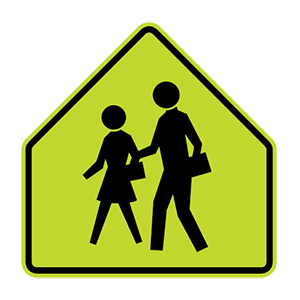
This yellow warning sign means:
You are approaching a school or school crosswalk.
Slow down, drive with caution, and watch for children.
Both of the above.
Q.23.
Highway pavement will be particularly treacherous and most slippery:
If it has been raining several hours.
If it has just begun to rain.
If it has been raining for one to two hours.
Q.24.
To prevent eye fatigue when driving at night, drivers should:
Stare straight ahead.
Continue moving their eyes and scanning the road.
Rest their eyes by closing them for a couple of seconds at a time.
Q.25.
If you drive more slowly than the flow of traffic, you will most likely:
Interfere with traffic and receive a ticket.
Improve traffic flow.
Demonstrate defensive driving techniques.
Q.26.
Which of these statements is true about roadwork zones?
Fines are the same for violations committed in work zones as they are under normal traffic conditions.
You must "Slow for the Cone Zone."
Slow down only if you think workers are present.
Q.27.
If you encounter an aggressive driver, you should:
Challenge them.
Get out of their way.
Speed up.
Q.28.
When changing lanes:
Check your side mirror and look over your shoulder to make sure the lane is clear.
Check the inside rearview mirror.
Slow down.
Q.29.
To avoid carbon monoxide poisoning, a driver should:
Have their exhaust system checked regularly to be sure there are no leaks.
Keep their engine turned off when their vehicle is enclosed in a garage.
Both of the above.
Q.30.
Continuous hard braking on ice and snow often:
Helps you stop faster.
Locks the front wheels of a vehicle, causing a loss of steering.
Keeps the brakes from freezing.
Q.31.
Posters and signs on car windows:
Are a fun way to personalize your vehicle.
Are prohibited by state law if they obstruct a driver's view of the road.
Are allowed only if they do not contain offensive language.
Q.32.
Distracted driving is:
Anything that causes evasive action while driving.
Anything that takes your attention away from driving.
Anything that causes you to pay more attention to driving.
Q.33.
This sign is a warning that you are approaching:
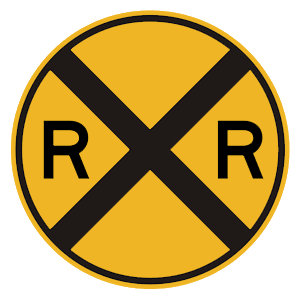
An intersection.
A crosswalk.
A railroad crossing.
Q.34.
Regulatory signs are usually ____ and should always be obeyed.
White
Blue
Green
Q.35.
At a red traffic light with a green arrow, you may proceed in the direction of the arrow if:
You first come to a complete stop.
You wait until the light changes.
You are in the proper lane and the roadway is clear.
Q.36.
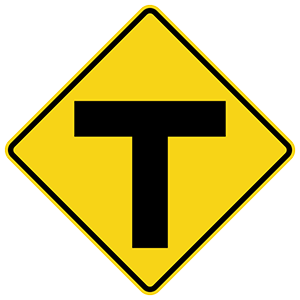
This sign shows one type of:
Right turn.
Intersection.
Lane change.
Q.37.
You hit a parked vehicle and can't find the owner. What must you do?
Call your insurance company when you get home.
Wait for the owner to return.
Leave a note with your name and address on the parked vehicle.
Q.38.
A green traffic signal indicates that approaching drivers should:
Come to a complete stop.
Increase their speed to quickly clear the intersection.
Continue driving straight through the intersection, turn left, or turn right.
Q.39.
A distraction when driving is:
Anything that causes evasive action while driving.
Anything that takes your attention away from driving.
Anything that causes you to pay more attention to driving.
Q.40.
When a school bus is stopped on the road ahead to load or unload children, you must:
Come to a complete stop until all the children have left the bus.
Come to a complete stop until the red lights stop flashing and the stop arm is withdrawn.
Change lanes, drive slowly, and pass the bus cautiously.
Support mcqgeeks.com by disabling your adblocker.
×
Please disable the adBlock and continue.
Thank you.
Reload page