MCQGeeks
CBSE
JEE
NTSE
NEET
English
UK Quiz
Quiz
Driving Test
Practice
Games
Driving Test
Alabama
Alabama Motorcycle Driving Permit Test-11
Answers
Q.1.
Lanes of traffic moving in the same direction are separated by:
White lines.
Yellow lines.
Road signs.
Q.2.
The front brake supplies about how much of a motorcycle's potential stopping power?
About one-quarter
About one-half
About three-quarters
Q.3.
To reduce the chances of a collision, you should:
Wear bright or reflective clothing.
Change lanes frequently.
Focus only on your riding, not on your surroundings.
Q.4.
If you have to ride over an object, you should:
Increase your speed.
Lean your motorcycle.
Slow down.
Q.5.
To control a motorcycle well, a rider should:
Use their arms to steer, not to support their body.
Sit far enough back that their arms are not bent when reaching for the handle grips.
Keep their knees away from the gas tank.
Q.6.
Noise created by wind:
Is easy to get used to.
May cause irreversible hearing damage.
Is never a danger.
Q.7.
Locking your brakes can:
Be helpful in most situations.
Improve steering.
Cause control problems.
Q.8.
Where is the gearshift located?
In front of the left footrest
In front of the right footrest
On the right handle grip
Q.9.
To improve your chances of being seen, you should:
Use your headlight only at night or when conditions reduce visibility.
Always use your headlight.
Add an orange tint to your headlight.
Q.10.
A primary cause of single-vehicle motorcycle collisions is:
Motorcyclists' tendency to ride too fast for weather conditions.
Motorcyclists turning too wide in a curve or turn.
Motorcyclists running off the road while trying to avoid a collision with another vehicle.
Q.11.
When riding, jackets and pants should:
Fit loosely enough to allow the wind to catch the fabric.
Be snug enough to keep from flapping in the wind.
Be tight enough to prevent you from moving freely.
Q.12.
When approaching a blind intersection, you should:
Move into the portion of the lane that will bring you into another driver’s field of vision at the earliest possible moment.
Stop at the stop sign or signal and then proceed normally.
Flash your lights and sound your horn to alert other drivers to your presence.
Q.13.
Unlike other beverages, alcohol:
Is absorbed into the bloodstream right away.
Needs to be digested.
Doesn’t affect humans.
Q.14.
If using saddlebags to carry a load, you should:
Load the bags as evenly as possible.
Unevenly distribute weight into the saddlebags.
Place as much weight as possible into one saddlebag.
Q.15.
When slowing or stopping a motorcycle, you should:
Not change gears.
Shift up through the gears.
Shift down through the gears.
Q.16.
When riding a motorcycle, you should:
Wear half-fingered gloves.
Wear full-fingered gloves.
Not wear gloves.
Q.17.
A motorcycle’s brake light is _________ a passenger vehicle’s brake light.
More noticeable than
Just as noticeable as
Not as noticeable as
Q.18.
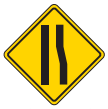
What does this sign mean?
Right lane ends
Left lane ends
Traffic control device ahead
Q.19.
When stopping, you should:
Use both brakes.
Use the front brake only.
Use the rear brake only.
Q.20.
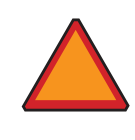
What does this sign mean?
Yield
Slow-moving vehicle
Railroad crossing
Q.21.
You should pick a lane position that:
Best increases your visibility and allows for a safe cushion of space.
You like, without regard to others.
Gets you close to other vehicles.
Q.22.
When approaching an intersection, a motorcyclist should not:
Choose a lane position that increases their visibility.
Speed up to cross the intersection quickly.
Cover the clutch and brakes to reduce their reaction time.
Q.23.
To reduce the chances of a collision, a motorcyclist should:
Stare straight in front of their motorcycle.
Be unwilling to move to avoid a potential hazard.
Scan their path of travel, looking at least 10 to 15 seconds ahead of their motorcycle.
Q.24.
You should maintain an increased following distance:
If the pavement is slippery.
If traffic is light.
If you can see through the vehicles in front of you to determine traffic conditions.
Q.25.
A headlight:
Is a good way to help others see you.
Often distracts other drivers.
Attracts unwanted attention.
Q.26.
When parked on the road, a motorcycle should:
Create an angle with the curb that is between 45 and 90 degrees.
Be parked without a wheel or fender touching the curb.
Be parked parallel to the curb.
Q.27.
After riding over an object on the road, you should:
Continue riding because the danger has passed.
Pull to the side of the road and check your tires and rims for damage.
Stop to remove the object from the road.
Q.28.
Which of the following is not a method used to maintain control of a motorcycle in a turn?
Accelerate through the turn.
Reduce your speed before turning.
Lean into the turn.
Q.29.
When traveling at night, it is:
Easier to judge distances than it is during the day.
About as easy to judge distances as it is during the day.
More difficult to judge distances than it is during the day.
Q.30.
A good way to handle a tailgater is to:
Encourage the tailgater to pass by slowing down or changing lanes.
Speed up to put distance between you and the tailgater.
Ignore the tailgater.
Support mcqgeeks.com by disabling your adblocker.
×
Please disable the adBlock and continue.
Thank you.
Reload page