MCQGeeks
CBSE
JEE
NTSE
NEET
English
UK Quiz
Quiz
Driving Test
Practice
Games
Driving Test
Alaska
Alaska Car Driving Permit Test-3
Answers
Q.1.
When parking in an uphill direction on a roadway with a curb, your front wheels:
Should point straight ahead.
Should turn away from the curb.
Should turn toward the curb.
May face in any direction, as long as you set the parking brake.
Q.2.
If two drivers arrive at the same time to a four-way intersection controlled by stop signs:
The driver on the right has the right-of-way.
The driver on the left has the right-of-way.
One driver may continue driving without stopping.
One driver should honk to indicate that they are giving up the right-of-way.
Q.3.
How can you help prevent rear-end collisions?
Avoid sudden stops.
Before stopping, check your mirrors and blind spots for traffic.
Release the gas pedal and let your vehicle slow before applying the brakes.
All of the above.
Q.4.
When passing a large vehicle, the driver of a small vehicle must be prepared for:
Loud noises.
Excess air pollution.
Wind gusts produced by the large vehicle.
Falling vehicle parts.
Q.5.
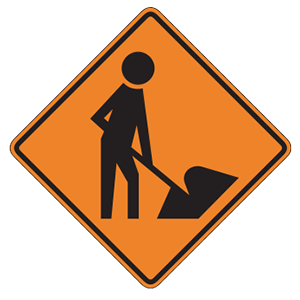
This sign means that:
A community service group is picking up trash along the highway ahead.
Workers are on or very close to the road in the work zone ahead.
Children are at play ahead.
There is a pedestrian crosswalk ahead.
Q.6.
To avoid colliding with the car in front of you, you should:
Watch for hazards ahead.
Watch for brake lights ahead.
Use the four-second rule.
All of the above.
Q.7.
Blood alcohol content (BAC) depends on each of the following, except:
Your body weight.
How much you drink.
How much time passes between drinks.
How physically fit you are.
Q.8.
What might happen when alcohol is combined with another drug?
The effects of the alcohol and the drug may both be increased.
Nothing will happen.
The effects of the alcohol and the drug may both be reduced.
The effects of only the alcohol may be reduced.
Q.9.
If involved in an accident, a driver should:
Stop their vehicle at or near the scene.
Not stand or walk in traffic lanes.
Turn off the ignitions of wrecked vehicles.
All of the above.
Q.10.
An approaching driver fails to dim their high beam headlights. Where should you look?
At the wheels of the approaching vehicle.
Toward the right side of the road.
Toward the left side of the road.
Straight down the middle of the road.
Q.11.
If an aggressive driver cuts you off, you should:
Call the police immediately.
Stay calm and move out of the aggressive driver's way.
Flash your vehicle's lights to let the aggressive driver know he is wrong.
Use a driving action of your own to get back at the aggressive driver.
Q.12.
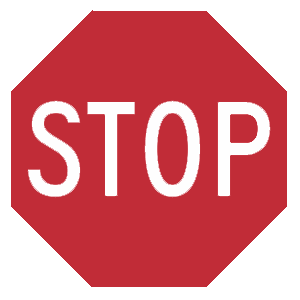
This road sign means:
Slow down or stop.
Stop, if necessary.
You must come to a complete stop.
Drive with caution and be ready to stop.
Q.13.
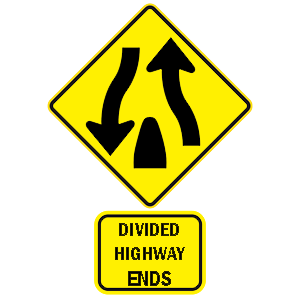
This sign means:
One-way traffic.
Divided highway ends.
Two-way traffic.
Keep left.
Q.14.
If you stop at a railroad crossing with more than one track:
Wait to proceed until you have a clear view of all tracks.
Stop on the first railroad track and watch for another train.
Go through as soon as the train passes.
Go through when one of the tracks is free.
Q.15.
The driver's left arm and hand are extended upward. This hand signal means that the driver plans to:
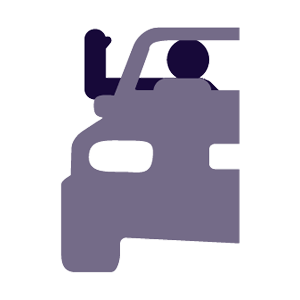
Turn left.
Turn right.
Come to a stop.
Go straight ahead.
Q.16.
Parking lights may only be used:
When a vehicle is parked.
When visibility is poor.
Within one hour of sunset or sunrise.
When a vehicle is being driven under the speed limit.
Q.17.
You must stop at a railroad crossing when:
Directed to do so by a flagger.
It is controlled by a stop sign.
Flashing red signals and gates are present and operating.
All of the above.
Q.18.
When entering a highway from an entrance ramp, you should generally:
Enter above the speed of traffic to get ahead.
Enter slowly to avoid other vehicles.
Stop first, then slowly enter traffic.
Accelerate to the speed of traffic.
Q.19.
Which of the following statements is true?
Signal at least 100 feet before changing lanes to pass and ensure there is no oncoming traffic.
Use your mirrors and look over your left shoulder to check your blind spot when passing to the left.
When passing, wait until you can see both headlights of the passed car in your rearview mirror before returning to your original lane.
All of the above.
Q.20.
If a crossing guard is directing traffic in a school zone, you must:
Follow the directions given by the crossing guard.
Copy what surrounding traffic is doing, despite the crossing guard's instructions.
Assume the guard is not supposed to be directing traffic.
Follow rules that would be in place if no children were present.
Support mcqgeeks.com by disabling your adblocker.
×
Please disable the adBlock and continue.
Thank you.
Reload page