MCQGeeks
CBSE
JEE
NTSE
NEET
English
UK Quiz
Quiz
Driving Test
Practice
Games
Driving Test
Arizona
Arizona Car Driving Permit Test-13
Answers
Q.1.
When should drivers adjust their mirrors, seats, and steering wheels?
Before turning on their vehicles.
While backing out of their driveways.
Before reaching speeds of 55 mph or above.
Q.2.
Stopping distances and severity of crashes:
Decrease as vehicle speed increases.
Are not affected by vehicle speed.
Increase as vehicle speed increases.
Q.3.
Bicyclists:
Should ride facing traffic.
Must stay in the right lane.
Must follow the same laws as motorists.
Q.4.
A sign with this shape means:
No passing zone.
Right turn permitted on red.
Yield right-of-way.
Q.5.
A broken yellow centerline means that:
Passing is not permitted.
Passing on the right is permitted when the way ahead is clear.
Passing on the left is permitted when the way ahead is clear.
Q.6.
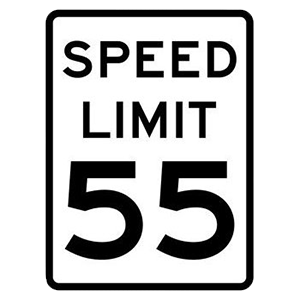
This road sign means:
You must travel through the intersection at the posted speed limit.
The maximum speed limit under ideal conditions is 55 mph.
You must not travel below the speed indicated.
Q.7.
When driving on a slippery surface, such as snow or ice:
Shift to a low gear before going down steep hills.
Maintain traction by following other vehicles closely.
Pump your brakes to keep them from freezing.
Q.8.
You should not make sudden stops in front of large trucks and buses because:
Small vehicle drivers cannot adequately see large trucks and buses in their rearview mirrors.
Large trucks and buses, due to their size and weight, require longer distances to stop than smaller passenger vehicles.
Large trucks and buses travel at a higher speeds than small vehicles.
Q.9.
If a vehicle is equipped with airbags:
Seat belts should still be worn.
Seat belts do not need to be worn.
Seat belts should be worn behind the back.
Q.10.
This road sign means:
Intersection ahead.
Steep grade ahead.
Winding road.
Q.11.
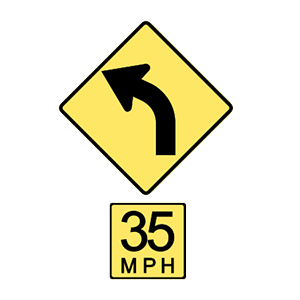
This sign means:
There is a 35 mph speed zone after the curve ahead.
Drive no slower than 35 mph around the upcoming curve.
Approach the upcoming curve at a speed of 35 mph or slower.
Q.12.
Which of the following statements about blind spots is true?
They are eliminated if you have one outside mirror on each side of the vehicle.
Large trucks have bigger blind spots than most passenger vehicles.
Blind spots can be checked by looking in your rearview mirrors.
Q.13.
Which of the following statements is correct?
Use your left foot to brake.
Use your right foot for both braking and accelerating your vehicle.
You should always brake abruptly to ensure stopping.
Q.14.
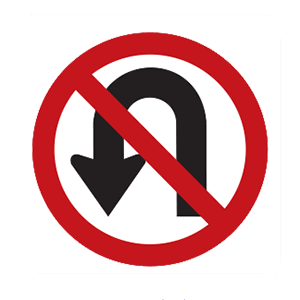
This road sign means:
Do not enter.
Roundabout ahead.
No U-turns.
Q.15.
A flashing red traffic light at an intersection means:
The same thing as a yield sign.
The light is about to turn green.
The same thing as a stop sign.
Q.16.
A broken yellow centerline indicates that:
Passing is not permitted.
Passing on the right is permitted when the way ahead is clear.
Passing on the left is permitted when the way ahead is clear.
Q.17.
If the rear of your vehicle is skidding to the left, you should:
Not turn your steering wheel.
Turn your steering wheel to the left to correct the skid.
Turn your steering wheel to the right to correct the skid.
Q.18.
To avoid glare from the headlights of an approaching car:
Look briefly toward the right side of the road.
Stay focused on the centerline on the road.
Flash your high beams.
Q.19.
Before changing lanes or attempting to pass another vehicle, you should:
Check your blind spots and mirrors.
Signal your intention before changing lanes.
All of the above.
Q.20.
You have stopped for a train at a railroad crossing. After the train passes, you should:
Wait for signal lights to stop flashing.
Look for a second train.
Both of the above.
Q.21.
When changing lanes:
Check your side mirror and look over your shoulder to make sure the lane is clear.
Check the inside rearview mirror.
Slow down.
Q.22.
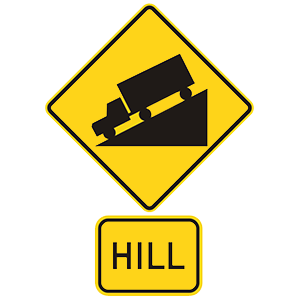
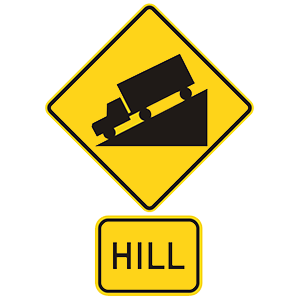
This sign means:
Trucks under 18,000 pounds are allowed.
Hill ahead.
Truck stop ahead.
Q.23.
While in a motor vehicle on a highway, it is:
Illegal to either drink from or possess open containers of alcohol.
Legal to drink alcohol if you're not driving.
Legal to drink alcohol if you're driving but not drunk.
Q.24.
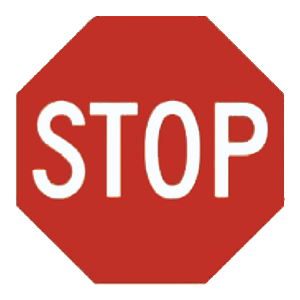
This road sign means:
Drive with caution and be ready to stop.
You must come to a complete stop.
Stop, if necessary.
Q.25.
The amount of alcohol in the blood is referred to as:
Implied consent (IC).
Blood alcohol concentration (BAC).
Rate of alcohol consumption (RAC).
Q.26.
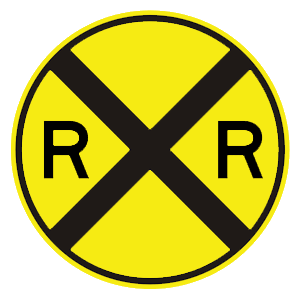
This sign indicates a:
Railroad crossing.
Pedestrian crossing.
No passing zone.
Q.27.
A broken yellow line beside a solid yellow line indicates that passing is:
Permitted from the side next to the solid yellow line.
Not permitted from either direction.
Permitted from the side next to the broken yellow line.
Q.28.
Which of the following statements about driving speed is true?
As your speed increases, the chance of a fatality increases.
As your speed increases, so should your following distance.
Both of the above.
Q.29.
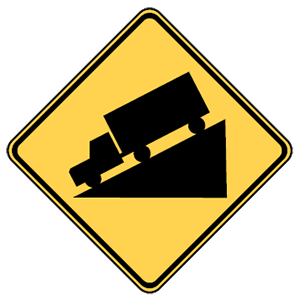
This road sign means:
Intersection ahead.
Merging traffic.
Steep hill ahead.
Q.30.
In which of the following scenarios should your wheels not be pointed straight ahead?
When waiting to make a left turn at a traffic light.
When parked on a hill or sloping driveway.
When parked on the side of a level roadway where there is no curb.
Support mcqgeeks.com by disabling your adblocker.
×
Please disable the adBlock and continue.
Thank you.
Reload page