MCQGeeks
CBSE
JEE
NTSE
NEET
English
UK Quiz
Quiz
Driving Test
Practice
Games
Driving Test
Arizona
Arizona Car Driving Permit Test-17
Answers
Q.1.
A steady green traffic light at an intersection means:
Increase your speed.
Adjust your mirrors.
You may continue through the intersection at a safe and reasonable speed, if it is clear to do so.
Q.2.
You have allowed the wheels of your vehicle to run off the edge of the pavement. What should you do first?
Turn the front wheels slightly to the left to edge the car back onto the pavement.
Hold the steering wheel firmly, release the gas pedal, and gently apply the brakes.
Apply the brakes and turn the front wheels sharply to the left.
Q.3.
Excessive speed:
Does not increase the chance of a crash.
Increases your ability to react to a hazard.
Often leads to high-risk decision-making.
Q.4.
When preparing to make a left turn from a two-way street, you should drive:
Near the right-hand side of the road.
Near the centerline.
On the left of the centerline.
Q.5.
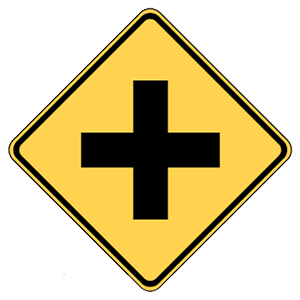
This road sign means:
Hospital.
Upcoming intersection.
Railroad crossing.
Q.6.
When entering a roadway from an alley:
Stop at the sidewalk.
Honk your horn.
The speed limit is 15 mph.
Q.7.
When driving at night on a dimly lit street, you should:
Drive slowly enough that you can stop within the area illuminated by your headlights.
Turn on your high beam headlights to better see the vehicles ahead of you.
Keep the instrument panel lights bright to be more visible to other drivers.
Q.8.
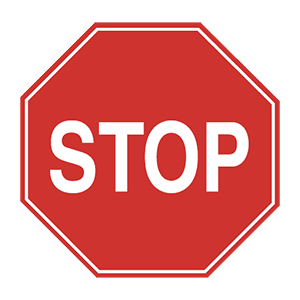
This sign means:
Stop.
Merge.
Upcoming change in direction.
Q.9.
If it feels like your tires have lost contact with the surface of the road, you should:
Slow down by shifting into a lower gear.
Ease your foot off the gas pedal.
Slow down by pumping the brakes quickly and firmly.
Q.10.
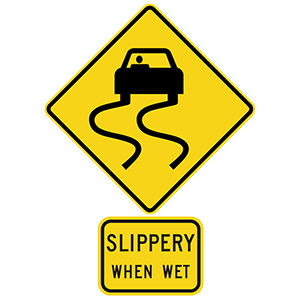
This road sign means:
When pavement is wet, reduce your speed.
The road ahead winds in a series of turns or curves.
Traffic increases ahead.
Q.11.
When driving in fog, it is best to drive with:
High beam headlights.
Low beam headlights.
Four-way flashers.
Q.12.
When may you legally drive around or under a railroad crossing gate?
Never.
When you can see clearly in both directions.
When the warning lights are not flashing.
Q.13.
What should a driver do when approaching a traffic control signal that is not in operation?
Come to a full stop and yield the right-of-way before entering the intersection.
If the intersection is clear, the driver does not need to stop.
Drive quickly through the intersection to get out of the way of other vehicles.
Q.14.
A U-turn is not permitted:
In a parking lot.
On or near any curve or hill.
On a straight roadway with a clear view for 500 feet in both directions.
Q.15.
When passing another vehicle:
Pass the vehicle as slowly as possible.
Drive at the same speed as the vehicle you are passing.
Pass the vehicle as safely and as quickly as possible.
Q.16.
There are oncoming vehicles to your left and a row of parked vehicles to your right. You should steer:
Closer to the oncoming vehicles than the parked vehicles.
Closer to the parked vehicles than the oncoming vehicles.
A middle course between the oncoming and parked vehicles.
Q.17.
When driving under low-visibility conditions due to fog, you should:
Turn on your high beam headlights.
Slow down and use your low beam headlights.
Increase your speed so you do not cause an accident.
Q.18.
Which of these statements is true about large trucks?
They take longer to stop than passenger vehicles.
They all have air brakes that allow them to stop quickly.
They are more maneuverable than passenger vehicles.
Q.19.
To help avoid skidding on slippery surfaces, you should:
Shift to a lower gear after starting down a steep hill.
Speed up to enter curves and slow down to exit them.
Slow down before entering curves and intersections.
Q.20.
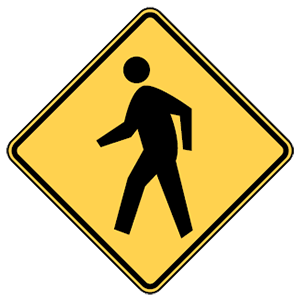
This road sign means:
Pedestrian crossing.
School crossing.
Jogging trail.
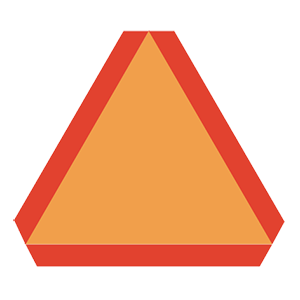
Q.21.
This symbol is used for:
Dangerous intersections.
Slow-moving vehicles.
Yield signs.
Q.22.
Trucks' blind spots are:
Directly behind the body.
On the immediate left of the cab.
Both on the immediate left of the cab and directly behind the body.
Q.23.
You hit a parked vehicle and can't find the owner. What must you do?
Call your insurance company when you get home.
Wait for the owner to return.
Leave a note with your name and address on the parked vehicle.
Q.24.
From top to bottom, the following is the proper order for traffic lights:
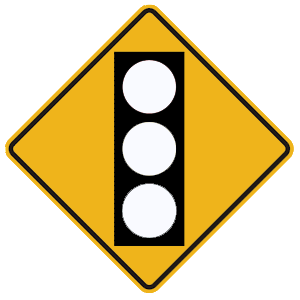
Red, yellow, green.
Red, green, yellow.
Green, red, yellow.
Q.25.
At a crosswalk:
You must yield to pedestrians.
Pedestrians must yield to you.
Construction workers must yield to you.
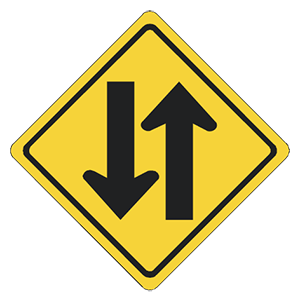
Q.26.
This sign means:
Two-way traffic.
Change in direction ahead.
School zone and crossing.
Q.27.
When being passed by another vehicle:
Brake hard.
Maintain a constant speed.
Speed up.
Q.28.
Driving under the influence of any medication which impairs your driving is permitted:
Under no circumstances.
If you don't feel drowsy.
If it is prescribed by a physician.
Q.29.
After passing a vehicle, it is safe to return to your driving lane when:
The driver you passed signals for you to return to your lane.
You signal your intention for three seconds.
You see the headlights of the passed vehicle in your rearview mirror.
Q.30.
To prevent yourself from becoming an aggressive driver:
Relax and concentrate on driving.
Drive above the posted speed limit.
Tailgate the driver in front of you.
Support mcqgeeks.com by disabling your adblocker.
×
Please disable the adBlock and continue.
Thank you.
Reload page