MCQGeeks
CBSE
JEE
NTSE
NEET
English
UK Quiz
Quiz
Driving Test
Practice
Games
Driving Test
Arizona
Arizona Car Driving Permit Test-18
Answers
Q.1.
This sign means:
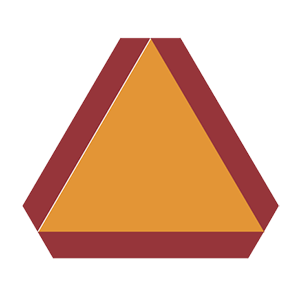
Slow-moving vehicle.
Road construction/maintenance area.
Traffic signal ahead.
Q.2.
If you are about to be hit from the rear, you should consider each of the following, except for:
Applying your brakes.
Letting go of the steering wheel.
Pressing your head firmly against the head restraint.
Q.3.
When turning left at an intersection:
You should always yield to oncoming traffic and pedestrians.
Oncoming traffic and pedestrians should yield to you.
You should never yield to oncoming traffic and pedestrians.
Q.4.
Which of the following substances can affect the ability to drive?
Tranquilizers, marijuana, and sedatives.
Cough syrups and cold tablets containing codeine or antihistamines.
All of the above.
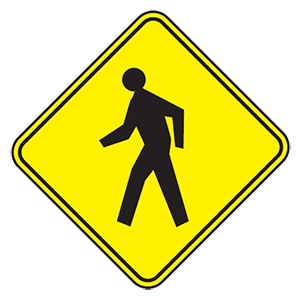
Q.5.
This sign means:
School crossing.
School zone.
Pedestrian crossing.
Q.6.
Before you enter an intersection, you should look to your:
Left, your right, then your left again.
Right.
Left.
Q.7.
Fatigue increases the risk of:
Missing an exit.
Being late for an appointment.
Falling asleep behind the wheel and crashing.
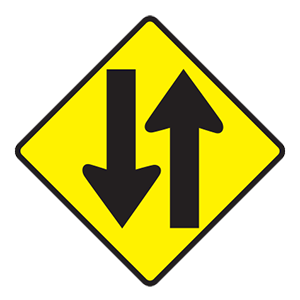
Q.8.
This sign means:
You can travel in either direction in this lane.
There is two-way traffic.
You are approaching a divided highway.
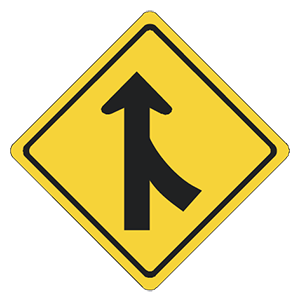
Q.9.
This sign means:
Merge.
Winding road ahead.
Reserved parking for persons with disabilities.
Q.10.
The first thing that alcohol effects is:
Vision.
Judgment.
Balance.
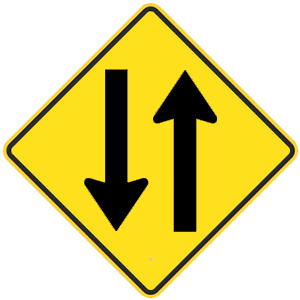
Q.11.
This sign means:
Four-lane traffic ahead.
Divided highway ahead.
Two-way traffic ahead.
Q.12.
The best thing to do if you become tired while driving is to:
Stop to rest or change drivers.
Drink coffee.
Open a window.
Q.13.
It is illegal for a personyears of age or older to drive with a minimum blood alcohol concentration (BAC) of:
0.05 percent.
0.08 percent.
0.02 percent.
Q.14.
Which of these statements is true about drugs and driving?
Any prescription drug is safe to use if you don't feel drowsy.
Even over-the-counter drugs can impair your driving.
Only illegal drugs can impair your driving.
Q.15.
When entering traffic after being parked at a curb, you:
Should drive more slowly than other traffic for 200 feet.
Should wait for a large enough gap to get up to the speed of traffic.
Should wait for the first two vehicles to pass, then drive into the lane.
Q.16.
A solid yellow line next to a broken yellow line means that vehicles:
Driving in both directions may pass.
Next to the broken line may pass.
Next to the solid line may pass.
Q.17.
If you are driving near a large commercial vehicle, you should:
Follow the large vehicle closely to reduce wind drag on your vehicle.
Avoid driving beside it for long stretches of time.
Drive on its right side when on curves and hills.
Q.18.
You enter a designated turn lane to make a left turn at an upcoming intersection. There is oncoming traffic. You should:
Move to the left of the center lane.
Signal before you arrive at the intersection.
Turn your front wheels to the left to be prepared to turn.
Q.19.
You exit the freeway on a ramp that curves downhill. You should:
Slow to a safe speed before the curve.
Slow to the posted speed limit for the freeway.
Wait until you have entered the curve to begin braking.
Q.20.
When passing another car, you have enough space to return to the driving lane:
If the other driver signals for you to re-enter the lane.
If you look over your shoulder and see the passed car behind you.
If you can see both of the passed vehicle's headlights in your rearview mirror.
Q.21.
Temporary signs used in construction and maintenance work areas:
Have a red background with green writing.
Have an orange background with black writing.
Have a yellow background with blue writing.
Q.22.
Distracted driving is:
Anything that causes evasive action while driving.
Anything that takes your attention away from driving.
Anything that causes you to pay more attention to driving.
Q.23.
Handicap parking spaces are available:
Only to drivers with the appropriate license plate or hanging tag.
To anyone, but only if all other spaces are occupied.
To people who are not feeling well.
Q.24.
Tailgating other drivers (driving too closely to their rear bumper):
Can frustrate other drivers and make them angry.
Cannot result in a traffic citation.
Reduces collisions by preventing being "cut off."
Q.25.
When parking your vehicle on any hill:
One of your rear wheels should touch the curb.
Use your parking brake and leave the vehicle in "park."
Your front wheels should be parallel to the road, if there is no curb.
Q.26.
Should you always drive more slowly than other traffic?
No, you can block traffic when you drive too slowly.
Yes, it is a good defensive driving technique.
Yes, it is always safer than driving faster than other traffic.
Q.27.
In rainy weather, you should be most careful when turning or stopping:
After it has been raining all day.
One half hour after it stops raining.
During the first half hour of rain.
Q.28.
In a vehicle equipped with airbags, the safest place for children ageand under to ride is in:
The front seat.
The back seat.
The bed of a pick-up truck.
Q.29.
When driving in work zones, you should:
Follow the driver in front of you closely.
Pass the driver in front of you as soon as you can.
Avoid tailgating and keep a safe following distance.
Q.30.
You want to turn left at an upcoming corner. Yield the right-of-way to:
Oncoming vehicles also turning left.
All approaching vehicles.
Pedestrians on the sidewalk waiting for a "Walk" signal.
Support mcqgeeks.com by disabling your adblocker.
×
Please disable the adBlock and continue.
Thank you.
Reload page