MCQGeeks
CBSE
JEE
NTSE
NEET
English
UK Quiz
Quiz
Driving Test
Practice
Games
Driving Test
Arizona
Arizona Car Driving Permit Test-21
Answers
Q.1.
Night driving presents unique problems because:
The speed limit is increased at night.
There are fewer cars on the roads at night.
Distance and vehicle speed are difficult to judge in the dark.
Q.2.
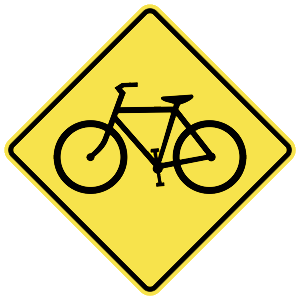
This road sign means:
Bicycle crossing.
Stop only if other cars are approaching.
Yield the right-of-way to pedestrians.
Q.3.
It is unlawful to:
Pass another vehicle in any marked no passing zone.
Pass another vehicle over a railroad crossing.
Both of the above.
Q.4.
Which of the following road surfaces freezes first?
A tunnel
An intersection
A bridge
Q.5.
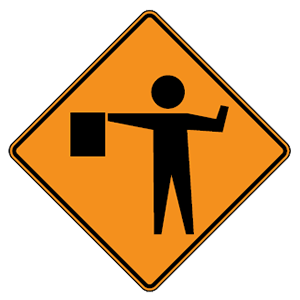
This road sign means:
Flagger ahead.
Turn left at the intersection.
Last turn before a toll road.
Q.6.
When stopping on snow or ice, drivers who are operating vehicles equipped with an Anti-Lock Braking System (ABS) should:
Pump the brakes.
Press and hold the brake pedal firmly.
Stay off the brakes and wait for the car to drift to a stop.
Q.7.
Drivers should leave a space cushion of ____ between themselves and the vehicle ahead of them.
One second
Three to six seconds
10 seconds
Q.8.
You should yield to a pedestrian:
Only if they are in a crosswalk.
At all times, even if the pedestrian is not obeying traffic laws.
Only if the traffic lights are in the pedestrian's favor.
Q.9.
Double solid yellow lane markings mean that:
Neither lane may pass.
Both lanes may pass.
The lane to the right may pass.
Q.10.
When you see this road sign, you should:
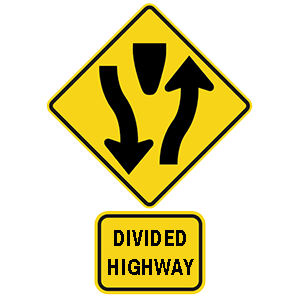
Keep right.
Keep left.
Pass with caution.
Q.11.
If you come to an intersection controlled by a flashing yellow light, you must:
Wait for the green light before proceeding.
Slow down and cross the intersection carefully.
Stop before crossing the intersection.
Q.12.
You can help keep the driver behind you a safe distance away from your vehicle by:
Driving 10 mph faster than the car behind you.
Driving 10 mph slower than the car behind you.
Maintaining a steady speed.
Q.13.
This sign is used to warn drivers about:
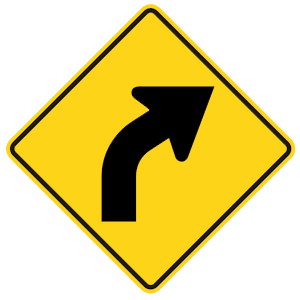
Upcoming intersections.
Road construction.
Road curves ahead.
Q.14.
If a tire suddenly blows out while you are driving, you should:
Grip the steering wheel firmly, slow down, and exit the traffic lane.
Pump the brakes rapidly.
Brake hard and steer toward the right edge of the roadway.
Q.15.
When driving at night, you should:
Always use your high beams.
Look directly at the headlights of an oncoming vehicle.
Increase your following distance.
Q.16.
If you approach a stopped school bus that has its lights flashing and signal arm extended, you should:
Stop.
Proceed at 15 mph if no children are present.
Proceed at normal speed, but watch for children.
Q.17.
When using a roundabout, drivers should:
Yield to traffic already in the roundabout.
Yield to entering traffic.
Drive in a clockwise direction.
Q.18.
When entering the interstate on a short entrance ramp where there is no acceleration lane, you should:
Immediately enter the far-right traffic lane on the interstate and speed up to match the flow of traffic.
Use the shoulder of the main road to get up to the speed of traffic.
Speed up and enter the interstate only after you have identified a gap in traffic.
Q.19.
If you are about to be hit from the rear, you should not:
Release your seat belt.
Brace yourself.
Press your head against the head restraint.
Q.20.
When you see this sign, you should:
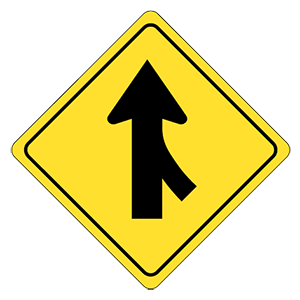
Watch for traffic merging from the right.
Merge right.
Turn left.
Q.21.
To know where traffic is behind you:
Frequently check your rearview mirror.
Turn and look out your back window.
Keep other vehicles out of your blind spots.
Q.22.
If you come to a railroad crossing with lowered gates and flashing warning lights, you should:
Drive around the crossing gates if you can't see a train.
Come to a complete stop well behind the gates, wait for the tracks to clear, and proceed once the gates are lifted.
Slow down and drive around the gates.
Q.23.
If you are driving and a tire suddenly goes flat, you should:
Rapidly pump the brake pedal several times.
Slow down gradually and not brake.
Press down on the brake pedal as hard as you can.
Q.24.
When you see this sign, you should stop and:
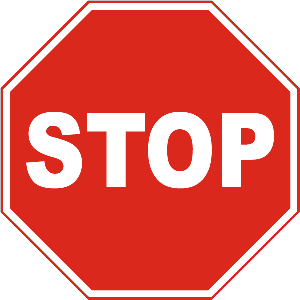
Check for vehicles only in the direction that you plan on going, then proceed.
Let all vehicles that arrive before or after you go first.
Check for traffic in all directions before proceeding.
Q.25.
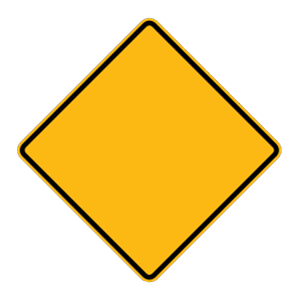
A sign with this shape means:
Railroad crossing.
Warning.
Signal ahead.
Q.26.
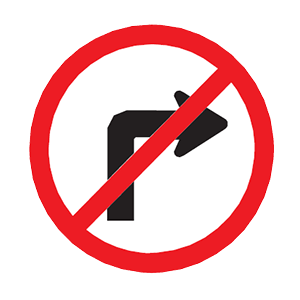
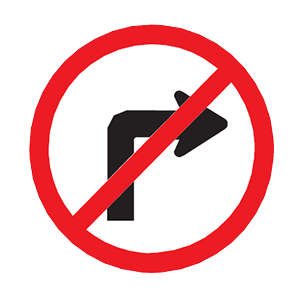
This sign means:
No right turn.
Right turn on red light permitted with caution.
All traffic must turn right at next intersection.
Q.27.
This sign means:
No right turn.
You must turn right.
Watch for traffic on your right.
Q.28.
A red arrow pointing to the right on a traffic light means you may:
Turn in that direction after slowing and checking for traffic.
Not turn in that direction until the light turns green.
Turn in that direction after you come to a complete stop.
Q.29.
If you are approaching an intersection where the traffic light has changed from green to yellow:
You should proceed with caution.
You must clear the intersection before the light turns red.
You should come to a safe stop and wait for the light to turn green to proceed.
Q.30.
If a road is slippery, maintain a following distance that is:
No different than normal.
Farther from the car ahead than normal.
Closer to the car ahead than normal.
Support mcqgeeks.com by disabling your adblocker.
×
Please disable the adBlock and continue.
Thank you.
Reload page