MCQGeeks
CBSE
JEE
NTSE
NEET
English
UK Quiz
Quiz
Driving Test
Practice
Games
Driving Test
Arizona
Arizona Motorcycle Driving Permit Test-3
Answers
Q.1.
The front brake is:
Safe, if used properly.
Safe, even if used improperly.
Only to be used if the rear brake fails.
Not to be used regularly.
Q.2.
To increase your chances of being seen at an intersection, you should:
Try to make eye contact with other drivers.
Ride with your headlight on.
Reduce your space cushion.
Ride in a weaving pattern.
Q.3.
Which of the following provides the best protection?
Sunglasses
Windshield
Goggles
Face shield
Q.4.
If you find your motorcycle being chased by a dog, you should:
Swerve around the animal.
Stop until the animal loses interest.
Ride alongside the animal.
Approach the animal slowly, then speed up.
Q.5.
Of the crashes involving both a motorcycle and a car, how many are caused by the driver failing to properly yield the right-of-way to the rider?
About 10 percent
About 25 percent
Over 50 percent
About 90 percent
Q.6.
When stopping behind a vehicle, you should:
Stop far behind the vehicle, then slowly creep up.
Stay well behind the vehicle.
Make a quick stop right behind the vehicle.
Stay about four car lengths behind the vehicle.
Q.7.
Normally, you should maintain a following distance of:
One second.
Two seconds.
Three seconds.
Four seconds.
Q.8.
When exiting a highway while riding in a group, which riding formation should be used?
Staggered
Single-file
Paired up
Riding three across a lane
Q.9.
If the front wheel locks, you should:
Continue to hold the brake and the skid should end.
Release the front brake and not use the front brake.
Release the front brake and then quickly squeeze the front brake.
Release the front brake immediately and re-apply the front brake smoothly.
Q.10.
Riding alongside a car:
Is encouraged.
Can place you in a blind spot.
Is not an issue unless the roadway is wet.
Can make driving easier for the other motorist.
Q.11.
When riding at night you should:
Increase your speed.
Decrease your following distance.
Use the vehicle in front of you to help see.
Wear tinted glasses.
Q.12.
If hazards are on your left, you should ride:
In the left portion of the lane.
In the right portion of the lane.
In any portion of the lane.
On the shoulder.
Q.13.
If you are feeling tired while riding, you should:
Keep going and hope to wake up.
Ride faster.
Ride on the shoulder.
Get off the road and rest.
Q.14.
If you are hit by a wind blast caused by a passing vehicle, you will have the most room for error if you are riding:
In the left portion of the lane.
In the center portion of the lane.
In the right portion of the lane.
On the shoulder.
Q.15.
When stopped behind another vehicle, you should:
Get as close as possible to the vehicle.
Maintain a space cushion between your motorcycle and the other vehicle.
Not use your rearview mirrors to monitor traffic behind you.
Look for opportunities to squeeze through the stopped traffic.
Q.16.
Proper clothing for riding offers all of the following, except:
Comfort.
Protection in a collision.
Protection from the cold.
Discomfort.
Q.17.
A plastic, shatter-resistant face shield:
Is not necessary if you have a windshield.
Only protects your eyes.
Helps protect your whole face.
Is less effective than goggles.
Q.18.
Brightly-colored helmets:
May make it easier for the wearer to be seen.
Can be distracting.
Don’t help to improve a rider's visibility.
Are not permitted.
Q.19.
When riding, you should:
Turn your head and shoulders to look through turns.
Keep your arms straight.
Keep your knees away from the gas tank.
Turn just your head and eyes to look through turns.
Q.20.
Goggles can:
Protect your eyes and your face.
Protect your face but not your eyes.
Protect your eyes, but not your face.
Not protect your face or eyes.
Q.21.
Most crashes occur in broad daylight. To be more visible, you should:
Wear brightly-colored clothing.
Wear darkly-clothing.
Ride without your headlight.
Ride in a weaving pattern.
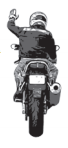
Q.22.
What does this signal mean?
Follow me
Slow down
Speed up
Exit
Q.23.
To lessen your chances of being involved in an accident, you should:
Ride within a foot of the vehicle in front of you.
Wear dark clothing.
Signal only when you feel like it.
Stay alert and be prepared to act to avoid a crash.
Q.24.
When riding in a group, inexperienced riders should be placed:
In the front of the group.
Just behind the lead rider.
At the back of the group.
Anywhere within the group.
Q.25.
When entering a turn, a rider should:
Speed up.
Reduce their speed.
Move their shoulders to match the angle of the turn.
Sit up as high as possible.
Q.26.
The front brake supplies approximately how much of a motorcycle's potential stopping power?
About 25 percent
About 50 percent
About 70 percent
About 95 percent
Q.27.
A thorough check of your motorcycle:
Is useless unless done by a mechanic.
Should not be done before a ride.
Should be done only after a ride.
Can help you identify any mechanical defects or equipment failures.
Q.28.
When changing lanes:
There is no need to do a head check if you use your mirrors.
Mirrors provide a full view of the road around your motorcycle.
You should turn your head and look over your shoulder.
You can assume drivers will properly respond to your turn signal.
Q.29.
If a tire goes flat while riding and you must stop, it is usually best to:
Relax on the handgrips.
Shift your weight toward the good tire.
Brake on the good tire and steer to the side of the road.
Use both brakes and stop quickly.
Q.30.
Before changing lanes, you should:
Turn your head to check for vehicles in your blind spot.
Rely on your mirrors to show you all of your surroundings.
Point in the direction of the lane change.
Speed up to get ahead of other vehicles.
Support mcqgeeks.com by disabling your adblocker.
×
Please disable the adBlock and continue.
Thank you.
Reload page