MCQGeeks
CBSE
JEE
NTSE
NEET
English
UK Quiz
Quiz
Driving Test
Practice
Games
Driving Test
Arkansas
Arkansas Car Driving Permit Test-19
Answers
Q.1.
A broken yellow line beside a solid yellow line indicates that passing is:
Permitted from the side next to the solid yellow line.
Not permitted from either direction.
Permitted from the side next to the broken yellow line.
Q.2.
When you are behind a motorcycle, you should:
Be ready to use your horn.
Drive more slowly.
Allow a larger following distance.
Q.3.
What is a potential effect of taking a prescription drug while drinking alcohol?
There will likely be no effect.
It will make you more alert.
It can make you unfit to drive.
Q.4.
Which of these statements is true about large trucks?
They take longer to stop than passenger vehicles.
They all have air brakes that allow them to stop quickly.
They are more maneuverable than passenger vehicles.
Q.5.
You are involved in a minor collision at an intersection. There are no injuries and there is very little vehicle damage. You should:
Leave your vehicle in the traffic lane until law enforcement arrives.
Move your vehicle out of the traffic lane, if possible.
Not move your vehicle for any reason.
Q.6.
At a red traffic light with a green arrow, you may proceed in the direction of the arrow if:
You first come to a complete stop.
You wait until the light changes.
You are in the proper lane and the roadway is clear.
Q.7.
This sign indicates that the road ahead:
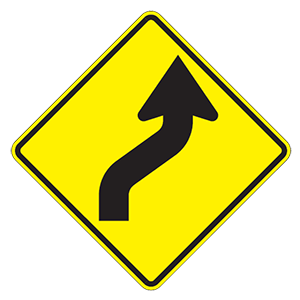
Turns sharply right, then left.
Curves right, then left.
Curves right.
Q.8.
If you experience a tire blowout:
Tap or pump the brakes.
Slow down gradually and use your brakes lightly.
Apply the brakes firmly and quickly.
Q.9.
You are approaching an intersection with a steady yellow traffic light. If you have not already entered the intersection, you should:
Speed up to beat the red light.
Reduce you speed and proceed carefully through the intersection.
Come to a safe stop.
Q.10.
If a child is riding a bicycle near your vehicle:
Beep your horn.
Expect the child to be in total control of the bicycle.
Expect the unexpected.
Q.11.
Adjust your rearview and side mirrors:
Before you start driving.
Whenever you need to use them.
Before you get into the car.
Q.12.
The driver ahead of you stops at a crosswalk. What should you do?
Cautiously pass the vehicle at 10 mph or slower.
Stop, proceeding only when all the pedestrians have crossed.
Change lanes, look carefully, and pass the stopped vehicle.
Q.13.
You can help keep the driver behind you a safe distance away from your vehicle by:
Driving 10 mph faster than the car behind you.
Driving 10 mph slower than the car behind you.
Maintaining a steady speed.
Q.14.
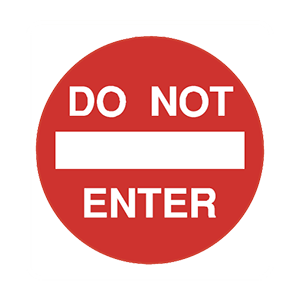
This sign means:
Do not enter.
Yield the right-of-way.
Reserved parking for persons with disabilities.
Q.15.
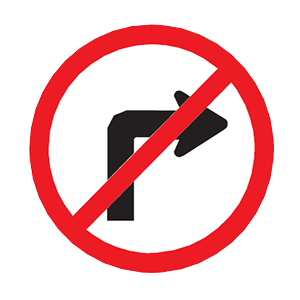
This sign means:
No right turn.
Right turn on red light permitted with caution.
All traffic must turn right at next intersection.
Q.16.
"No passing zone" signs tell drivers:
To speed up slightly.
That it is not safe to pass.
To maintain a steady speed.
Q.17.
When you see a flashing yellow light at an intersection, you should:
Yield to all traffic before crossing the intersection.
Stop, then enter the intersection when it is safe to do so.
Slow down and cross the intersection carefully.
Q.18.
Which of the following are factors commonly contributing to traffic crashes?
Exceeding the posted speed limit and driving too fast for conditions or circumstances.
Getting adequate rest and staying alert.
Scanning the environment and staying focused on the driving task.
Q.19.
If you have an argument with another person and you are angry, you should:
Loudly play the radio while driving so you won’t think about your argument.
Take a few minutes to cool off before driving.
Drive on the interstate to let off steam.
Q.20.
When driving on the highway, consistently looking far ahead of your vehicle:
Helps you keep up with traffic.
Reduces the need for last-minute braking or turning.
Allows you to spot upcoming police officers.
Q.21.
When passing another vehicle, you should return to your original lane when:
You can see both headlights of the passed vehicle in your rearview mirror.
You have cleared the front bumper of the passed vehicle.
You are 50 feet in front of the passed vehicle.
Q.22.
If the driver of an oncoming vehicle fails to dim their headlights:
Look toward the center of the roadway.
Look toward the right side of the road.
Look straight ahead.
Q.23.
When driving behind another vehicle at night, you should:
Keep your headlights on the low beam setting.
Use your high beam headlights until you are within 10 feet of the vehicle ahead.
Use your high beam headlights.
Q.24.
When you see this sign, you should:
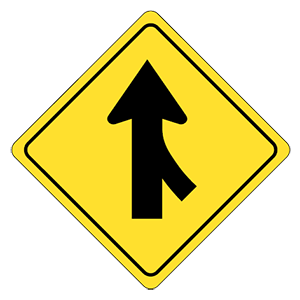
Watch for traffic merging from the right.
Merge right.
Turn left.
Q.25.
When should drivers yield the right-of-way to pedestrians in a crosswalk?
Only if the pedestrians first wave to the driver.
Only if the pedestrians are not texting while walking.
At all times.
Support mcqgeeks.com by disabling your adblocker.
×
Please disable the adBlock and continue.
Thank you.
Reload page