MCQGeeks
CBSE
JEE
NTSE
NEET
English
UK Quiz
Quiz
Driving Test
Practice
Games
Driving Test
Arkansas
Arkansas Motorcycle Driving Permit Test-8
Answers
Q.1.
If passing another vehicle:
You may exceed the speed limit until the pass is complete.
You may disregard no passing zone markings if you began the pass in a passing zone.
You must observe the posted speed limit.
Q.2.
Alcohol reaches the brain ________ being consumed.
Within minutes of
About an hour after
About two hours after
Q.3.
As your motorcycle increases speed, you will:
Need to shift up through the gears.
Need to shift down through the gears.
Need to put the motorcycle into neutral.
Q.4.
When wearing a helmet at the time of a crash, a rider is:
Less likely to survive than a person who is not wearing helmet.
Just as likely to survive as a person not wearing a helmet.
More likely to survive than a person not wearing helmet.
Q.5.
When entering a curve, you should always position your motorcycle:
On the left side of the lane.
In a position that allows you to most effectively see and be seen.
In the center of the lane.
Q.6.
When riding, you should wear boots or shoes that:
Cover your ankles.
Have long heels.
Have long and loose laces.
Q.7.
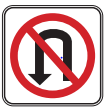
What does this sign mean?
No right turn
No left turn
No U-turn
Q.8.
A solid white line on the side of the road indicates:
No parking is permitted.
The right edge of a traffic lane.
Traffic must merge.
Q.9.
As you approach a blind intersection, you should:
Move into the part of the lane that allows other drivers to most easily see you.
Move into the part of the lane closest to the traffic control device.
Move into the outside edge of the lane.
Q.10.
A plastic, shatter-resistant face shield:
Is not necessary if you have a windshield.
Only protects your eyes.
Helps protect your whole face.
Q.11.
Which lane position is usually best for minimizing the risk of other vehicles sharing your lane?
The left portion of the lane
The center portion of the lane
The right portion of the lane
Q.12.
The best way to stop quickly is to:
Use only your front brake.
Use only your rear brake.
Use both brakes at the same time.
Q.13.
A pre-ride inspection should include all of the following, except:
A tire check.
A test of the turn signals.
A paint inspection.
Q.14.
In areas where dangers could be present, a motorcyclist should:
Maintain their speed.
Assume they will be safe.
Cover the clutch and both brake levers to reduce their reaction time.
Q.15.
To reduce the chances of a collision, a motorcyclist should:
Stare straight in front of their motorcycle.
Be unwilling to move to avoid a potential hazard.
Scan their path of travel, looking at least 10 to 15 seconds ahead of their motorcycle.
Q.16.
When riding a motorcycle, your lane position:
Has little impact on whether or not other drivers can see you.
Is very important because it may affect whether or not other drivers can see you.
Cannot protect you from wind blasts from other vehicles.
Q.17.
Passengers should:
Hold onto the rider's hips, waist, or belt.
Never hold onto the rider.
Not lean into any turn.
Q.18.
What does a flashing red traffic light mean?
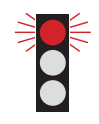
Come to a complete stop and proceed when it is safe to do so.
Only stop to yield to other traffic.
Vehicles will be entering the roadway.
Q.19.
You should operate the engine cut-off switch and pull in the clutch when:
The throttle is stuck and you cannot free it.
You start to lose control in a curve.
The motorcycle starts to wobble.
Q.20.
When being passed by another vehicle, you should travel in:
The left portion of the lane.
The center portion of the lane.
The right portion of the lane.
Q.21.
Motorcycles may pass on the right:
If there is at least eight feet of unobstructed pavement.
By riding on the shoulder of the road.
By riding on the grass, if it is level.
Q.22.
There may be less traction available for braking when:
A motorcycle is leaning.
A motorcycle is straight up and down.
A motorcycle is on dry pavement.
Q.23.
The best way to help others see your motorcycle is to:
Use your headlight.
Maintain eye contact.
Wave at drivers.
Q.24.
When sitting on a motorcycle, you should:
Use your arms to hold up your body.
Sit at an angle so your arms can support your weight.
Sit so you can use your arms to control the motorcycle.
Q.25.
Eye protection is:
Required for all riders.
Not required, but recommended.
Only required for inexperienced motorcycle users.
Support mcqgeeks.com by disabling your adblocker.
×
Please disable the adBlock and continue.
Thank you.
Reload page