MCQGeeks
CBSE
JEE
NTSE
NEET
English
UK Quiz
Quiz
Driving Test
Practice
Games
Driving Test
California
California Car Driving Permit Test-11
Answers
Q.1.
A broken yellow line beside a solid yellow line indicates that:
Passing is permitted from the lane next to the solid yellow line.
Passing is not permitted from either direction.
Passing is permitted from the lane next to the broken yellow line.
Q.2.
You were parked and have been waiting a long time with your turn signal on to re-enter traffic. However, traffic is heavy. You should:
Continue waiting and yielding to traffic in the lane.
Slowly inch your vehicle into the traffic lane.
Drive on the shoulder until a gap in traffic appears.
Q.3.
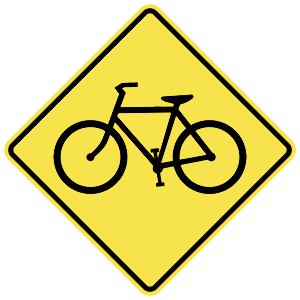
This road sign means:
Bicycle crossing.
Stop only if other cars are approaching.
Yield the right-of-way to pedestrians.
Q.4.
You must obey instructions from school crossing guards:
At all times.
Only during school hours.
Unless you do not see any children present.
Q.5.
Roadways are the most slippery:
During a heavy downpour.
After it has been raining for awhile.
During the first rain after a dry spell.
Q.6.
You see a signal person at a road construction site ahead. You should obey his or her instructions:
Only if you see orange cones on the road ahead.
Unless they conflict with existing signs, signals, or laws.
At all times.
Q.7.
If there is no crosswalk and you see a pedestrian crossing your lane, you should:
Make sure the pedestrian can see you before proceeding.
Cautiously drive around the pedestrian.
Stop and let the pedestrian finish crossing.
Q.8.
While driving at night, a vehicle coming toward you has its high beams on, making it hard for you to see the road ahead. You should:
Look ahead toward the left edge of your lane.
Look ahead toward the right edge of your lane.
Look straight ahead in your lane.
Q.9.
When preparing to make a left turn from a two-way street, you should drive:
Near the right-hand side of the road.
Near the centerline.
On the left of the centerline.
Q.10.
What is a potential effect of taking a prescription drug while drinking alcohol?
There will likely be no effect.
It will make you more alert.
It can make you unfit to drive.
Q.11.
All of the following practices are dangerous to do while driving. Which of these is also illegal?
Listening to music through headphones that cover both ears.
Adjusting your outside mirrors.
Transporting an unrestrained animal inside the vehicle.
Q.12.
You are approaching a railroad crossing with no warning devices and are unable to seefeet down the tracks in one direction. The speed limit is:
15 mph.
20 mph.
25 mph.
Q.13.
Highway pavement will be particularly treacherous and most slippery:
If it has been raining several hours.
If it has just begun to rain.
If it has been raining for one to two hours.
Q.14.
Drivers turning left must yield to:
Overtaking cars.
Oncoming cars.
No one.
Q.15.
When you are merging onto the freeway, you should be driving:
At or near the speed of traffic on the freeway.
Five to 10 mph slower than the speed of traffic on the freeway.
The posted speed limit for freeway traffic.
Q.16.
It is against the law to enter an intersection when:
You can't get all the way across before the light turns red.
The light is flashing yellow and you didn't stop first.
The light is yellow and you cannot stop safely.
Q.17.
If you are about to be hit from the rear, you should consider each of the following, except for:
Applying your brakes.
Letting go of the steering wheel.
Pressing your head firmly against the head restraint.
Q.18.
A white painted curb indicates a:
Loading zone for freight or passengers.
Loading zone for passengers or mail only.
Loading zone for freight only.
Q.19.
If you are involved in a traffic accident in California, you must file a report of the accident with the DMV when:
The collision causes $1,000 in damage.
You plan on being out of the state for more than 30 days.
You refinance the remaining balance of your vehicle loan.
Q.20.
You are driving on a freeway with a posted speed limit ofmph. Traffic is heavy and moving atmph. The best speed for your vehicle is most likely:
25 mph.
35 mph.
30 mph.
Q.21.
If you want to pass a pedestrian who is walking along the roadway and an oncoming vehicle is approaching, you should:
Slow down and let the oncoming vehicle pass before you pass the pedestrian.
Keep driving at a steady speed. The oncoming vehicle must stop for you.
Honk your horn to get the pedestrian to move over.
Q.22.
Temporary signs used in construction and maintenance work areas:
Have a red background with green writing.
Have an orange background with black writing.
Have a yellow background with blue writing.
Q.23.
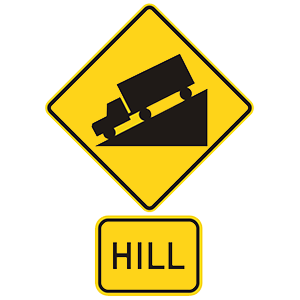
This sign means:
Trucks under 18,000 pounds are allowed.
Hill ahead.
Truck stop ahead.
Q.24.
You are about to make a left turn. You must signal continuously during the last ____ feet before the turn.
50
75
100
Q.25.
If your car becomes disabled while on the highway, you should:
Stop in the right lane.
Park with all four wheels off the traveled highway, if possible.
Stop where you are.
Q.26.
When double solid yellow lines separate lanes of traffic:
Passing is permitted from the left.
Passing is permitted from the right.
Passing is not permitted from either direction.
Q.27.
Driving under the influence of any medication which impairs your driving is permitted:
Under no circumstances.
If you don't feel drowsy.
If it is prescribed by a physician.
Q.28.
Drivers are required to obey instructions from:
Security guards patrolling parking lots.
Other drivers whose vehicles are broken down on the roadway.
Flaggers (signal persons) at construction sites.
Q.29.
Collisions are more likely to happen when:
All vehicles are traveling at about the same speed.
One lane of traffic is traveling faster than the other lanes.
One vehicle is traveling faster or slower than the flow of traffic.
Q.30.
A school bus is stopped ahead of you in your lane with its red lights flashing. You should:
Stop and proceed when you think all of the children have exited the bus.
Slow to 25 mph and pass cautiously.
Stop for as long as the red lights are flashing.
Q.31.
If you have a green light but traffic is blocking the intersection, you should:
Stay out of the intersection until traffic clears.
Enter the intersection and wait until traffic clears.
Merge into another lane and try to go around the traffic.
Q.32.
If you are being passed in a no passing zone, you should:
Pull off the road.
Maintain your speed and position.
Slow down and let the other driver safely return to the drive lane.
Q.33.
What does this road sign indicate?
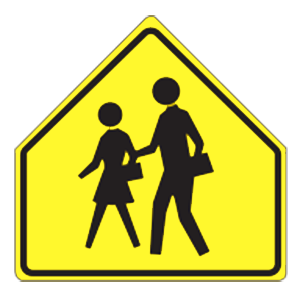
Directions for children
School zone ahead
Playground area ahead
Q.34.
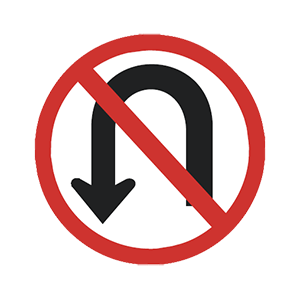
This sign means:
No U-turn.
Traffic signal ahead.
Railroad ahead.
Q.35.
You may make a left turn on a red light only from a:
One-way street onto a two-way street.
One-way street onto a one-way street.
Two-way street onto a one-way street.
Q.36.
You enter a designated turn lane to make a left turn at an upcoming intersection. There is oncoming traffic. You should:
Move to the left of the center lane.
Signal before you arrive at the intersection.
Turn your front wheels to the left to be prepared to turn.
Support mcqgeeks.com by disabling your adblocker.
×
Please disable the adBlock and continue.
Thank you.
Reload page