MCQGeeks
CBSE
JEE
NTSE
NEET
English
UK Quiz
Quiz
Driving Test
Practice
Games
Driving Test
California
California Car Driving Permit Test-14
Answers
Q.1.
When entering traffic after being parked at a curb, you:
Should drive more slowly than other traffic for 200 feet.
Should wait for a large enough gap to get up to the speed of traffic.
Should wait for the first two vehicles to pass, then drive into the lane.
Q.2.
To help others see you when daylight begins to fade, you should use your:
Parking lights.
Low beam headlights.
Emergency flashers.
Q.3.
If you have a sudden tire blowout:
Use the brakes lightly.
Pump the brakes.
Apply the brakes firmly.
Q.4.
When changing lanes:
Check your side mirror and look over your shoulder to make sure the lane is clear.
Check the inside rearview mirror.
Slow down.
Q.5.
Extra space in front of a large truck is needed for:
Other drivers to merge onto the freeway.
The truck driver to stop the vehicle.
Other drivers when they want to slow down.
Q.6.
You should signal continuously while turning because it:
Is illegal to turn off your signal before completing a turn.
Lets other drivers know what your intentions are.
Is always unsafe to turn off a signal before completing a turn.
Q.7.
A safety zone is a specially marked area for passengers to get on or off of buses or trolleys. You may not drive through a safety zone:
When a bus or trolley is present.
When a bus or trolley is unloading passengers.
At any time for any reason.
Q.8.
A flashing red traffic light at an intersection means:
Slow down before entering.
Stop before entering.
Stop and wait for the green light.
Q.9.
Distracted driving is:
Anything that causes evasive action while driving.
Anything that takes your attention away from driving.
Anything that causes you to pay more attention to driving.
Q.10.
If you drivemph in amph zone, you can be given a speeding ticket:
Under no circumstances because it is always legal.
If the road or weather conditions require a slower speed.
Only if you are approaching a sharp curve in the road.
Q.11.
When parking your vehicle parallel to the curb on a level street:
Your front wheels must be turned toward the street.
Your wheels must be within 18 inches of the curb.
One of your rear wheels must touch the curb.
Q.12.
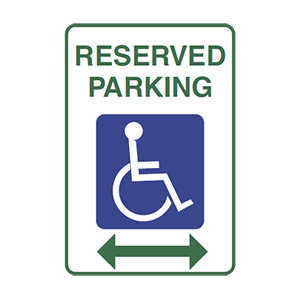
This sign means:
Reserved parking for persons with disabilities.
Slow-moving vehicle.
No U-turn.
Q.13.
Trucks' blind spots are:
Directly behind the body.
On the immediate left of the cab.
Both on the immediate left of the cab and directly behind the body.
Q.14.
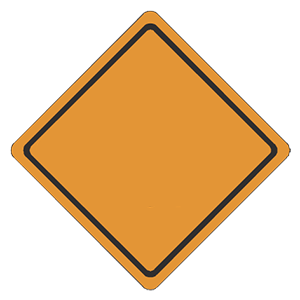
This sign means:
Road construction/maintenance area.
Side road.
Railroad ahead.
Q.15.
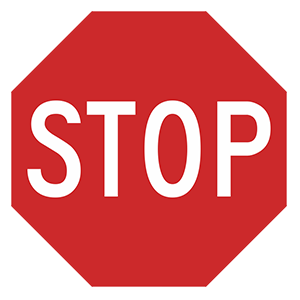
This road sign means:
Slow down or stop.
Stop if necessary.
You must come to a complete stop.
Q.16.
To see objects in their blind spot when changing lanes, drivers should check:
Only the left outside mirror.
Over their left or right shoulder.
Only the inside rearview mirror.
Q.17.
This white sign means you should not pass other vehicles:
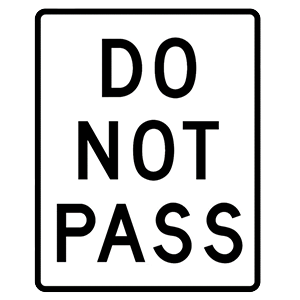
Until after you pass the sign.
Unless it seems safe to do so.
For any reason.
Q.18.
If a motorist sees pedestrians in an upcoming crosswalk, what should the motorist do?
Continue ahead. The motorist has the right-of-way.
Wait for the pedestrians to cross the street.
Pull to the right and go around the pedestrians.
Q.19.
If you are driving and a tire suddenly goes flat, you should:
Rapidly pump the brake pedal several times.
Slow down gradually and not brake.
Press down on the brake pedal as hard as you can.
Q.20.
Which of the following statements about driving speed is true?
As your speed increases, the chance of a fatality increases.
As your speed increases, so should your following distance.
Both of the above.
Q.21.
You want to park uphill on a two-way road and there is no curb. Which direction do you turn your front wheels?
Straight ahead
Right, toward the side of the road
Left, toward the center of the road
Q.22.
If you have a green light but traffic is blocking the intersection, you should:
Stay out of the intersection until traffic clears.
Enter the intersection and wait until traffic clears.
Merge into another lane and try to go around the traffic.
Q.23.
Before changing lanes or attempting to pass another vehicle, you should:
Check your blind spots and mirrors.
Signal your intention before changing lanes.
All of the above.
Q.24.
Always carefully look for motorcycles before you change lanes because:
Their small size can make them hard to see.
They usually have the right-of-way at intersections.
It is illegal for motorcycles to share traffic lanes.
Q.25.
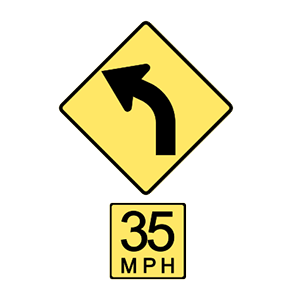
This sign means:
There is a 35 mph speed zone after the curve ahead.
Drive no slower than 35 mph around the upcoming curve.
Approach the upcoming curve at a speed of 35 mph or slower.
Q.26.
To be able to turn quickly, your hands must be:
On opposite sides of the steering wheel.
Next to each other on the top of the steering wheel.
On the top and bottom of the steering wheel.
Q.27.
Children on bicycles should be given extra space by motor vehicle operators because:
They do not have the same physical reflexes as adults.
They are smaller and more difficult to see than adults.
Both of the above.
Q.28.
When passing another vehicle, it is safe to return to your lane if you:
Cannot see the vehicle directly to your right.
See the vehicle’s headlights in your rearview mirror.
Have passed the other vehicle’s front bumper.
Q.29.
A broken yellow line down the center of a road indicates that:
A construction zone is ahead.
Passing is not permitted from either direction.
Passing is permitted from either direction.
Q.30.
After you have passed a vehicle moving in the same direction, it is safe to move back into the right lane:
After about three seconds.
When you can no longer see the passed vehicle over your right shoulder.
When you can see the entire front of the passed vehicle in your rearview mirror.
Q.31.
You may drive off of the paved roadway to pass another vehicle:
If the shoulder is wide enough to accommodate your vehicle.
If the vehicle ahead of you is turning left.
Under no circumstances.
Q.32.
When being followed by a tailgater, which of the following will help you avoid being hit from behind?
Merging into another lane
Decreasing your following distance
Changing lanes frequently
Q.33.
You enter a designated turn lane to make a left turn at an upcoming intersection. There is oncoming traffic. You should:
Move to the left of the center lane.
Signal before you arrive at the intersection.
Turn your front wheels to the left to be prepared to turn.
Q.34.
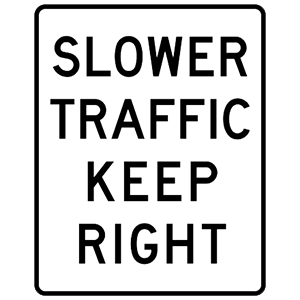
This white sign means:
You should slow down and move to the right lane.
Stay in the right lane if you are driving more slowly than other traffic.
Slower traffic must exit on the right.
Q.35.
It is dangerous to follow a motorcycle too closely because:
They do not follow the same rules as motor vehicles.
A motorcycle can stop much faster than a standard vehicle.
They brake more slowly than motor vehicles.
Q.36.
You see a flashing yellow traffic signal at an upcoming intersection. The flashing yellow light means:
Stop before entering the intersection, as long as you can do so safely.
Stop. Yield to all cross traffic before crossing the intersection.
Slow down and cross the intersection carefully.
Support mcqgeeks.com by disabling your adblocker.
×
Please disable the adBlock and continue.
Thank you.
Reload page