MCQGeeks
CBSE
JEE
NTSE
NEET
English
UK Quiz
Quiz
Driving Test
Practice
Games
Driving Test
California
California Car Driving Permit Test-17
Answers
Q.1.
When making a right turn from a highway with two lanes traveling in your direction, you may turn from:
The lane closest to the center of the road.
The lane nearest the curb or edge of the roadway.
Either lane, depending on oncoming traffic.
Q.2.
You may cross a double yellow line to pass another vehicle if the yellow line next to:
The other side of the road is a solid line.
Your side of the road is a broken line.
The other side of the road is a broken line.
Q.3.
While in a motor vehicle on a highway, it is:
Illegal to either drink from or possess open containers of alcohol.
Legal to drink alcohol if you're not driving.
Legal to drink alcohol if you're driving but not drunk.
Q.4.
When driving on gravel or dirt roads:
Your tires grip the road better than when you are driving on pavement.
Your tires do not have as much traction as they do on pavement, so you must slow down.
Visibility is better than on pavement.
Q.5.
If there is a deep puddle on the road ahead, you should:
Maintain the posted speed to make it through the water.
Avoid the puddle if possible.
Shift into neutral as you drive through the water.
Q.6.
You are driving on a city street and see an emergency vehicle with flashing lights behind you. What should you do?
Drive to the right edge of the road and slow down.
Drive to the right edge of the road and stop.
Stay in your lane, slow down, and let it pass.
Q.7.
When approaching an intersection controlled by a flashing yellow light, you must:
Come to a complete stop at the intersection.
Maintain your normal speed.
Slow down and proceed with caution.
Q.8.
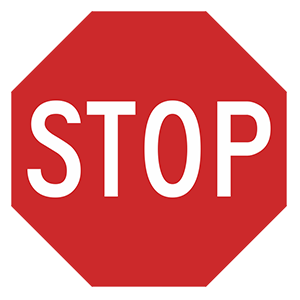
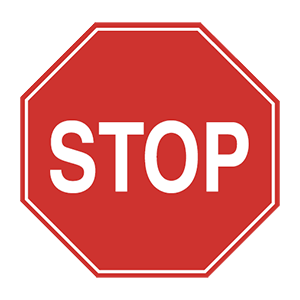
What does this road sign mean?
Slow down and prepare to stop if cars are approaching you.
Come to a full stop then proceed when it is safe to do so.
Proceed carefully through the intersection, not always stopping.
Q.9.
When driving at night on a dimly lit street, you should:
Drive slowly enough that you can stop within the area illuminated by your headlights.
Turn on your high beam headlights to better see the vehicles ahead of you.
Keep the instrument panel lights bright to be more visible to other drivers.
Q.10.
When you see this sign, you should:
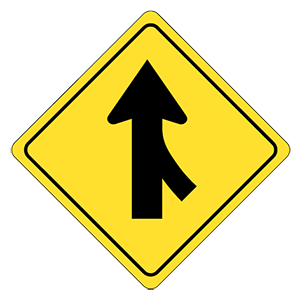
Watch for traffic merging from the right.
Merge right.
Turn left.
Q.11.
If you experience a tire blowout:
Tap or pump the brakes.
Slow down gradually and use your brakes lightly.
Apply the brakes firmly and quickly.
Q.12.
All of the following are dangerous to do while driving. Which is also illegal?
Wearing a headset that covers both ears
Having one or more interior lights on
Using cruise control on residential streets
Q.13.
To help avoid skidding on slippery surfaces, you should:
Shift to a lower gear after starting down a steep hill.
Speed up to enter curves and slow down to exit them.
Slow down before entering curves and intersections.
Q.14.
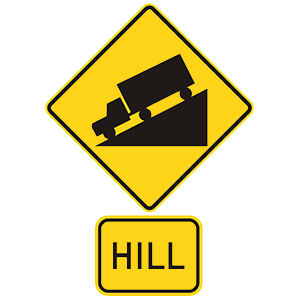
What does this road sign mean?
Falling rocks
Trucks use second gear
Steep hill
Q.15.
Dim your headlights for oncoming vehicles or when you are withinfeet of a vehicle:
That you are approaching from behind.
Approaching you from behind.
That you have already passed.
Q.16.
Slowing down just to look at collisions or anything else out-of-the-ordinary:
Causes traffic congestion.
Prevents rear-end collisions.
Improves traffic flow by preventing collisions.
Q.17.
Remove all snow, frost, and ice from:
Just the windshield.
All windows.
Just the windshield and passenger window.
Q.18.
What is the purpose of rumble strips?
They alert drivers to potential tire problems.
They test a vehicle's shock absorbers.
Through vibration and sound, they alert inattentive drivers to the fact that their vehicles have left the travel lane.
Q.19.
Continuous hard braking on ice and snow often:
Helps you stop faster.
Locks the front wheels of a vehicle, causing a loss of steering.
Keeps the brakes from freezing.
Q.20.
There is no crosswalk and you see a pedestrian crossing your lane ahead. You should:
Make eye contact with and then pass the pedestrian.
Slow down as you pass the pedestrian.
Stop and let the pedestrian finish crossing the street.
Q.21.
Which of the following increases your chances of being in a collision?
Looking over your shoulder while making lane changes
Continuously changing lanes to pass other vehicles
Adjusting your rearview mirror before you start driving
Q.22.
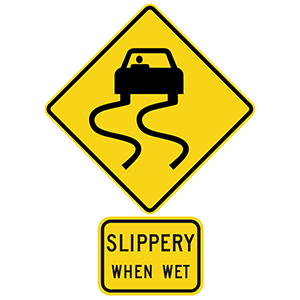
This sign means:
Do not drink and drive.
Slippery when wet.
Road curves ahead.
Q.23.
Where is it safe to pass another vehicle?
Within an intersection where there are no oncoming vehicles
Wherever signs and/or pavement markings permit passing
Within a curve where there are no oncoming vehicles
Q.24.
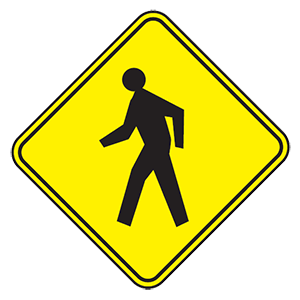
This sign means:
School crossing.
School zone.
Pedestrian crossing.
Q.25.
It is illegal for a personyears of age or older to drive with a blood alcohol concentration (BAC) that is ____ or higher.
0.08% -- Eight-hundredths of one percent
0.10% -- One-tenth of one percent
0.05% -- Five-hundredths of one percent
Q.26.
Always use your seat belt:
Unless the vehicle was built before 1978.
Unless you are in a limousine.
When the vehicle is equipped with seat belts.
Q.27.
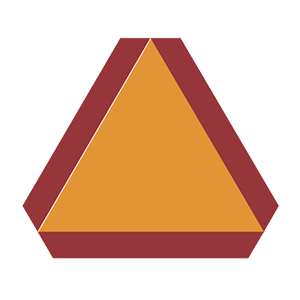
An orange and red triangular sign on a vehicle always means:
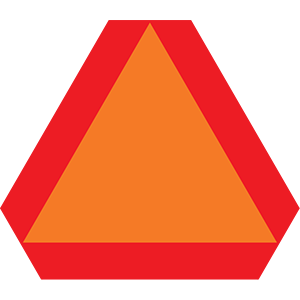
The vehicle has the right-of-way.
Slow-moving vehicle.
Shoulder work ahead.
Q.28.
This sign means:
Merge.
Stop.
Upcoming change in direction.
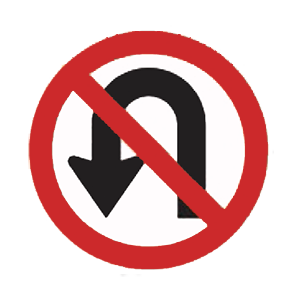
Q.29.
This sign means:
No turns.
No outlet.
No U-turns.
Q.30.
When you see this road sign, you should:
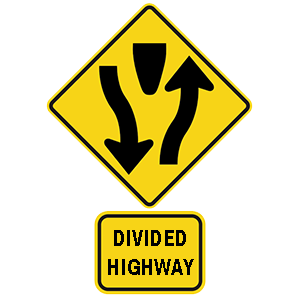
Keep right.
Keep left.
Pass with caution.
Q.31.
This sign means:
Slow-moving vehicle.
Road construction/maintenance area.
Traffic signal ahead.
Q.32.
Which of these statements is true about large trucks?
They take longer to stop than passenger vehicles.
They all have air brakes that allow them to stop quickly.
They are more maneuverable than passenger vehicles.
Q.33.
There is a vehicle stopped on the right shoulder of the road with its hazard lights on. You should:
Change lanes to the left and speed up.
Slow down and pass very carefully.
Stop your vehicle until you can see what has happened.
Q.34.
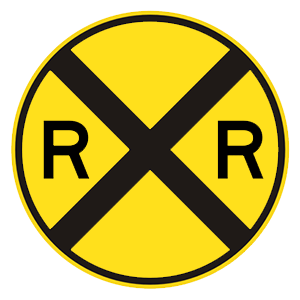
When you see this sign, you:
Are approaching a railroad crossing and should prepare to stop.
Will always stop at the upcoming railroad crossing.
Should stop and wait for a signal before crossing the railroad tracks.
Q.35.
To prevent yourself from becoming an aggressive driver:
Relax and concentrate on driving.
Drive above the posted speed limit.
Tailgate the driver in front of you.
Q.36.
Which of the following is true about vehicles displaying a diamond-shaped sign that indicates a hazardous load?
They are not allowed to drive on freeways.
They must stop before crossing railroad tracks.
They are not allowed to exceed 35 mph.
Support mcqgeeks.com by disabling your adblocker.
×
Please disable the adBlock and continue.
Thank you.
Reload page