MCQGeeks
CBSE
JEE
NTSE
NEET
English
UK Quiz
Quiz
Driving Test
Practice
Games
Driving Test
California
California Car Driving Permit Test-23
Answers
Q.1.
If your vehicle begins to skid, you should:
Ease up on the gas pedal.
Brake as hard as possible.
Turn off the ignition.
Q.2.
When passing another car, you have enough space to return to the driving lane:
If the other driver signals for you to re-enter the lane.
If you look over your shoulder and see the passed car behind you.
If you can see both of the passed vehicle's headlights in your rearview mirror.
Q.3.
To avoid last-minute moves, you should be looking down the road to where your vehicle will be in about:
5 to 10 seconds.
10 to 15 seconds.
15 to 20 seconds.
Q.4.
U-turns in business districts are:
Always illegal because they are dangerous.
Legal whenever oncoming vehicles are not a hazard.
Legal at intersections, unless a sign prohibits them.
Q.5.
Roads are slippery after it first starts to rain. When the road is slippery, you should:
Avoid making turns and stops while driving at high speeds.
Test your tires' traction while going uphill.
Decrease the distance you look ahead of your vehicle.
Q.6.
Roads with double solid yellow line markings down the center indicate that passing is:
Allowed from both directions.
Allowed only from your direction of travel.
Not allowed from either direction.
Q.7.
You are merging onto an interstate highway. You should:
Select a safe gap and merge into the lane of traffic.
Merge across two lanes at once.
Always stop before entering the highway.
Q.8.
When can you drive in a bike lane?
30 minutes after sunset or 30 minutes before sunrise
On foggy days when visibility is low
200 feet before making a turn
Q.9.
Blocking an intersection during "rush hour" traffic is not permitted:
Unless you entered the intersection on a green light.
Under any circumstances, even if your light is green.
Unless you have the right-of-way or a green light.
Q.10.
If you are involved in a traffic collision, you are required to complete and submit a written report to the DMV:
Only if you or the other driver is injured.
If there is property damage in excess of $1,000 or if there are any injuries.
Only if you are at fault.
Q.11.
You must obey instructions from school crossing guards:
At all times.
Only during school hours.
Unless you do not see any children present.
Q.12.
Two sets of solid double yellow lines that are two or more feet apart:
May be crossed to enter or exit a private driveway.
May not be crossed for any reason.
Should be treated as a separate traffic lane.
Q.13.
A flashing yellow light at an intersection means you should:
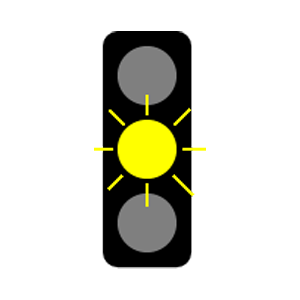
Slow down and proceed with caution.
Come to a complete stop as quickly as possible.
Stop and proceed only when the intersection is clear.
Q.14.
You can drive off the road to pass another vehicle:
If the vehicle ahead is turning left.
If there are two or more lanes traveling in your direction.
Under no circumstances.
Q.15.
If you park facing uphill where there is no curb, set the parking brake and:
Turn your wheels toward the edge of the road.
Turn your wheels away from the edge of the road.
Keep your wheels facing straight.
Q.16.
When you approach an octagonal sign, you must:

Slow.
Stop.
Turn.
Q.17.
Which of these statements is true about changing lanes?
You only need to turn and look over your right shoulder for lane changes to the right or left.
Look over your right shoulder for a right lane change and your left shoulder for a left lane change.
Vehicles with two outside mirrors do not have blind spots.
Q.18.
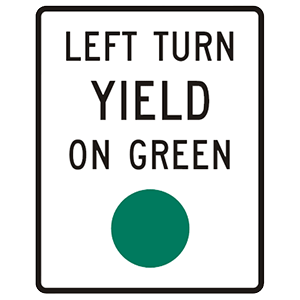
This white sign means you:
May turn left only on a green arrow.
May turn left on a green light when it is safe.
Must wait for the solid green light before you turn left.
Q.19.
A red arrow pointing to the right on a traffic light means you may:
Turn in that direction after slowing and checking for traffic.
Not turn in that direction until the light turns green.
Turn in that direction after you come to a complete stop.
Q.20.
When you see this yellow sign, you should:
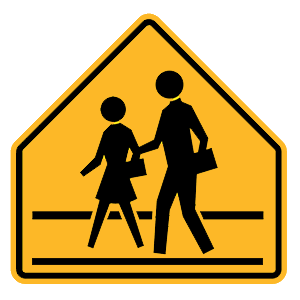
Always stop at the crosswalk.
Stop at the crosswalk until a crossing guards signals for you to go.
Be prepared to stop if children are in the crosswalk.
Q.21.
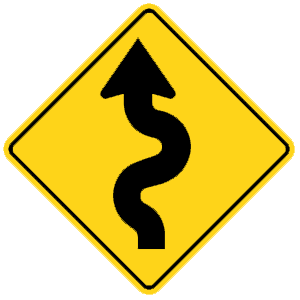
This sign tells you that:
No turns are allowed on the road.
The road narrows ahead.
There is a series of curves ahead.
Q.22.
Which of the following statements is true?
Driving too slowly is not an unsafe practice.
Driving too slowly on certain highways can be dangerous.
The speed at which you drive a vehicle does not affect safety.
Q.23.
You are on the freeway and traffic is merging into your lane. You should:
Make room for the merging traffic, if possible.
Assert your right-of-way by driving faster.
Always maintain your position.
Q.24.
At an intersection with a yield sign, you:
Must yield the right-of-way to cross traffic that is close enough to cause conflict.
Must yield to vehicles only on your right.
Should slow down but never stop.
Q.25.
You are driving on a freeway with a posted speed limit ofmph. Traffic is traveling atmph. You may legally drive:
70 mph or faster to keep up with the speed of traffic.
Between 65 mph and 70 mph.
No faster than 65 mph.
Q.26.
On a freeway, you should look farther ahead than you would on a city street:
In order to see potential hazards early.
Because it takes a quarter of a mile to stop your vehicle completely.
Because it helps you keep up with traffic.
Q.27.
A white painted curb indicates a:
Loading zone for freight or passengers.
Loading zone for passengers or mail only.
Loading zone for freight only.
Q.28.
If a vehicle is equipped with airbags:
Seat belts should still be worn.
Seat belts do not need to be worn.
Seat belts should be worn behind the back.
Q.29.
A person may legally ride in the back of a pickup truck when:
The sides of the pickup bed are at least 24 inches high.
The back of the pickup is covered with a camper shell.
In a secured seat and while using an approved safety belt.
Q.30.
A curb painted blue means parking is:
Allowed for no longer than 15 minutes.
Only allowed when picking up or dropping off passengers.
For disabled persons with a special placard or plate.
Q.31.
If you see orange construction signs and cones on a freeway, you must:
Slow down because the lane ends ahead.
Be prepared for workers and equipment ahead.
Change lanes and maintain your current speed.
Q.32.
When using a roundabout, drivers should:
Stop in the middle of the roundabout.
Yield to traffic already in the roundabout.
Yield to entering traffic.
Q.33.
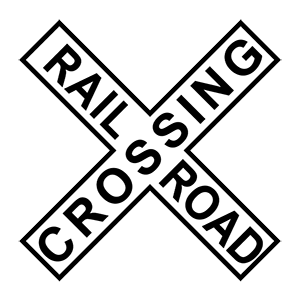
This white sign means:
The railroad crossing is controlled. Continue at your regular speed.
Look, listen, and prepare to stop at the crossing if necessary.
Stop at the railroad tracks and wait for a signal before crossing.
Q.34.
Which of these statements is true about drinking alcohol and driving?
If you can walk in a straight line after drinking, it is safe to drive.
If you are under the legal blood alcohol concentration limit, your driving isn't impaired.
Alcohol affects judgement, which is needed to drive safely.
Q.35.
When merging onto the freeway, you should be driving:
At or near the speed of the freeway traffic.
At the legal speed limit.
More slowly than the freeway traffic.
Q.36.
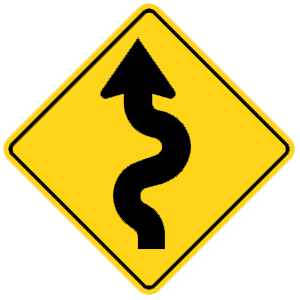
This road sign means:
Sharp turn to the right ahead.
Upcoming sharp left and right turns.
Winding road ahead.
Support mcqgeeks.com by disabling your adblocker.
×
Please disable the adBlock and continue.
Thank you.
Reload page