MCQGeeks
CBSE
JEE
NTSE
NEET
English
UK Quiz
Quiz
Driving Test
Practice
Games
Driving Test
California
California Car Driving Permit Test-5
Answers
Q.1.
With a Class C driver license, a person may drive:
A three-axle vehicle if the Gross Vehicle Weight is less than 6,000 pounds.
Any three-axle vehicle, regardless of the weight.
A vehicle pulling two trailers.
Q.2.
The amount of alcohol in the blood is referred to as:
Implied consent (IC).
Blood alcohol concentration (BAC).
Rate of alcohol consumption (RAC).
Q.3.
At a red traffic light with a green arrow, you may proceed in the direction of the arrow if:
You first come to a complete stop.
You wait until the light changes.
You are in the proper lane and the roadway is clear.
Q.4.
Safely backing your vehicle requires all of the following, except:
Looking over your right shoulder as you back up.
Checking your vehicle's surroundings.
Tapping your horn before you back up.
Q.5.
For which of the following traffic lights must you always stop your vehicle?
Solid red lights, flashing red lights, and blacked out traffic signals.
Solid red lights, red arrows, and flashing yellow lights.
Solid red lights, flashing red lights, and yellow lights.
Q.6.
To turn left from a multilane one-way street onto a one-way street, you should start your turn from:
Any lane (as long as it is safe).
The lane closest to the left curb.
The lane in the center of the road.
Q.7.
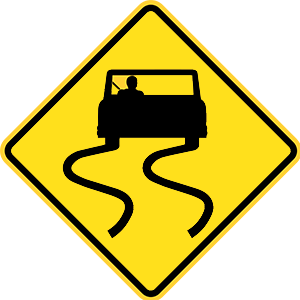
This yellow signs means:
The road ahead has many curves.
There is a sharp curve in the road ahead.
The road ahead may be slippery.
Q.8.
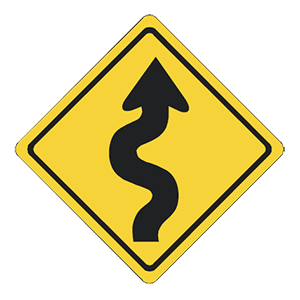
This sign means:
Winding road ahead.
Do not enter.
Pedestrian crossing.
Q.9.
You must yield to a pedestrian using a white cane or guide dog:
Only when the guide dog is leading the person across the street.
At all times.
Only if a crossing guard is present.
Q.10.
Roads are slippery after it first starts to rain. When the road is slippery, you should:
Avoid making turns and stops while driving at high speeds.
Test your tires' traction while going uphill.
Decrease the distance you look ahead of your vehicle.
Q.11.
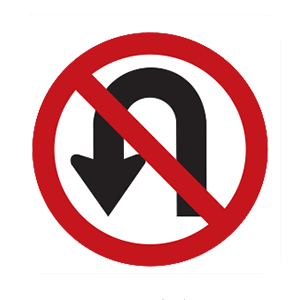
This road sign means:
Do not enter.
Roundabout ahead.
No U-turns.
Q.12.
Always use your seat belt:
Unless the vehicle was built before 1978.
Unless you are in a limousine.
When the vehicle is equipped with seat belts.
Q.13.
In rainy weather, you should be most careful when turning or stopping:
After it has been raining all day.
One half hour after it stops raining.
During the first half hour of rain.
Q.14.
Two sets of solid double yellow lines that are two or more feet apart:
May be crossed to enter or exit a private driveway.
May not be crossed for any reason.
Should be treated as a separate traffic lane.
Q.15.
If you come to an intersection and your view to the side is blocked, you should:
Slow down and look both ways.
Maintain your speed and look both ways.
Stop, then inch forward until you can see clearly in both directions.
Q.16.
To improve visibility lowered by rain or fog, drivers should use their:
Low beam headlights.
High beam headlights.
Parking lights.
Q.17.
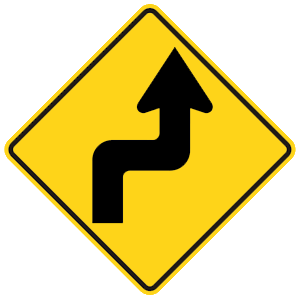
This road sign means:
Sharp right turn ahead.
A road joins from the right.
The road ahead turns sharply right then sharply left.
Q.18.
When passing another vehicle, it is safe to return to your lane if you:
Cannot see the vehicle directly to your right.
See the vehicle’s headlights in your rearview mirror.
Have passed the other vehicle’s front bumper.
Q.19.
You are driving on a city street and see an emergency vehicle with flashing lights behind you. What should you do?
Drive to the right edge of the road and slow down.
Drive to the right edge of the road and stop.
Stay in your lane, slow down, and let it pass.
Q.20.
It is legal to drive with an alcoholic beverage container that has been opened only if the container is:
Under the front seat.
In the glove department.
In the trunk.
Q.21.
You should not use your horn:
When visibility ahead is limited.
If you might hit another vehicle.
Near blind pedestrians.
Q.22.
When driving in work zones, you should:
Follow the driver in front of you closely.
Pass the driver in front of you as soon as you can.
Avoid tailgating and keep a safe following distance.
Q.23.
Which of these statements is true about roadwork zones?
Fines are the same for violations committed in work zones as they are under normal traffic conditions.
You must "Slow for the Cone Zone."
Slow down only if you think workers are present.
Q.24.
When passing on the left of a vehicle, it is safe to move back into the right lane:
After about three seconds.
When you can no longer see the vehicle over your right shoulder.
When you can see the front of the vehicle in your rearview mirror.
Q.25.
Before switching on the ignition, you should:
Buckle your safety belt.
Be sure all passengers have buckled their safety belts.
Both of the above.
Q.26.
When driving in fog or mist, never put your headlights on the high beam setting because:
The light will reflect back into your eyes.
Approaching vehicles might not see you.
Vehicles behind you may follow too closely.
Q.27.
To turn left from a one-way street onto a one-way street, start from:
The lane closest to the left curb.
The center lane.
Any lane, as long as it seems safe to do so.
Q.28.
If you find yourself in a skid:
Brake lightly.
Stay off the brakes.
Brake abruptly.
Q.29.
If you see orange construction signs and cones on a freeway, you must:
Slow down because the lane ends ahead.
Be prepared for workers and equipment ahead.
Change lanes and maintain your current speed.
Q.30.
Which of the following roadways freeze first when wet?
Bridges and overpasses
Intersections
Tunnels
Q.31.
You should always travel:
At the speed of vehicles surrounding you.
At the speed limit.
At a speed appropriate for road and weather conditions.
Q.32.
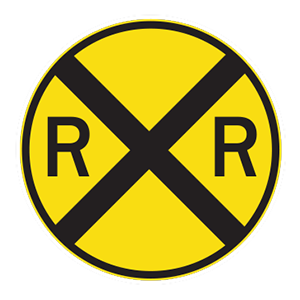
This sign means:
Stop sign ahead.
Railroad crossing ahead.
Construction ahead.
Q.33.
When turning left from a two-way street onto a one-way street, you should:
Turn into any lane.
Turn into first lane.
Turn into second lane.
Q.34.
You exit the freeway on a ramp that curves downhill. You should:
Slow to a safe speed before the curve.
Slow to the posted speed limit for the freeway.
Wait until you have entered the curve to begin braking.
Q.35.
Which of the following is not a safe driving practice when driving on the interstate?
Slower traffic must keep to the right.
Change lanes without signaling.
If you miss your exit, you must go to the next exit.
Q.36.
Which of these is a safe driving technique?
Using your high beam lights in the fog.
Staring at the road ahead of your vehicle.
Checking your rearview mirrors frequently.
Support mcqgeeks.com by disabling your adblocker.
×
Please disable the adBlock and continue.
Thank you.
Reload page