MCQGeeks
CBSE
JEE
NTSE
NEET
English
UK Quiz
Quiz
Driving Test
Practice
Games
Driving Test
California
California Car Driving Permit Test-9
Answers
Q.1.
When passing another vehicle:
Pass the vehicle as slowly as possible.
Drive at the same speed as the vehicle you are passing.
Pass the vehicle as safely and as quickly as possible.
Q.2.
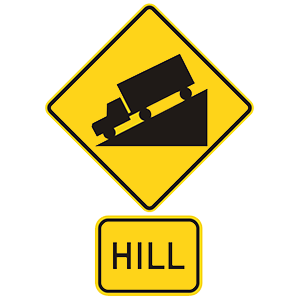
This sign indicates that:
There is a steep hill ahead.
No trucks are allowed on the upcoming hill.
A logging road is ahead.
Q.3.
Which of the following statements about blind spots is true?
Blind spots are eliminated if you have one outside mirror.
Large trucks have bigger blind spots than most passenger vehicles.
Blind spots can be checked by looking in your rearview mirror.
Q.4.
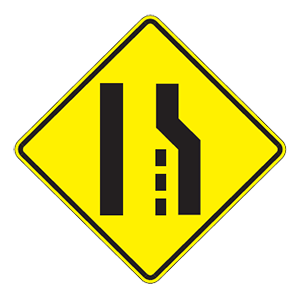
This sign means:
Merge right.
Divided highway begins.
Lane ends.
Q.5.
You should drive on the shoulder to pass a car:
If the vehicle ahead of you is turning left.
Under no circumstances.
If the shoulder is wide enough.
Q.6.
To make a right turn at a corner, you:
May not enter the bicycle lane.
Should only merge into the bicycle lane if you stop before turning.
Must merge into the bicycle lane before turning.
Q.7.
A solid yellow line next to a broken yellow line means that vehicles:
Driving in both directions may pass.
Next to the broken line may pass.
Next to the solid line may pass.
Q.8.
When parking your vehicle parallel to the curb on a level street:
Your front wheels must be turned toward the street.
Your wheels must be within 18 inches of the curb.
One of your rear wheels must touch the curb.
Q.9.
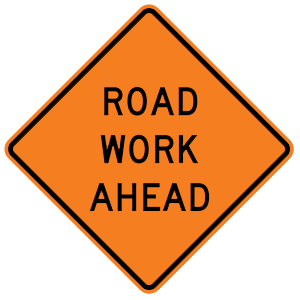
This road sign means:
Watch for people crossing your path.
No passing zone.
Work zone ahead.
Q.10.
When turning left at an intersection:
You should always yield to oncoming traffic and pedestrians.
Oncoming traffic and pedestrians should yield to you.
You should never yield to oncoming traffic and pedestrians.
Q.11.
Changing from one lane to another is best done:
Quickly and often.
When a car is in your blind spot.
Gradually and carefully.
Q.12.
To know where traffic is behind you:
Frequently check your rearview mirror.
Turn and look out your back window.
Keep other vehicles out of your blind spots.
Q.13.
When merging onto the freeway, you should be driving:
At or near the speed of the freeway traffic.
At the legal speed limit.
More slowly than the freeway traffic.
Q.14.
You must yield the right-of-way to an emergency vehicle that is using its siren and flashing lights by:
Driving as closely to the right edge of the road as possible and stopping.
Moving into the right lane and driving slowly until it has passed.
Stopping immediately, even if you are within an intersection.
Q.15.
To prevent tailgating, drivers should follow the:
One-second rule.
Two-second rule.
Three-second rule.
Q.16.
You should not make sudden stops in front of large trucks and buses because:
Small vehicle drivers cannot adequately see large trucks and buses in their rearview mirrors.
Large trucks and buses, due to their size and weight, require longer distances to stop than smaller passenger vehicles.
Large trucks and buses travel at a higher speeds than small vehicles.
Q.17.
This is the shape and color of a ____ sign.
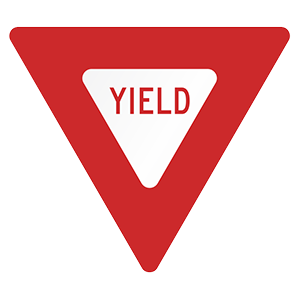
Stop
Wrong way
Yield
Q.18.
This sign means:
No U-turn.
No turning.
No left turn.
Q.19.
You have been involved in a minor traffic collision with a parked vehicle and you can't find the owner. You must:
Leave a note on the vehicle.
Report the collision without delay to the city police or, in unincorporated areas, to the California Highway Patrol.
Both of the above.
Q.20.
If weather or light conditions require you to have your lights on while driving:
Use your parking lights.
Use your high beams.
Use your low beams.
Q.21.
Which of the following is true about roadways on bridges and overpasses in cold, wet weather?
They tend to freeze before the rest of the road does.
They do not freeze because they are made of concrete.
They tend to freeze after the rest of the road does.
Q.22.
When entering traffic after being parked at a curb, you:
Should drive more slowly than other traffic for 200 feet.
Should wait for a large enough gap to get up to the speed of traffic.
Should wait for the first two vehicles to pass, then drive into the lane.
Q.23.
Use your headlights on rainy, snowy, or foggy days:
To keep your engine warm.
So others can see your vehicle.
To warn others of bad weather conditions.
Q.24.
Check your rearview mirrors:
Often to see how traffic is moving behind you.
To see if a vehicle is in your blind spot.
Only when you are slowing down.
Q.25.
If you drive faster than other vehicles on a road with one lane moving in each direction and continually pass the other cars, you will:
Get you to your destination much more quickly and safely.
Increase your chances of an collision.
Help prevent traffic congestion.
Q.26.
You should signal continuously while turning because it:
Is illegal to turn off your signal before completing a turn.
Lets other drivers know what your intentions are.
Is always unsafe to turn off a signal before completing a turn.
Q.27.
You should turn on your headlights:
One half hour after sunset.
When stopped at a railroad crossing.
When parked at a school.
Q.28.
You are approaching an intersection with a steady yellow traffic light. If you have not already entered the intersection, you should:
Speed up to beat the red light.
Reduce you speed and proceed carefully through the intersection.
Come to a safe stop.
Q.29.
There is a vehicle stopped on the right shoulder of the road with its hazard lights on. You should:
Change lanes to the left and speed up.
Slow down and pass very carefully.
Stop your vehicle until you can see what has happened.
Q.30.
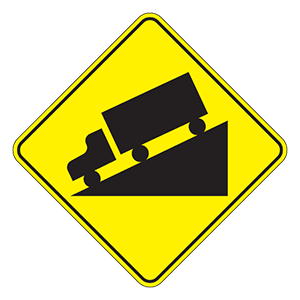
This sign means:
Trucks entering.
Truck exit only.
Steep downgrade ahead.
Q.31.
You just sold your vehicle. You must notify the DMV within ____ days.
Five
10
15
Q.32.
Before returning to your original lane after passing another vehicle, you should:
Beep your horn.
See both headlights of the passed vehicle in your rearview mirror.
Flash your headlights.
Q.33.
If you are driving near a large commercial vehicle, you should:
Follow the large vehicle closely to reduce wind drag on your vehicle.
Avoid driving beside it for long stretches of time.
Drive on its right side when on curves and hills.
Q.34.
If you are involved in a traffic collision, you are required to complete and submit a written report to the DMV:
Only if you or the other driver is injured.
If there is property damage in excess of $1,000 or if there are any injuries.
Only if you are at fault.
Q.35.
Always stop before crossing railroad tracks when:
There isn't room on the other side for you to completely cross the tracks.
The railroad crossing is located in a city or town that has frequent train traffic.
You are transporting two or more young children in a passenger vehicle.
Q.36.
When you see this yellow sign, you should:
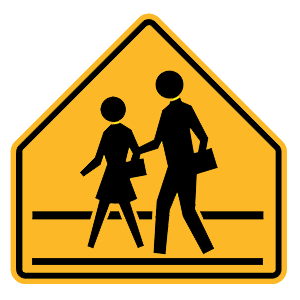
Always stop at the crosswalk.
Stop at the crosswalk until a crossing guards signals for you to go.
Be prepared to stop if children are in the crosswalk.
Support mcqgeeks.com by disabling your adblocker.
×
Please disable the adBlock and continue.
Thank you.
Reload page