MCQGeeks
CBSE
JEE
NTSE
NEET
English
UK Quiz
Quiz
Driving Test
Practice
Games
Driving Test
California
California Motorcycle Driving Permit Test-13
Answers
Q.1.
When riding with a group of motorcyclists, a staggered formation:
Is recommended at all times.
Should not be used when entering or exiting a highway.
Should be used when riding in curves.
Q.2.
When wearing a helmet at the time of a crash, a rider is:
Less likely to survive than a person who is not wearing helmet.
Just as likely to survive as a person not wearing a helmet.
More likely to survive than a person not wearing helmet.
Q.3.
A primary cause of single-vehicle motorcycle collisions is:
Motorcyclists' tendency to ride too fast for weather conditions.
Motorcyclists turning too wide in a curve or turn.
Motorcyclists running off the road while trying to avoid a collision with another vehicle.
Q.4.
To minimize the potential for fatigue on a long trip, you should:
Drink coffee.
Limit your riding per day.
Play loud music.
Q.5.
A good way to handle a tailgater is to:
Encourage the tailgater to pass by slowing down or changing lanes.
Speed up to put distance between you and the tailgater.
Ignore the tailgater.
Q.6.
Which of the following statements is true?
The front brake is more powerful than the rear brake.
The rear brake is more powerful than the front brake.
Both the front and rear brakes are equally powerful.
Q.7.
A "wobble," or a sudden shaking of the front wheel and handle bars, can usually be traced to:
Incorrect tire pressure or uneven loading.
Improperly tightening the front wheel to the frame.
Hitting an object with the front tire.
Q.8.
If your motorcycle begins to weave while you are riding over rain grooves or bridge gratings, you should:
Speed up to get over the surface faster.
Exaggerate the zigzag motion to get the attention of other drivers.
Maintain a steady speed and ride straight across the grooves or gratings.
Q.9.
Whichever style of helmet you choose, you will get the most protection by ensuring that your helmet:
Fits snugly.
Is clean.
Looks cool.
Q.10.
When slowing or stopping a motorcycle, you should:
Not change gears.
Shift up through the gears.
Shift down through the gears.
Q.11.
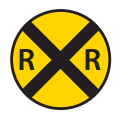
What does this sign mean?
Railroad crossing ahead
Yield
Reduce speed
Q.12.
Use your mirrors when stopping at an intersection:
To determine if drivers behind you are aware that you are stopping.
To watch for pedestrians ahead.
To look for dark clouds that may indicate poor weather conditions.
Q.13.
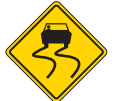
What does this sign mean?
Slippery when wet
Lanes shift
Yield
Q.14.
When entering a curve, you should always position your motorcycle:
On the left side of the lane.
In a position that allows you to most effectively see and be seen.
In the center of the lane.
Q.15.
If you borrow a motorcycle, you should:
Assume all controls are in the same location as they are on your motorcycle.
Immediately take it out on the highway.
Get familiar with it in a controlled area.
Q.16.
When starting your motorcycle, the engine should be in:
First gear.
Neutral.
Third gear.
Q.17.
When entering a turn, you should:
Slow down.
Speed up.
Come to a complete stop.
Q.18.
When selecting a jacket that will be used as protective apparel, a motorcycle rider should look for a jacket that is:
Black, or another dark color.
Warm.
Made of leather or synthetic materials.
Q.19.
When passing a row of parked cars, you should:
Ride on the left side of the lane.
Ride wherever you are most comfortable.
Ride in the right portion of the lane.
Q.20.
When riding at night:
Ride on the shoulder of the road.
Decrease your following distance.
Increase your following distance.
Q.21.
Mirrors on motorcycles:
Have blind spots, just like cars.
Do not have blind spots because a motorcycle is usually smaller than a car
Are not required.
Q.22.
When making a U-turn:
The front and rear brakes need to be used at the same time.
Do not use the front brake because it could cause the bike to tip over.
Use the front brake to increase stability of the motorcycle.
Q.23.
If you get a flat tire while riding, you should:
Hold the handle grips firmly and stay off the brakes.
Shift your weight toward the good wheel and brake normally.
Brake on the good wheel while immediately pulling off the road.
Q.24.
When riding near a truck:
If you cannot see the truck’s mirrors, the driver cannot see you.
You should not be able to see the truck’s mirrors.
You should concentrate on operating your motorcycle and not worry about the truck’s mirrors.
Q.25.
Motorcycles may pass on the right:
If there is at least eight feet of unobstructed pavement.
By riding on the shoulder of the road.
By riding on the grass, if it is level.
Q.26.
To reduce the chances of a collision, you should:
Wear bright or reflective clothing.
Change lanes frequently.
Focus only on your riding, not on your surroundings.
Q.27.
When riding at night:
Only ride in the left portion of the lane to better see around other vehicles ahead.
Ride closely to the vehicle in front of you to most effectively use their headlights.
Reduce your speed to increase your chances of avoiding an unexpected hazard.
Q.28.
If a sign prohibits the use of a moped on a freeway:
Mopeds cannot be used on the freeway.
Mopeds can only be used on the freeway when traffic is moving smoothly.
Mopeds can be used on the freeway if they are not operated at speeds faster than 25 mph.
Q.29.
When approaching an intersection, a motorcyclist should not:
Choose a lane position that increases their visibility.
Speed up to cross the intersection quickly.
Cover the clutch and brakes to reduce their reaction time.
Q.30.
The front brake supplies about how much of a motorcycle's potential stopping power?
About one-quarter
About one-half
About three-quarters
Support mcqgeeks.com by disabling your adblocker.
×
Please disable the adBlock and continue.
Thank you.
Reload page