MCQGeeks
CBSE
JEE
NTSE
NEET
English
UK Quiz
Quiz
Driving Test
Practice
Games
Driving Test
California
California Motorcycle Driving Permit Test-3
Answers
Q.1.
Which factor does not play a major role in affecting your blood alcohol content (BAC)?
Age
The amount of alcohol consumed
Body weight
Q.2.
When you are being passed on the left, you should:
Speed up.
Ride in the right portion of the lane.
Ride in the center portion of the lane.
Q.3.
When approaching a blind intersection, riders should:
Stop at the stop line before moving forward to improve their view of cross traffic.
Ignore the stop line and move forward to get a better look.
Stop at the stop line then proceed through the intersection.
Q.4.
Stopping in a turn can be difficult because:
There is decreased traction available for stopping while the bike is leaning.
The rider is usually focused on the turn and not on the braking.
The brake controls do not work in turns.
Q.5.
The proper action to take when riding an unfamiliar motorcycle for the first time is to:
Just start riding. There is no better way to learn than by doing.
Just start riding. Most bikes are similar, so you don’t have to take the time to identify safety features.
Work the throttle, clutch, and brakes before riding to learn the bike's gear pattern.
Q.6.
If you have a passenger aboard your motorcycle, you should do all of the following, except:
Ride at speeds that are slower than usual.
Allow more distance to stop than usual.
Tell the passenger to hold onto the back of the bike.
Q.7.
A rider's boots or shoes should:
Be below their ankles.
Cover their ankles.
Be made of a soft, pliable material.
Q.8.
Which of the following materials provides the best protection for motorcycle riders?
Fleece
Leather
Denim
Q.9.
The safest part of the lane:
Is always the left portion of the lane.
Is always the right portion of the lane.
Changes depending on the situation.
Q.10.
You should flash your brake light to:
Tell other motorists that you are riding near them.
Help other motorists see your motorcycle while traveling in slow traffic.
Tell other motorists that you are going to slow down or stop where they don't expect you to do so.
Q.11.
When traveling at night, you should:
Ride as fast as you would if riding during the day.
Ride more slowly than you would if riding during the day.
Ride faster than you would if riding during the day.
Q.12.
For motorcycle operators, eye protection is:
Required.
Not required, but recommended.
Not recommended.
Q.13.
Your motorcycle should fit you, meaning:
Your fingertips should barely reach the handlebars when you are seated on the motorcycle.
The seat should be one foot higher than your waist when you are standing next to the motorcycle.
Your feet should comfortably reach the ground when you are seated on the motorcycle.
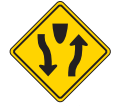
Q.14.
What does this sign mean?
Signal ahead
Crossroad ahead
Divided roadway ahead
Q.15.
If your motorcycle starts to weave while riding over uneven metal bridge gratings, you should:
Downshift immediately to a lower gear.
Proceed in a zigzag pattern until you cross the bridge.
Relax and steer straight.
Q.16.
When riding, your feet should be:
On the gas tank.
Hanging loosely.
On the footrests.
Q.17.
If your motorcycle begins to weave while you are riding over rain grooves or bridge gratings, you should:
Speed up to get over the surface faster.
Exaggerate the zigzag motion to get the attention of other drivers.
Maintain a steady speed and ride straight across the grooves or gratings.
Q.18.
The operator of any motor vehicle involved in a collision resulting in more than $1,000 worth of property damage must:
File a report, but only if planning to report the accident to their insurance company.
Submit a report of the accident to the DMV.
Contact the highway department.
Q.19.
A plastic, shatter-resistant face shield:
Protects your face, but not your eyes.
Protects your eyes, but not your whole face.
Helps protect your whole face.
Q.20.
Lanes of traffic moving in the same direction are separated by:
White lines.
Yellow lines.
Road signs.
Q.21.
When attempting to pass another vehicle, you should:
Ride within the posted speed limits.
Exceed the posted speed limit to complete the pass, but not by more than 10 mph.
Pass more than one vehicle at a time.
Q.22.
To reduce the chances of a collision, a motorcycle rider should:
Maintain an adequate space cushion.
Ride very slowly.
Ride the centerline.
Q.23.
Helmets are:
Required for all riders.
Not required, but recommended.
Only required for inexperienced motorcycle users.
Q.24.
When sitting on a motorcycle, your arms should:
Have a large bend at the elbow when reaching for the handle grips.
Be slightly bent when holding the handle grips.
Be fully extended when reaching for the handle grips.
Q.25.
Noise created by wind:
Is easy to get used to.
May cause irreversible hearing damage.
Is never a danger.
Q.26.
When wearing a jacket for protection, the jacket should:
Be loose-fitting and flap in the wind while riding.
Fit snugly.
Be uncomfortable.
Q.27.
Which of the following is not a factor in determining a person's blood alcohol content (BAC)?
The amount of alcohol consumed
How quickly the alcohol is consumed
How often the person consumes alcohol
Q.28.
What can remove alcohol from a person's system?
Time
Coffee
Exercise
Q.29.
A flat front tire is especially dangerous because:
The front tire affects your steering, which also affects your balance.
The front tire being flat will disable the front brake.
The front tire being flat will prevent you from accelerating.
Q.30.
If your front wheel locks while you are stopping, you should:
Continue to apply the front brake.
Release the front brake and only use the rear brake.
Immediately release the front brake, then re-apply the brake firmly.
Support mcqgeeks.com by disabling your adblocker.
×
Please disable the adBlock and continue.
Thank you.
Reload page