MCQGeeks
CBSE
JEE
NTSE
NEET
English
UK Quiz
Quiz
Driving Test
Practice
Games
Driving Test
Colorado
Colorado Car Driving Permit Test-16
Answers
Q.1.
Seat belts are most effective when they are worn by:
The person driving the car.
Passengers when they are on a long drive.
All occupants of a car being driven on an expressway.
All occupants of a car every time the car is driven.
Q.2.
It is important to be alert to motorcycles because:
They are more difficult to see than cars.
They rarely use their headlights.
Motorcyclists are less skilled drivers than other motorists.
All of the above.
Q.3.
If you are driving on the interstate and pass your exit, you should:
Quickly cut across traffic to make your turn.
Make a U-turn to go back to the exit.
Continue driving and use the next exit.
Put your vehicle in reverse to go back to the exit.
Q.4.
A driver should be extra alert to motorcyclists, bicyclists, and pedestrians because:
They’re difficult to see in traffic.
They obey different traffic laws than larger motor vehicles.
They always have the right-of-way.
They don’t have rearview mirrors.
Q.5.
Which is the most common cause of traffic crashes?
New drivers
Human error
Bad weather
Bad roads
Q.6.
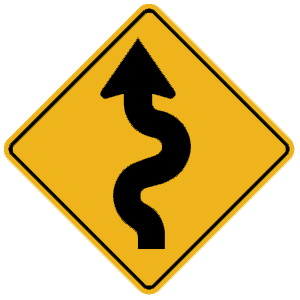
This sign tells you that:
No turns are allowed on this road.
The road narrows ahead.
There are a series of curves ahead.
The road may be slippery when wet.
Q.7.
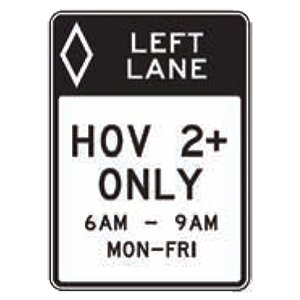
This road sign means:
The left lane is reserved for vehicles with a specific number of occupants.
Specific turning movements are allowed from specific lanes.
Do not enter.
Drivers in both lanes are responsible for merging smoothly.
Q.8.
Regulatory signs:
Are placed in every location where there is a present danger.
Indicate what a driver must or must not do.
Are diamond-shaped and yellow or green.
May warn drivers that they are approaching a school zone.
Q.9.
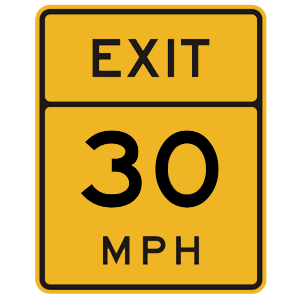
This road sign indicates:
The maximum safe speed for a residential area.
The maximum safe speed for an expressway exit.
The maximum safe speed for an expressway entrance.
The maximum safe speed for a work zone.
Q.10.
When changing lanes, you can check your blind spots by:
Using the inside rearview mirror.
Using the outside rearview mirror.
Using both inside and outside rearview mirrors.
Turning your head and looking over your shoulder.
Q.11.
The most common color of warning signs is:
Red.
Yellow.
Green.
Blue.
Q.12.
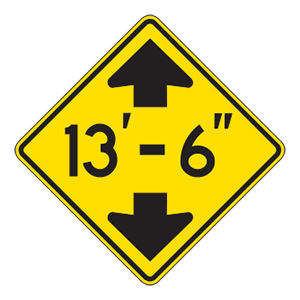
This sign means:
Low clearance.
Fines double in a work zone.
No left turn.
Do not block intersection.
Q.13.
A passenger in a moving motor vehicle is not permitted to:
Use a cell phone.
Have an opened alcohol container.
Sleep.
Use a map.
Q.14.
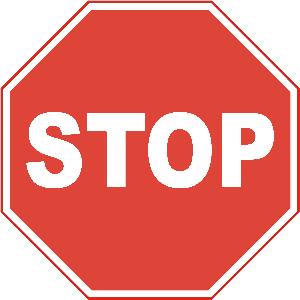
What does this road sign mean?
Slow down and prepare to stop if cars are approaching you.
Come to a full stop and go when it is safe to do so.
Proceed carefully through the intersection, not always stopping.
Stop only for traffic on an intersecting road.
Q.15.
If one of your tires blows out as you are driving, you should:
Brake hard immediately.
Try to steer straight while gradually slowing by removing your foot from the gas pedal.
Maintain your current speed and steer straight.
Swerve back and forth to alert traffic behind you.
Q.16.
When you want to make a right turn, your car must be:
Near the center of the street.
Close to the left side of the street.
Close to the right side of the street.
Past the center of the intersection when you begin to turn.
Q.17.
When driving in bad weather, drivers should:
Increase their speed to reach their final destination more quickly.
Decrease their following distance.
Increase their following distance.
None of the above.
Q.18.
Traffic signs and pavement markings:
Must always be obeyed.
Are merely suggestions.
Must be followed only when there is other traffic.
Must be followed only when a police officer is present.
Q.19.
Drivers must yield to a pedestrian:
Even if the pedestrian crosses the street carelessly.
Only when the pedestrian is in a crosswalk.
Only if the pedestrian is on the same side of the road as the driver.
If the pedestrian uses a hand signal to ask oncoming drivers to stop.
Q.20.
You may cross double solid yellow lines:
To pass a slow-moving truck.
To turn into a driveway.
To pass another car.
Under no conditions.
Q.21.
Unless otherwise posted, the speed limit is ____ on narrow, winding mountain highways.
70 mph
55 mph
40 mph
20 mph
Q.22.
What does a single dashed yellow line separating traffic mean?
Drivers may pass if it is safe to do so.
Both lanes travel in the same direction.
Drivers may not pass.
Drivers may pass, even if it could be dangerous.
Q.23.
Increasing your vehicle’s speed:
Increases your field of vision.
Decreases your field of vision.
Makes it easier to see cross traffic.
Has no effect on your field of vision.
Q.24.
Driving while being distracted by any activity:
Is never dangerous.
Usually causes the driver to react more slowly to hazards.
Usually causes the driver to drive faster.
Is only dangerous for young drivers.
Q.25.
A good defensive driver:
Drives slowly at all times.
Looks out for the actions of other drivers.
Travels at a constant speed.
Only drives in familiar areas.
Support mcqgeeks.com by disabling your adblocker.
×
Please disable the adBlock and continue.
Thank you.
Reload page