MCQGeeks
CBSE
JEE
NTSE
NEET
English
UK Quiz
Quiz
Driving Test
Practice
Games
Driving Test
Colorado
Colorado Car Driving Permit Test-21
Answers
Q.1.
If you need to slow down while driving on a slippery road, the first thing you should do is:
Firmly apply your brakes.
Take your foot off the gas pedal.
Apply your parking brake.
Pump your brakes.
Q.2.
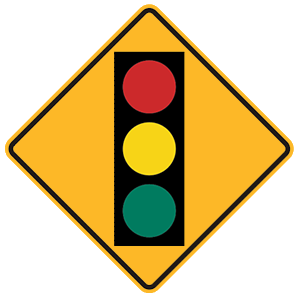
This sign means:
Continue at your current speed.
You must stop ahead.
Speeding is not allowed.
There is a traffic signal ahead.
Q.3.
Motorcycles are entitled to:
The bicycle lane.
The same full lane width as other motor vehicles.
Half the width of a lane.
The width of the sidewalk.
Q.4.
If you drink alcohol socially, what helps ensure safe driving?
Drink coffee before driving.
Ride home with a friend who has not been drinking.
Take a cold shower before driving.
Stop drinking one half hour before driving.
Q.5.
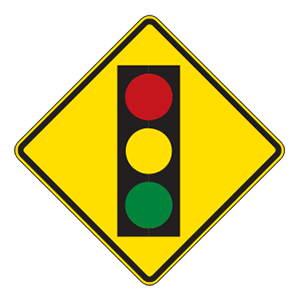
This sign means:
Traffic signal.
Fire station.
T intersection.
Left turn signal.
Q.6.
What color are pavement markings that separate traffic lanes moving in opposite direction?
Yellow
White
Yellow and white
Yellow, white, and black
Q.7.
When sharing the road with a truck, it is important to remember that trucks generally:
Require longer distances to stop than smaller vehicles do.
Require less time to pass on a downgrade than smaller vehicles do.
Require a smaller turning radius than smaller vehicles do.
Require less time to pass on an incline than smaller vehicles do.
Q.8.
How can you lower the risk of hydroplaning?
Do not speed when the roads are wet.
Use tires with proper air pressure.
Replace tires with bad tread.
All of the above.
Q.9.
Road rage and aggressive driving may be reduced by:
Allowing extra travel time.
Obeying posted speed limits.
Using proper turn signals.
All of the above.
Q.10.
When parking uphill on a hill or incline with a curb:
Turn your front wheels sharply toward the curb.
Turn your front wheels slightly to the right.
Turn your front wheels sharply away from the curb.
Keep your front wheels straight.
Q.11.
When approaching a steady yellow traffic light, drivers should:
Accelerate to avoid a red light.
Continue driving, as they have the right-of-way.
Slow to a stop, unless they are already within the intersection.
Check to see what the cars next to them are doing.
Q.12.
You may pass another vehicle if the line dividing your lane from the lane you wish to enter is a ____ line.
Broken white
Double solid yellow
Solid yellow
Solid white
Q.13.
If a vehicle using high beams comes toward you, you should look toward ____ of the road.
Either side
The center
The right side
The left side
Q.14.
You must yield for emergency vehicles:
Under no circumstances.
When you see a flashing red or blue light or hear a siren.
Only when other vehicles yield.
None of the above.
Q.15.
To enter a freeway:
Signal, yield to existing traffic, and enter at the same speed that traffic is moving.
Signal and enter the freeway. Freeway traffic must yield.
Drive slowly so you can check traffic.
Always come to a complete stop first.
Q.16.
If you reach an intersection where you wish to turn but you are not in the proper lane, you should:
Quickly cut across traffic to make your turn.
Turn on your blinker and make the turn from your current lane.
Drive to the next intersection and make your turn then.
Safely change lanes then put your vehicle in reverse to go back to the intersection.
Q.17.
If a High Intensity Activated Crosswalk (HAWK) signal is solid red, it means:
Drivers may proceed with caution.
Drivers should slow down and prepare to stop.
Drivers should come to a complete stop.
There are no pedestrians nearby.
Q.18.
When making a turn, you must ____ your speed.
Increase
Maintain
Vary
Reduce
Q.19.
Before switching on the ignition, you should:
Be sure only backseat passengers have buckled their seat belts.
Be sure only adult passengers have buckled their seat belts.
Be sure only child passengers have buckled their seat belts.
Be sure all of the vehicle's occupants have buckled their seat belts.
Q.20.
Railroad crossings should always be considered:
Safe to cross, as it is unlikely that a train will be coming.
Dangerous.
Safe locations to park a car.
A place where it is required to stop
Q.21.
“Highway hypnosis” is a driving condition that can result from:
Staring at the roadway for long periods of time.
Frequent rest stops.
Too much sleep the night before your trip.
Short trips on expressways.
Q.22.
If an approaching train is near enough or going fast enough to be a danger, you must:
Slow down and proceed with caution.
Not cross the tracks until the train has completely passed.
Cross the tracks at your own risk.
Find an alternative route across tracks.
Q.23.
As alcohol builds up in your blood, it:
Slows down your reactions.
Makes you feel less confident.
Begins to metabolize itself more quickly.
Decreases the number of driving errors.
Q.24.
To turn left from multilane, one-way streets and highways, you should start from:
The middle of the intersection.
The right lane.
The left lane.
Any lane.
Q.25.
You are entering a crowded freeway. What should you do to merge into traffic?
Use your side and rearview mirrors and check your blind spots.
Use the acceleration lane to adjust your speed to match the speed of freeway traffic.
Yield to traffic already on the freeway.
All of the above.
Support mcqgeeks.com by disabling your adblocker.
×
Please disable the adBlock and continue.
Thank you.
Reload page