MCQGeeks
CBSE
JEE
NTSE
NEET
English
UK Quiz
Quiz
Driving Test
Practice
Games
Driving Test
Colorado
Colorado Car Driving Permit Test-24
Answers
Q.1.
This sign means:
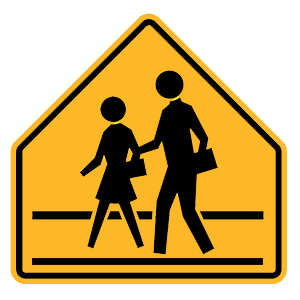
Pedestrians only.
Intersection ahead.
Hiking trails ahead.
School crossing ahead.
Q.2.
A diamond-shaped sign:
Warns of existing or possible hazards.
Alerts drivers to school zones.
Alerts drivers to public recreation areas.
Alerts drivers to upcoming food and gas locations.
Q.3.
A driver entering interstate traffic from an entrance or acceleration ramp:
Should yield to drivers already on the interstate.
Has the right-of-way.
May force their way into traffic.
Can assume that other drivers will change lanes to make room.
Q.4.
At a light rail intersection, always:
Look both ways before crossing tracks.
Pay attention and obey all traffic signals.
Share the road with pedestrians and bicyclists.
All of these.
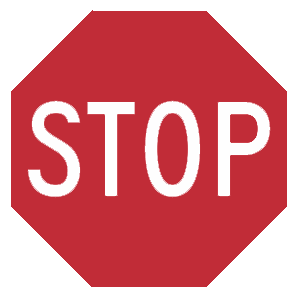
Q.5.
This road sign means:
Slow down or stop.
Stop, if necessary.
You must come to a complete stop.
Drive with caution and be ready to stop.
Q.6.
Compared to driving during the day, driving at night is:
Less dangerous.
No more or less dangerous.
More dangerous.
Easier on your eyes.
Q.7.
Emergency vehicles:
Have the right-of-way when using sirens, horns, and/or flashing lights.
May use a loudspeaker to give instructions.
May follow each other.
All of the above.
Q.8.
At night, it is hardest to see:
Road signs.
Pedestrians.
Other motorists.
Street lights.
Q.9.
Which is not a factor in determining the distance that it takes to stop your vehicle?
Steering ability
Braking distance
Reaction distance
Perception time
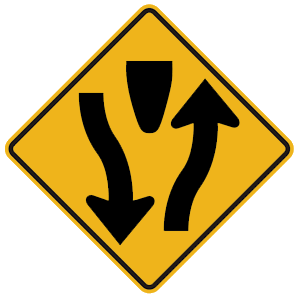
Q.10.
This sign means:
A divided highway ends.
A one-way street begins.
A one-way street ends.
A divided highway begins.
Q.11.
When is it illegal to drive below the speed limit?
When driving slowly disrupts the normal flow of traffic
When in heavy traffic in a construction zone
Only when driving in rural areas.
When driving under adverse weather conditions
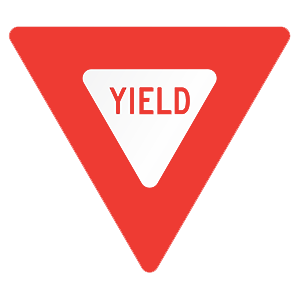
Q.12.
This sign means:
Slow down if an emergency vehicle is approaching.
Look both ways as you cross the intersection.
Always come to a full stop at the intersection.
Slow down and be prepared to stop if necessary.
Q.13.
You are making a left turn from a two-way street onto a one-way street. When you have completed the turn, your car should be:
In the right lane of the street.
In the center of the street.
In the left lane of the street.
In the lane with the least traffic.
Q.14.
Who must yield when a driver is turning and a pedestrian is crossing without a traffic light?
Whoever started moving last
The driver
Whoever is slower
The pedestrian
Q.15.
If your vehicle begins to skid, you should:
Overcorrect.
Turn your steering wheel into traffic.
Turn your steering wheel in the direction you want to go.
Release the steering wheel.
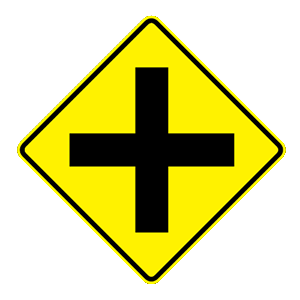
Q.16.
This road sign means:
A steep grade is ahead.
You must turn left ahead.
Do not enter.
A four-way intersection is ahead.
Q.17.
You must stop at an intersection when you see a:
Flashing red light.
Steady yellow light.
Yellow arrow.
Flashing yellow light.
Q.18.
This sign means:
Lane ends.
No right turn.
Slippery when wet.
Two-way traffic.
Q.19.
This road sign means:
Bicycle crossing.
Stop only if other cars are approaching.
Bicycle store.
Soft shoulders.
Q.20.
Alcohol:
Slows reflexes and reaction time.
Puts you to sleep.
Wakes you up.
Improves your judgment.
Q.21.
When passing other vehicles:
Check your mirrors and blind spots.
Honk your horn at least three times.
Re-enter your lane within 10 feet of the passed vehicle.
There is no need to signal.
Q.22.
A broken yellow line alongside a solid yellow line means:
Passing on the left is permitted from either direction.
Passing is permitted from the lane next to the broken line.
Passing is permitted from the lane next to the solid line.
Passing is not allowed from either direction.
Q.23.
If a green arrow turns into a solid green light, you:
May still turn, but you must yield to oncoming traffic.
May no longer turn and must proceed straight.
Still have the right-of-way to turn.
No longer have to turn in the direction that the arrow indicated.
Q.24.
You are driving when your power steering stops working. You should:
Honk your horn and turn off the ignition.
Turn on your hazard lights and brace yourself.
Work hard to steer, reduce your speed, drive to a safe area, and stop.
Slam on your brakes.
Q.25.
When driving on wet pavement, it's important to remember:
That pavement is especially slippery right after it starts to rain.
That wet roads can cause hydroplaning.
To give yourself additional space when coming to a stop.
All of the above.
Support mcqgeeks.com by disabling your adblocker.
×
Please disable the adBlock and continue.
Thank you.
Reload page