MCQGeeks
CBSE
JEE
NTSE
NEET
English
UK Quiz
Quiz
Driving Test
Practice
Games
Driving Test
Colorado
Colorado Motorcycle Driving Permit Test-6
Answers
Q.1.
When it starts to rain, it is usually best to:
Increase your speed.
Exit the road.
Ride in the tire tracks left by cars.
Ride in the center of the lane.
Q.2.
When riding at night, you should:
Decrease your following distance.
Increase your following distance.
Ride faster than you usually would.
Avoid using your high beam headlight.
Q.3.
If your friend has been drinking alcohol, it is a good idea to do any of the following, except:
Arrange for a safe ride home for your friend.
Occupy your friend with activities to distract them from drinking.
Keep your friend from leaving until they are sober.
Allow your friend to ride their motorcycle.
Q.4.
Where is the clutch lever usually located?
On the left handgrip
On the right handgrip
Near the left footrest
Near the right footrest
Q.5.
It is important to flash your brake light when:
Approaching a police officer.
Someone is following too closely.
There is a stop sign ahead.
Your signals are not working.
Q.6.
When braking, you should use:
The front brake only.
The rear brake only.
Both front and rear brakes.
Either the front or rear brake, but not both.
Q.7.
To lessen your chances of being involved in a crash, you should:
Be visible to other drivers.
Keep your intentions unknown from other drivers.
Always stay within a foot of another vehicle.
Ride on the shoulder.
Q.8.
When entering a turn, a rider should:
Speed up.
Reduce their speed.
Move their shoulders to match the angle of the turn.
Sit up as high as possible.
Q.9.
When an operator's left arm is extended straight out to the left, it means the operator:
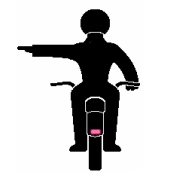
Plans to turn left.
Is about to stop.
Plans to turn right.
Is about to slow down.
Q.10.
Maintain an adequate following distance behind other vehicles:
To allow you time and space to identify and react to hazards.
So you can tailgate.
To allow for traffic counters to accurately count you as a vehicle.
To encourage other drivers to cut you off.
Q.11.
Which of the following is not an example of a slippery surface?
A dirt or gravel road
A strip of oil in the center of a lane
Mud on pavement
Dry pavement
Q.12.
Before carrying a passenger in traffic for the first time, you should:
Read books about carrying passengers.
Practice riding on an empty road.
Flash your lights so others can see you.
Practice riding on the shoulder of a road.
Q.13.
To prevent getting fatigued on a long ride, you should do all of the following, except:
Dress warmly.
Limit the distance traveled in a day.
Take frequent rest breaks.
Take artificial stimulants.
Q.14.
Reflective material on your helmet:
Helps you to be seen.
Is not allowed.
Should only be used at night.
Does not help you to be seen.
Q.15.
When braking, you should use:
Only the front brake.
Only the rear brake.
Both brakes.
Either brake, but never both at the same time.
Q.16.
When going through a turn on a motorcycle, you should:
Keep your eyes focused close to the front of the motorcycle.
Look through the turn to where you want to go.
Turn your entire body to see through the turn.
Increase your speed before the turn.
Q.17.
When riding in a group, inexperienced riders should ride:
In the front of the group.
Right behind the leader.
At the back of the group.
Wherever they are most comfortable.
Q.18.
When approaching railroad tracks that cross your lane at an angle, it is usually:
Safest to ride straight within your lane to cross the tracks.
Dangerous to ride straight within your lane to cross the tracks.
Not safe to cross tracks on a motorcycle.
Safest to cross the tracks by riding on the shoulder of the road.
Q.19.
Most crashes happen:
At speeds greater than 55 mph.
After several hours of riding.
On short trips.
On long trips.
Q.20.
A plastic, shatter-resistant face shield:
Is not necessary if you have a windshield.
Only protects your eyes.
Helps protect your whole face.
Does not protect your face as well as goggles.
Q.21.
If you are not traveling slowly enough when shifting into a lower gear, the:
Motorcycle could lurch and the rear tire could skid.
Motorcycle could accelerate too quickly.
Front tire will likely skid.
Engine will make a loud noise.
Q.22.
The faster you drink:
The more the alcohol will accumulate in your body.
The faster the alcohol is removed from your body.
The more minimal the effects of the alcohol will be.
The more likely you will be able to evade being pulled over.
Q.23.
When selecting footwear, you should choose:
Shoes with long heels.
Shoes with long laces that cannot be tucked in.
Shoes that cover your ankles.
Shoes that are made from flimsy materials.
Q.24.
When riding in fog, you should:
Use your high beam headlight.
Use your low beam headlight.
Use no lights.
Alternate between the low and high beams.
Q.25.
If you wait an hour per alcoholic drink before you ride your motorcycle:
You cannot be arrested for drinking and riding.
Your skills will not be affected.
Side effects may still remain.
You will be fine as long as you ride slowly.
Support mcqgeeks.com by disabling your adblocker.
×
Please disable the adBlock and continue.
Thank you.
Reload page