MCQGeeks
CBSE
JEE
NTSE
NEET
English
UK Quiz
Quiz
Driving Test
Practice
Games
Driving Test
Connecticut
Connecticut Car Driving Permit Test-12
Answers
Q.1.
When driving in fog, rain, or snow, use:
Low beams.
High beams.
Fog lights only.
Q.2.
If you are getting tired while driving, you should:
Stop and either get rest or change drivers.
Drink something with caffeine.
Open a window.
Q.3.
On a multilane road, a dashed yellow line next to a solid yellow line means:
Passing is prohibited from both directions.
Passing is permitted from both directions.
Passing is permitted only from the direction next to the dashed line.
Q.4.
Which statement is true?
You should put on your cruise control near a railroad crossing to maintain a constant speed.
You must stop at a railroad crossing when directed to do so by a flagger or stop sign.
You have the right-of-way at a railroad crossing and do not need to stop.
Q.5.
A blood alcohol concentration of 0.percent:
Won't have any effect on your driving.
Won't put other drivers at risk.
Will double your chances of having an accident.
Q.6.
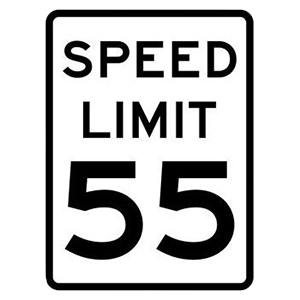
This road sign means:
You must travel through the intersection at the posted speed limit.
The maximum speed limit under ideal conditions is 55 mph.
You must not travel below the speed indicated.
Q.7.
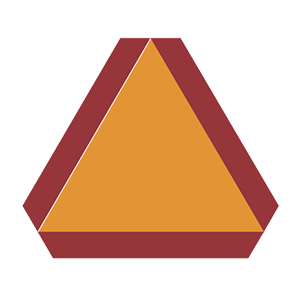
This sign means:
Slow-moving vehicle.
Road construction/maintenance area.
Traffic signal ahead.
Q.8.
A curb painted red means:
Loading zone.
The area is reserved for picking up or dropping off passengers.
No parking, standing, or stopping.
Q.9.
What is the purpose of rumble strips?
They alert drivers to potential tire problems.
They test a vehicle's shock absorbers.
Through vibration and sound, they alert inattentive drivers to the fact that their vehicles have left the travel lane.
Q.10.
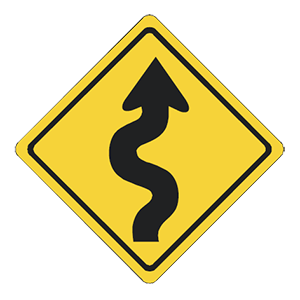
This sign means:
Winding road ahead.
Do not enter.
Pedestrian crossing.
Q.11.
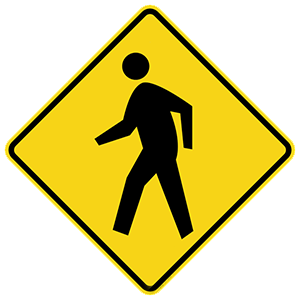
This sign means:
Pedestrians walking along the road ahead.
Pedestrian crossing ahead.
Pedestrians must not cross here.
Q.12.
If you find yourself in a skid:
Brake lightly.
Stay off the brakes.
Brake abruptly.
Q.13.
Yellow lines separate:
Traffic lanes on one-way streets.
Traffic moving in opposite directions on two-way roads.
All carpool lanes from regular traffic lanes.
Q.14.
When driving in work zones, you should:
Follow the driver in front of you closely.
Pass the driver in front of you as soon as you can.
Avoid tailgating and keep a safe following distance.
Q.15.
Having a driver license is a:
Right, not a privilege.
Privilege, not a right.
Requirement.
Q.16.
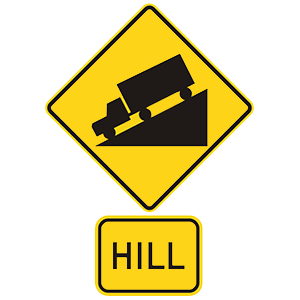
What does this road sign mean?
Falling rocks
Trucks use second gear
Steep hill
Q.17.
When a bicyclist is making a left turn:
They may use the left lane.
They may cut through all lanes.
They may wait on the side of the road.
Q.18.
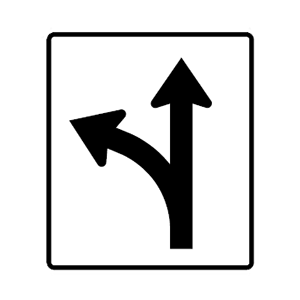
This sign means that you:
May only drive straight ahead.
Are approaching a divided highway.
May turn left or continue straight.
Q.19.
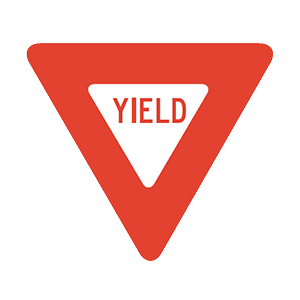
This sign means:
Cars on the right move first.
You have the right-of-way.
Let cross traffic pass before proceeding.
Q.20.
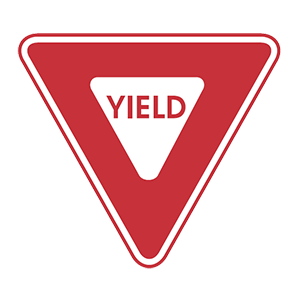
This sign is a:
Yield sign.
School crossing sign.
Stop sign.
Q.21.
You may pass a vehicle when:
You are on a hill or curve.
You are on a road with a solid line next to your lane.
You are on a road with a broken line next to your lane.
Q.22.
If you have had several beers, the effects of alcohol will be reduced only by:
Taking a cold shower.
Waiting several hours.
Drinking several cups of coffee.
Q.23.
If pedestrians are illegally crossing in the middle of the street instead of in a crosswalk, you:
Must stop for them.
Do not have to stop for them.
Should honk your horn at them.
Q.24.
The first thing that alcohol effects is:
Vision.
Judgment.
Balance.
Q.25.
Which of these statements is true about large trucks?
They take longer to stop than passenger vehicles.
They all have air brakes that allow them to stop quickly.
They are more maneuverable than passenger vehicles.
Support mcqgeeks.com by disabling your adblocker.
×
Please disable the adBlock and continue.
Thank you.
Reload page