MCQGeeks
CBSE
JEE
NTSE
NEET
English
UK Quiz
Quiz
Driving Test
Practice
Games
Driving Test
Connecticut
Connecticut Car Driving Permit Test-13
Answers
Q.1.
When driving on an interstate, to avoid traffic merging from on-ramps to your right, the best thing to do is to:
Change lanes to the left.
Slow down.
Maintain your speed and position.
Q.2.
When passing a row of parked vehicles, you should:
Be prepared for a person or vehicle to unexpectedly enter your lane.
Expect all other drivers and pedestrians to respect your right-of-way.
Drive closely to the parked vehicles to allow more room for moving traffic.
Q.3.
Trucks' blind spots are:
Directly behind the body.
On the immediate left of the cab.
Both on the immediate left of the cab and directly behind the body.
Q.4.
Fines for speeding in work zones:
Can be twice the amount of normal fines.
Are generally not enforced.
Can be argued in court.
Q.5.
When double solid yellow lines separate lanes of traffic:
Passing is permitted from the left.
Passing is permitted from the right.
Passing is not permitted from either direction.
Q.6.
When driving on the highway, consistently looking far ahead of your vehicle:
Helps you keep up with traffic.
Reduces the need for last-minute braking or turning.
Allows you to spot upcoming police officers.
Q.7.
To be able to turn quickly, your hands must be:
On opposite sides of the steering wheel.
Next to each other on the top of the steering wheel.
On the top and bottom of the steering wheel.
Q.8.
You should signal continuously while turning because it:
Is illegal to turn off your signal before completing a turn.
Lets other drivers know what your intentions are.
Is always unsafe to turn off a signal before completing a turn.
Q.9.
You see pedestrians near the road. You should:
Sound your horn and maintain your speed.
Speed up to clear the area quickly.
Slow down and pass with caution.
Q.10.
If you find that the roadway ahead of you is flooded, you should:
Slam on the brakes.
Not drive through the flooded area. Turn around and find another route.
Drive only in the center of the roadway.
Q.11.
When changing lanes, you should never:
Cross the centerline in an intersection.
Check your blind spots by looking over your left or right shoulder.
Check for other drivers moving into the same lane.
Q.12.
A solid yellow line next to a broken yellow line means that vehicles:
Driving in both directions may pass.
Next to the broken line may pass.
Next to the solid line may pass.
Q.13.
When driving near a distracted driver, you should give them plenty of space and maintain a safe following distance of at least:
One to two seconds.
Two to three seconds.
Three to four seconds.
Q.14.
It is dangerous to follow a motorcycle too closely because:
They do not follow the same rules as motor vehicles.
A motorcycle can stop much faster than a standard vehicle.
They brake more slowly than motor vehicles.
Q.15.
Only ____ can reduce blood alcohol content (BAC) and alcohol's effects on the body.
Drinking caffeine
Eating foods high in fat
Time
Q.16.
You hit a parked vehicle and can't find the owner. What must you do?
Call your insurance company when you get home.
Wait for the owner to return.
Leave a note with your name and address on the parked vehicle.
Q.17.
When passing, you should move back into the right lane when:
You are one vehicle length ahead of the passed vehicle.
You can see both headlights of the passed vehicle in your rearview mirror.
You are 50 feet ahead of the passed vehicle.
Q.18.
If you have an argument with another person and you are angry, you should:
Loudly play the radio while driving so you won’t think about your argument.
Take a few minutes to cool off before driving.
Drive on the interstate to let off steam.
Q.19.
Allow extra space in front of your vehicle when following a:
Station wagon.
Passenger vehicle.
Motorcycle.
Q.20.
Adjust your rearview and side mirrors:
Before you start driving.
Whenever you need to use them.
Before you get into the car.
Q.21.
If you experience a tire blowout:
Tap or pump the brakes.
Slow down gradually and use your brakes lightly.
Apply the brakes firmly and quickly.
Q.22.
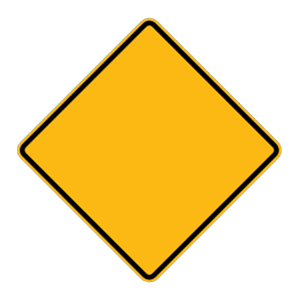
This sign is a:
Service sign.
Regulatory sign.
Warning sign.
Q.23.
When you see an emergency vehicle approaching while using its flashing lights, you must:
Maintain your speed and stay in your lane until the vehicle has passed.
Move into the right lane and drive slowly until the vehicle has passed.
Pull over to the curb or edge of the road and stop until the vehicle has passed.
Q.24.
If you come to an intersection and your view to the side is blocked, you should:
Slow down and look both ways.
Maintain your speed and look both ways.
Stop, then inch forward until you can see clearly in both directions.
Q.25.
When driving under low-visibility conditions due to fog, you should:
Turn on your high beam headlights.
Slow down and use your low beam headlights.
Increase your speed so you do not cause an accident.
Support mcqgeeks.com by disabling your adblocker.
×
Please disable the adBlock and continue.
Thank you.
Reload page