MCQGeeks
CBSE
JEE
NTSE
NEET
English
UK Quiz
Quiz
Driving Test
Practice
Games
Driving Test
Connecticut
Connecticut Car Driving Permit Test-16
Answers
Q.1.
As the percentage of alcohol (BAC) in your blood increases, you become:
More intoxicated.
More sober.
More coordinated.
Q.2.
If there are no reduced speed limit signs clearly posted within a work zone:
You should obey the normal speed limit.
You should drive 15 mph slower than the posted speed limit.
You should drive 15 mph faster than the posted speed limit.
Q.3.
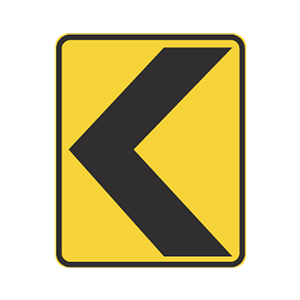
This sign means:
Change in direction or narrowing of roadway.
No right turn.
No passing zone.
Q.4.
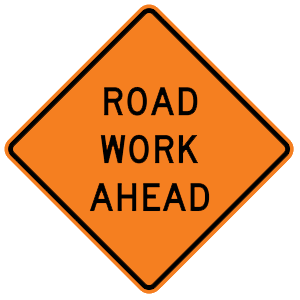
This road sign means:
Watch for people crossing your path.
No passing zone.
Work zone ahead.
Q.5.
If you park facing uphill on a street with a curb, set the parking brake and:
Turn the front wheels toward the curb.
Turn the front wheels away from the curb.
Leave the front wheels straight.
Q.6.
It is unlawful to:
Pass another vehicle in any marked no passing zone.
Pass another vehicle over a railroad crossing.
Both of the above.
Q.7.
Highway pavement will be particularly treacherous and most slippery:
If it has been raining several hours.
If it has just begun to rain.
If it has been raining for one to two hours.
Q.8.
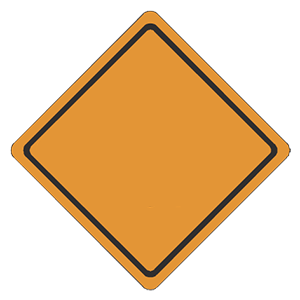
This sign means:
Do not enter.
Stop ahead.
Roadwork or maintenance is present.
Q.9.
Fatigue increases the risk of:
Missing an exit.
Being late for an appointment.
Falling asleep behind the wheel and crashing.
Q.10.
A U-turn is not permitted:
In a parking lot.
On or near any curve or hill.
On a straight roadway with a clear view for 500 feet in both directions.
Q.11.
Before stopping your vehicle at a traffic signal or sign, you should:
Press down hard on the accelerator.
Check your mirrors for surrounding traffic.
Set the parking brake.
Q.12.
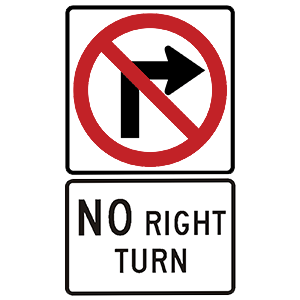
What does this road sign mean?
You must turn right.
No right turns permitted.
Right turns permitted on a red light.
Q.13.
A broken yellow centerline indicates that:
Passing is not permitted.
Passing on the right is permitted when the way ahead is clear.
Passing on the left is permitted when the way ahead is clear.
Q.14.
What is the only medically proven method of removing alcohol or other drug combinations from your system?
Breathe in some fresh air.
Give your body time.
Drink coffee.
Q.15.
When parking your vehicle on any hill:
One of your rear wheels should touch the curb.
Use your parking brake and leave the vehicle in "park."
Your front wheels should be parallel to the road, if there is no curb.
Q.16.
"No zones" are areas around trucks where cars:
Disappear into blind spots or are so close that they restrict the truck driver's ability to stop and maneuver safely.
Have sufficient space to travel behind the truck.
Have several car lengths between their vehicle and the truck.
Q.17.
You drive defensively when you:
Put one car length between you and the car ahead.
Look only at the car in front of you while driving.
Keep your eyes moving to look for possible hazards.
Q.18.
If you are feeling fatigued while driving, you should:
Increase your speed to reach your destination more quickly.
Increase the volume of your radio.
Find a safe parking area to take a short nap.
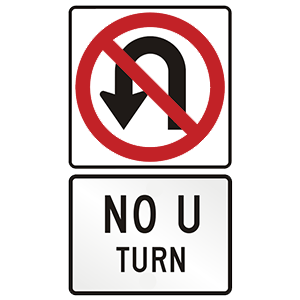
Q.19.
This sign means:
No U-turn.
No turning.
No left turn.
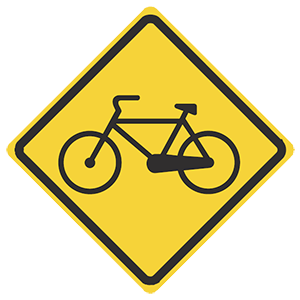
Q.20.
This sign means:
Watch for bicycles.
Bicycles not allowed.
Bicycle repair shop ahead.
Q.21.
When you are behind a motorcycle, you should:
Be ready to use your horn.
Drive more slowly.
Allow a larger following distance.
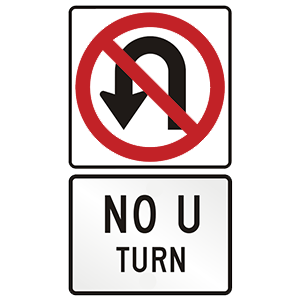
Q.22.
This road sign means:
Do not enter.
No parking.
No U-turn.
Q.23.
When changing lanes:
Rely on the rearview mirror.
Look over your shoulder in the direction you plan to move.
Rely on the left side mirror.
Q.24.
When you approach an octagonal sign, you must:

Slow.
Stop.
Turn.
Q.25.
When passing another vehicle, you should return to your original lane when:
You can see both headlights of the passed vehicle in your rearview mirror.
You have cleared the front bumper of the passed vehicle.
You are 50 feet in front of the passed vehicle.
Support mcqgeeks.com by disabling your adblocker.
×
Please disable the adBlock and continue.
Thank you.
Reload page