MCQGeeks
CBSE
JEE
NTSE
NEET
English
UK Quiz
Quiz
Driving Test
Practice
Games
Driving Test
Connecticut
Connecticut Car Driving Permit Test-22
Answers
Q.1.
When driving on packed snow, you should reduce your speed by:
One-third.
One-quarter.
One-half.
Q.2.
This white sign means you should not pass other vehicles:
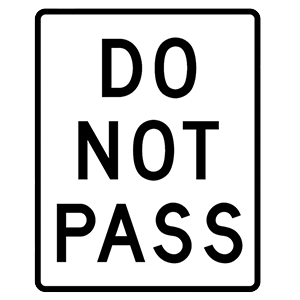
Until after you pass the sign.
Unless it seems safe to do so.
For any reason.
Q.3.
When entering an interstate highway, you should:
Stop, check for cars, and enter when safe.
Check for cars and reduce your speed to 25 mph before entering the traffic lane.
Check for cars, increase your speed to match the flow of traffic, and merge when the way is clear.
Q.4.
If you are driving and you see animals standing near the roadway:
Speed up to scare them away.
Slow down and proceed with caution.
Quickly swerve into the next lane.
Q.5.
When stopping on snow or ice, drivers who are operating vehicles equipped with an Anti-Lock Braking System (ABS) should:
Pump the brakes.
Press and hold the brake pedal firmly.
Stay off the brakes and wait for the car to drift to a stop.
Q.6.
If you see a pedestrian using a guide dog or carrying a white cane:
The pedestrian must yield the right-of-way.
You must yield the right-of-way.
Honk your horn to let them know you are there.
Q.7.
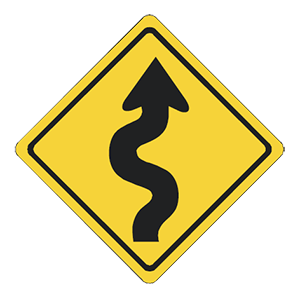
This sign means:
Winding road ahead.
Do not enter.
Pedestrian crossing.
Q.8.
To see objects in their blind spot when changing lanes, drivers should check:
Only the left outside mirror.
Over their left or right shoulder.
Only the inside rearview mirror.
Q.9.
You exit the freeway on a ramp that curves downhill. You should:
Slow to a safe speed before the curve.
Slow to the posted speed limit for the freeway.
Wait until you have entered the curve to begin braking.
Q.10.
When you see this sign, you should:
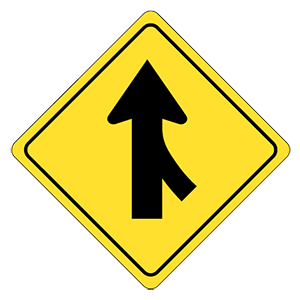
Watch for traffic merging from the right.
Merge right.
Turn left.
Q.11.
If you are arrested for a first time DUI offense and you refuse to take a breath test, your license will be suspended for at least:
14 days.
45 days.
21 days.
Q.12.
When arriving to an uncontrolled intersection at the same time as vehicles to your right and left, you should:
Yield the right-of-way to the vehicle on your left.
Yield the right-of-way to the vehicle on your right.
Wait until there are no vehicles at the intersection before proceeding.
Q.13.
You are driving on the freeway behind a large truck. You should drive:
Closer behind the truck than you would if following a passenger vehicle.
Farther behind the truck than you would if following a passenger vehicle.
To the right side of the truck and wait to pass.
Q.14.
When you see this sign, you should stop and:
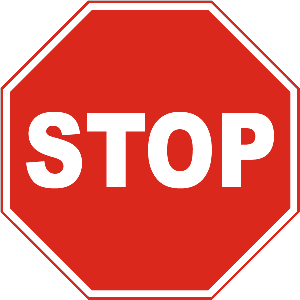
Check for vehicles only in the direction that you plan on going, then proceed.
Let all vehicles that arrive before or after you go first.
Check for traffic in all directions before proceeding.
Q.15.
You can drive off the road to pass another vehicle:
If the vehicle ahead is turning left.
If there are two or more lanes traveling in your direction.
Under no circumstances.
Q.16.
Drivers who areoryears of age are not permitted to use any type of:
Cell phone.
Text messaging device.
Both of the above.
Q.17.
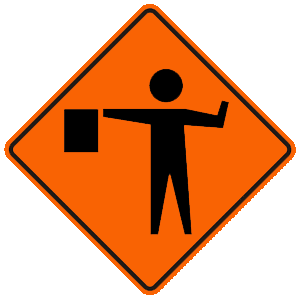
This sign tells a driver that:
A construction flagger is ahead.
A police officer is ahead.
A parking attendant is ahead.
Q.18.
Motorcycle/scooter/moped operators:
Are easy to see and are predictable.
Must share a traffic lane with another vehicle.
Have the right to use a complete traffic lane.
Q.19.
When driving in work zones, you should:
Follow the driver in front of you closely.
Pass the driver in front of you as soon as you can.
Avoid tailgating and keep a safe following distance.
Q.20.
Use your headlights on rainy, snowy, or foggy days:
To keep your engine warm.
So others can see your vehicle.
To warn others of bad weather conditions.
Q.21.
Drivers turning left must yield to:
Overtaking cars.
Oncoming cars.
No one.
Q.22.
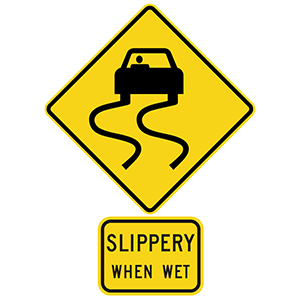
What does this road sign mean?
Winding road
Loose gravel
Slippery when wet
Q.23.
When you see this black and yellow sign, it means:
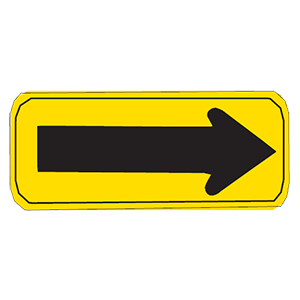
The road to the right is for one-way traffic only.
There is a detour to the right due to road construction.
The road ahead changes direction at an extreme angle.
Q.24.
Blind spots are:
Spots in your vision when you become fatigued.
Areas of the road that cannot be seen in a vehicle's mirrors.
Traffic control devices.
Q.25.
If the rear of your vehicle is skidding to the left, you should:
Not turn your steering wheel.
Turn your steering wheel to the left to correct the skid.
Turn your steering wheel to the right to correct the skid.
Support mcqgeeks.com by disabling your adblocker.
×
Please disable the adBlock and continue.
Thank you.
Reload page