MCQGeeks
CBSE
JEE
NTSE
NEET
English
UK Quiz
Quiz
Driving Test
Practice
Games
Driving Test
Delaware
Delaware Car Driving Permit Test-11
Answers
Q.1.
Increase your following distance when driving behind a large vehicle:
To better see around the sides of the vehicle.
Because other drivers tend to pull behind large vehicles before trying to pass them.
Because following too closely will get you caught in the vehicle's slipstream.
Q.2.
Which of the following is most likely to be slippery in cold weather after snow or rain?
A hilly, open road
A residential road
A road in a shaded area
Q.3.
Yellow lines separate:
Traffic lanes on one-way streets.
Traffic moving in opposite directions on two-way roads.
All carpool lanes from regular traffic lanes.
Q.4.
If you come to an intersection and your view to the side is blocked, you should:
Slow down and look both ways.
Maintain your speed and look both ways.
Stop, then inch forward until you can see clearly in both directions.
Q.5.
You reach an intersection with stop signs on all four corners at the same time as the driver on your left. Who has the right-of-way?
The driver on your left has the right-of-way.
You have the right-of-way.
Whoever is signaling to make a turn has the right-of-way.
Q.6.
As your speed increases, it is important to:
Turn on your headlights.
Look well ahead of your vehicle.
Change lanes frequently.
Q.7.
This sign indicates that the road ahead:
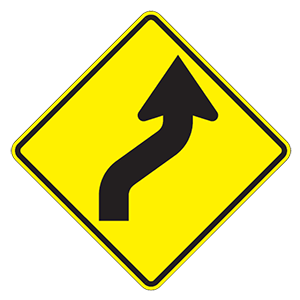
Turns sharply right, then left.
Curves right, then left.
Curves right.
Q.8.
One vehicle that is required to stop at all railroad crossings is:
A dairy truck.
A school bus.
A cattle truck.
Q.9.
What does this road sign indicate?
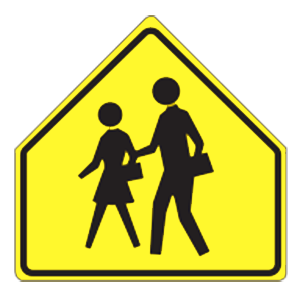
Directions for children
School zone ahead
Playground area ahead
Q.10.
If you approach a traffic light with a red signal and a police officer directs you to go through the intersection without stopping, you should:
Stop until the light turns green.
Go through the intersection without stopping.
Come to a complete stop before proceeding.
Q.11.
If you are driving and you see animals standing near the roadway:
Speed up to scare them away.
Slow down and proceed with caution.
Quickly swerve into the next lane.
Q.12.
Hydroplaning occurs when tires ride on a thin film of water instead of on the road. To prevent hydroplaning in wet weather, you should:
Put on your cruise control to maintain a constant speed.
Slow down.
Move to the shoulder of the road as soon as it starts to rain.
Q.13.
If you are continually being passed on the right and the left while driving in the center lane of an expressway, you should:
Stay in the center lane.
Move to the lane on your right.
Move to the lane on your left.
Q.14.
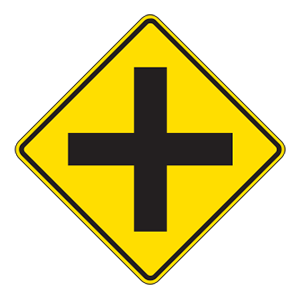
This sign shows one type of:
Intersection.
Road curve.
Right turn.
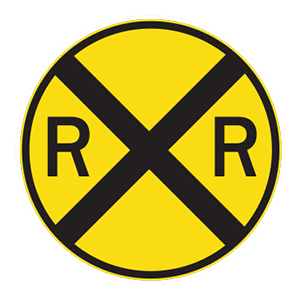
Q.15.
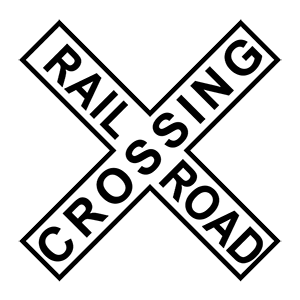
This white sign means:
The railroad crossing is controlled. Continue at your regular speed.
Look, listen, and prepare to stop at the crossing if necessary.
Stop at the railroad tracks and wait for a signal before crossing.
Q.16.
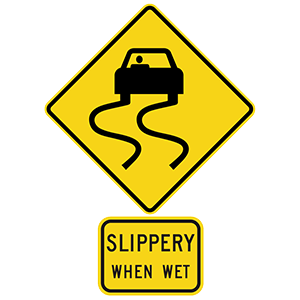
What does this road sign mean?
Winding road
Loose gravel
Slippery when wet
Q.17.
To avoid glare from the headlights of an approaching car:
Look briefly toward the right side of the road.
Stay focused on the centerline on the road.
Flash your high beams.
Q.18.
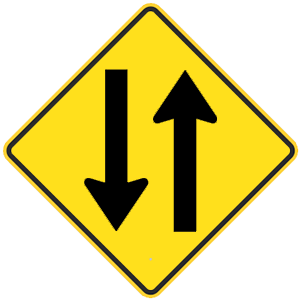
This sign means:
Four-lane traffic ahead.
Divided highway ahead.
Two-way traffic ahead.
Q.19.
To pass on a two-lane road, you should:
Sound your horn as you pass.
Flash your headlights as you pass.
Judge the distance to any oncoming vehicles.
Q.20.
Distracted driving is:
Anything that causes evasive action while driving.
Anything that takes your attention away from driving.
Anything that causes you to pay more attention to driving.
Q.21.
This sign means:
Stop sign ahead.
Railroad crossing ahead.
Construction ahead.
Q.22.
Which of the following substances can affect the ability to drive?
Tranquilizers, marijuana, and sedatives.
Cough syrups and cold tablets containing codeine or antihistamines.
All of the above.
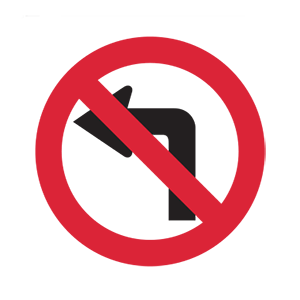
Q.23.
This sign means:
No left turn can be made here.
A left turn can be made only after stopping.
All traffic must turn right at the next intersection.
Q.24.
When changing lanes:
Rely on the rearview mirror.
Look over your shoulder in the direction you plan to move.
Rely on the left side mirror.
Q.25.
"No passing zone" signs tell drivers:
To speed up slightly.
That it is not safe to pass.
To maintain a steady speed.
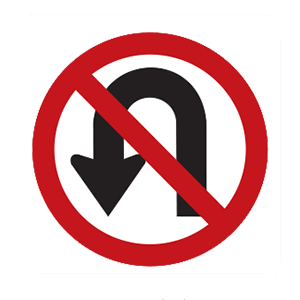
Q.26.
This road sign means:
Do not enter.
Roundabout ahead.
No U-turns.
Q.27.
You are approaching an intersection with a steady yellow traffic light. If you have not already entered the intersection, you should:
Speed up to beat the red light.
Reduce you speed and proceed carefully through the intersection.
Come to a safe stop.
Q.28.
If you are being followed too closely on a two-lane road:
Reduce your speed slowly to encourage the tailgater to drive around you.
Speed up to increase the distance between you and the other car.
Apply your brakes to slow down, then resume your original speed.
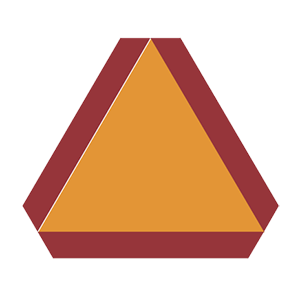
Q.29.
This sign means:
Slow-moving vehicle.
Road construction/maintenance area.
Traffic signal ahead.
Q.30.
When stopped at double railroad tracks, you may proceed:
When there are no trains approaching on either track.
As soon as one train has passed.
Only when the train is out of sight.
Support mcqgeeks.com by disabling your adblocker.
×
Please disable the adBlock and continue.
Thank you.
Reload page