MCQGeeks
CBSE
JEE
NTSE
NEET
English
UK Quiz
Quiz
Driving Test
Practice
Games
Driving Test
Delaware
Delaware Car Driving Permit Test-18
Answers
Q.1.
Interstate driving requires drivers to:
Have the ability to safely drive at increased speeds.
Be constantly alert.
Both of the above.
Q.2.
Stopping distances and severity of crashes:
Decrease as vehicle speed increases.
Are not affected by vehicle speed.
Increase as vehicle speed increases.
Q.3.
When passing a row of parked vehicles, you should:
Be prepared for a person or vehicle to unexpectedly enter your lane.
Expect all other drivers and pedestrians to respect your right-of-way.
Drive closely to the parked vehicles to allow more room for moving traffic.
Q.4.
If you come to a railroad crossing with lowered gates and flashing warning lights, you should:
Drive around the crossing gates if you can't see a train.
Come to a complete stop well behind the gates, wait for the tracks to clear, and proceed once the gates are lifted.
Slow down and drive around the gates.
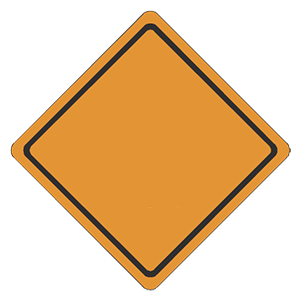
Q.5.
This sign means:
Do not enter.
Stop ahead.
Roadwork or maintenance is present.
Q.6.
The proper way to make a right turn is to:
Signal, slow down, and get into the lane closest to the centerline before turning.
Signal, slow down, and get into the lane closest to the right curb before turning.
Approach the corner in the lane nearest the right curb, but move over toward the middle of the street before turning.
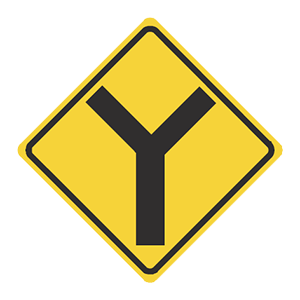
Q.7.
This road sign means:
The roadway ends ahead.
Drivers must bear either right or left.
A four-way intersection is ahead.
Q.8.
When stopped at double railroad tracks, you may proceed:
When there are no trains approaching on either track.
As soon as one train has passed.
Only when the train is out of sight.
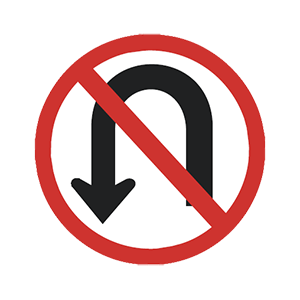
Q.9.
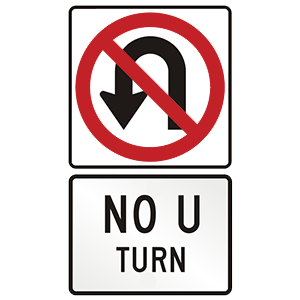
This sign means:
No U-turn.
Traffic signal ahead.
Railroad ahead.
Q.10.
A steady red arrow displayed on a traffic light means:
Drivers cannot turn in the indicated direction.
Drivers may turn in the indicated direction after coming to a complete stop.
Drivers may turn in the indicated direction.
Q.11.
Give the right-of-way to any pedestrian who is:
In a marked crosswalk.
In any crosswalk or intersection.
Crossing any street.
Q.12.
What is the purpose of rumble strips?
They alert drivers to potential tire problems.
They test a vehicle's shock absorbers.
Through vibration and sound, they alert inattentive drivers to the fact that their vehicles have left the travel lane.
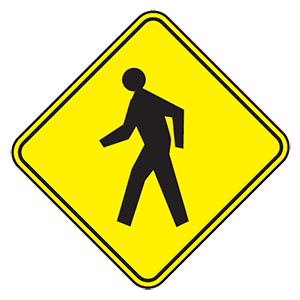
Q.13.
This sign means:
School crossing.
School zone.
Pedestrian crossing.
Q.14.
This sign means:
No U-turn.
No turning.
No left turn.
Q.15.
You are entering a freeway. Check traffic on the freeway by:
Using your rearview and side mirrors.
Using your rearview mirror.
Using your side mirror and looking over your shoulder.
Q.16.
When driving in work zones, you should:
Increase your speed to get through the zone as quickly as possible.
Reduce your speed and be prepared to stop suddenly.
Maintain your normal speed the whole way through the zone.
Q.17.
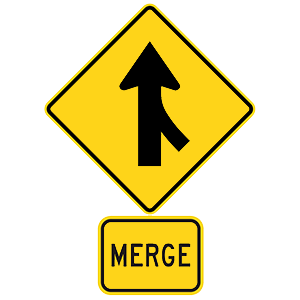
This road sign means:
Cars in the right lane must slow down.
No left turn.
Merge.
Q.18.
To help avoid skidding on slippery surfaces, you should:
Shift to a lower gear after starting down a steep hill.
Speed up to enter curves and slow down to exit them.
Slow down before entering curves and intersections.
Q.19.
A school bus is stopped ahead of you in your lane with its red lights flashing. You should:
Stop and proceed when you think all of the children have exited the bus.
Slow to 25 mph and pass cautiously.
Stop for as long as the red lights are flashing.
Q.20.
If you are driving on a highway next to a single broken white line marking:
You cannot cross the line to pass.
You may cross the line to pass and change lanes.
You may only cross the line to change lanes if you are in the left lane.
Q.21.
Adjust your rearview and side mirrors:
Before you start driving.
Whenever you need to use them.
Before you get into the car.
Q.22.
When you see this sign, you should stop and:
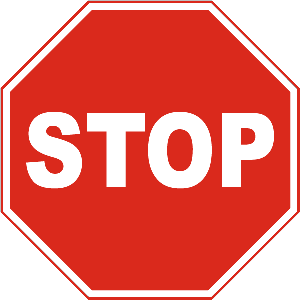
Check for vehicles only in the direction that you plan on going, then proceed.
Let all vehicles that arrive before or after you go first.
Check for traffic in all directions before proceeding.
Q.23.
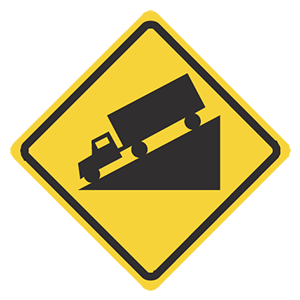
This sign means:
Upcoming downgrade or hill.
Road construction area.
Upcoming narrowing of roadway.
Q.24.
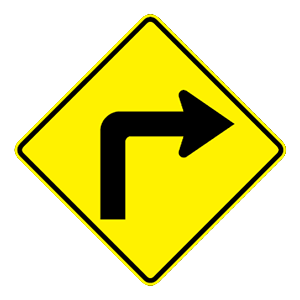
This yellow sign means:
There is a sharp turn to the right.
The lane must turn right.
A right turn is permitted on a green arrow only.
Q.25.
This sign means you are approaching a railroad crossing that does not have a signal. You should:
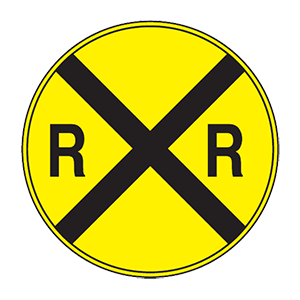
Come to a complete stop.
Proceed at a consistent speed while looking and listening for approaching trains.
Slow down, look both ways, listen for any trains, and be prepared to stop if any trains are nearby.
Q.26.
If your vehicle starts to lose traction because of water on the road, you should:
Drive at a constant speed to gain better traction.
Apply the brakes firmly to prevent your vehicle from sliding.
Slow down gradually and not apply the brakes.
Q.27.
What can you do to reduce road rage?
Always signal your intention when changing lanes.
Talk on your cell phone while driving.
Use your horn frequently.
Q.28.
When stopping on snow or ice, drivers who are operating vehicles equipped with an Anti-Lock Braking System (ABS) should:
Pump the brakes.
Press and hold the brake pedal firmly.
Stay off the brakes and wait for the car to drift to a stop.
Q.29.
If you see a pedestrian using a guide dog or carrying a white cane:
The pedestrian must yield the right-of-way.
You must yield the right-of-way.
Honk your horn to let them know you are there.
Q.30.
You are driving on the freeway behind a large truck. You should drive:
Closer behind the truck than you would if following a passenger vehicle.
Farther behind the truck than you would if following a passenger vehicle.
To the right side of the truck and wait to pass.
Support mcqgeeks.com by disabling your adblocker.
×
Please disable the adBlock and continue.
Thank you.
Reload page