MCQGeeks
CBSE
JEE
NTSE
NEET
English
UK Quiz
Quiz
Driving Test
Practice
Games
Driving Test
Delaware
Delaware Car Driving Permit Test-9
Answers
Q.1.
Continuous hard braking on ice and snow often:
Helps you stop faster.
Locks the front wheels of a vehicle, causing a loss of steering.
Keeps the brakes from freezing.
Q.2.
Which of these statements is true about drugs and driving?
Any prescription drug is safe to use if you don't feel drowsy.
Even over-the-counter drugs can impair your driving.
Only illegal drugs can impair your driving.
Q.3.
Which of the following is not a safe driving practice when driving on the interstate?
Slower traffic must keep to the right.
Change lanes without signaling.
If you miss your exit, you must go to the next exit.
Q.4.
An orange and red triangular sign on a vehicle always means:
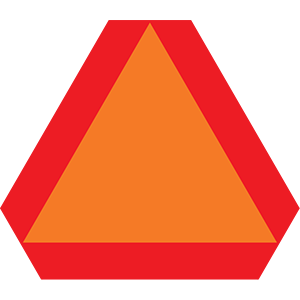
The vehicle has the right-of-way.
Slow-moving vehicle.
Shoulder work ahead.
Q.5.
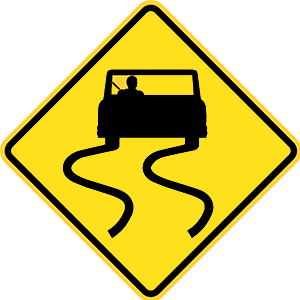
This yellow signs means:
The road ahead has many curves.
There is a sharp curve in the road ahead.
The road ahead may be slippery.
Q.6.
Drivers turning left must yield to:
Overtaking cars.
Oncoming cars.
No one.
Q.7.
If you are getting tired while driving, you should:
Stop and either get rest or change drivers.
Drink something with caffeine.
Open a window.
Q.8.
If you come to an intersection controlled by a flashing yellow light, you must:
Wait for the green light before proceeding.
Slow down and cross the intersection carefully.
Stop before crossing the intersection.
Q.9.
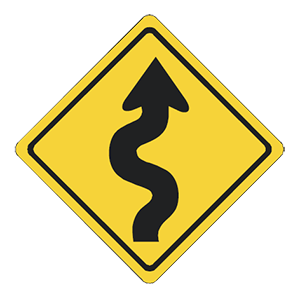
This sign means:
Winding road ahead.
Do not enter.
Pedestrian crossing.
Q.10.
Which of the following statements about driving speed is true?
As your speed increases, the chance of a fatality increases.
As your speed increases, so should your following distance.
Both of the above.
Q.11.
When you want to change lanes, you should never:
Move into another lane while within an intersection.
Check your blind spot by looking over your shoulder.
Check for other drivers moving into the same lane.
Q.12.
Adjust your rearview and side mirrors:
Before you start driving.
Whenever you need to use them.
Before you get into the car.
Q.13.
A broken yellow centerline indicates that:
Passing is not permitted.
Passing on the right is permitted when the way ahead is clear.
Passing on the left is permitted when the way ahead is clear.
Q.14.
While driving on a roadway with a single broken white centerline:
You must stay within your lane.
You may cross the centerline to change lanes.
You may change lanes only from the left lane.
Q.15.
If a tire blows out, you should:
Apply the brake and hold it.
Hold the steering wheel tightly and use the brakes lightly.
Pull over quickly.
Q.16.
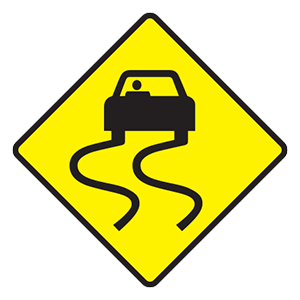
This sign means:
Slow down; curving road ahead.
Slow down and do not use your brakes.
Slow down; slippery when wet.
Q.17.
When passing on the left of a vehicle, it is safe to move back into the right lane:
After about three seconds.
When you can no longer see the vehicle over your right shoulder.
When you can see the front of the vehicle in your rearview mirror.
Q.18.
This sign is a:
Service sign.
Regulatory sign.
Warning sign.
Q.19.
The first thing that alcohol effects is:
Vision.
Judgment.
Balance.
Q.20.
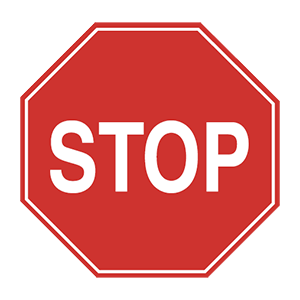
This sign means:
Stop.
Merge.
Upcoming change in direction.
Q.21.
At dawn or dusk and in rain or snow, it can be hard to see and be seen. A good way to let other drivers know you are there is to turn:
Up the instrumental panel lights.
On your parking lights.
On your headlights.
Q.22.
Which of the following driving skills are affected by the use of alcohol and/or drugs?
Alertness and concentration.
Reaction time and coordination.
All of the above.
Q.23.
When stopped at a red traffic light with a green arrow, you may proceed in the direction of the arrow if you:
First come to a complete stop.
Wait until the light changes.
Are in the proper lane and the intersection is clear.
Q.24.
At an intersection with stop signs on all corners, yield the right-of-way to any driver:
On your left.
Who arrived before you.
Across from your vehicle.
Q.25.
You may be able to identify an aggressive driver by:
Their erratic and improper lane changes.
The number of passengers in their car.
Their tendency to drive slowly.
Q.26.
This white sign means you should not pass other vehicles:
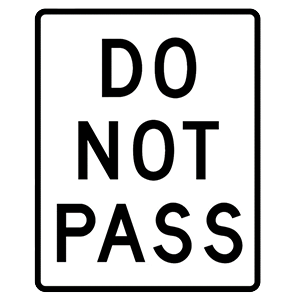
Until after you pass the sign.
Unless it seems safe to do so.
For any reason.
Q.27.
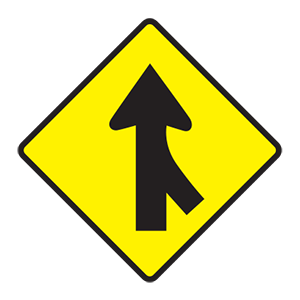
This sign means:
You should stop for other traffic.
Traffic is entering from another road and you should allow additional space for drivers to merge safely into the flow of traffic.
Traffic is entering from another road and you should keep right.
Q.28.
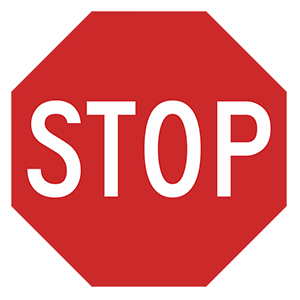
What does this road sign mean?
Slow down and prepare to stop if cars are approaching you.
Come to a full stop then proceed when it is safe to do so.
Proceed carefully through the intersection, not always stopping.
Q.29.
When entering the interstate on a short entrance ramp where there is no acceleration lane, you should:
Immediately enter the far-right traffic lane on the interstate and speed up to match the flow of traffic.
Use the shoulder of the main road to get up to the speed of traffic.
Speed up and enter the interstate only after you have identified a gap in traffic.
Q.30.
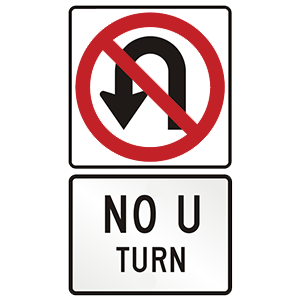
This road sign means:
Do not enter.
No parking.
No U-turn.
Support mcqgeeks.com by disabling your adblocker.
×
Please disable the adBlock and continue.
Thank you.
Reload page