MCQGeeks
CBSE
JEE
NTSE
NEET
English
UK Quiz
Quiz
Driving Test
Practice
Games
Driving Test
Delaware
Delaware Motorcycle Driving Permit Test-3
Answers
Q.1.
To help others see your motorcycle, you should:
Use your headlight.
Weave in your lane.
Maintain eye contact with other road users.
Q.2.
You should maintain an increased following distance:
If the pavement is slippery.
If traffic is light.
If you can see through the vehicles in front of you to determine traffic conditions.
Q.3.
Which factor does not play a major role in affecting your blood alcohol content (BAC)?
Age
The amount of alcohol consumed
Body weight
Q.4.
Wearing which of the following colors will make you less visible to other motorists?
Orange
Yellow
Brown
Q.5.
A benefit of keeping a cushion of space between you and surrounding vehicles is that:
You are better able to draft off of other vehicles.
You will be able to stop quickly.
You will have more time to react to the movements of other drivers.
Q.6.
A motorcyclist should not rely only on their mirrors because:
Sometimes mirrors can be dirty, limiting the motorcyclist's view.
Mirrors are always unreliable.
Motorcycles have blind spots.
Q.7.
How should a group of motorcyclists pass another vehicle?
In a staggered formation
In pairs
One at a time
Q.8.
When entering a curve, you should always position your motorcycle:
On the left side of the lane.
In a position that allows you to most effectively see and be seen.
In the center of the lane.
Q.9.
When passing a row of parked cars, you should:
Ride on the left side of the lane.
Ride wherever you are most comfortable.
Ride in the right portion of the lane.
Q.10.
Convex mirrors:
Provide a narrow view of the road behind you.
Provide a wide view of the road behind you.
Are illegal.
Q.11.
A sign that your rear tire has suddenly gone flat is that:
The back of your motorcycle is swaying from side to side.
You heard a loud noise.
A discharge of air can be seen.
Q.12.
When preparing to ride with a passenger, instruct the passenger to:
Get onto the motorcycle before you.
Sit as far back as possible.
Hold firmly onto your waist, hips, or belt.
Q.13.
The risk of a head or neck injury is reduced:
By wearing a helmet.
By riding more slowly.
By reading the owner’s manual.
Q.14.
To control a motorcycle well, you should:
Use your arms to hold yourself up.
Keep your knees against the gas tank.
Sit so your arms are straight when reaching for the handlebars.
Q.15.
When approaching an intersection, a motorcyclist should not:
Choose a lane position that increases their visibility.
Speed up to cross the intersection quickly.
Cover the clutch and brakes to reduce their reaction time.
Q.16.
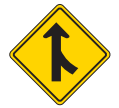
What does this sign mean?
Two-way traffic
Right lane ends
Merge
Q.17.
Which of the following is not a benefit of maintaining a space cushion between your motorcycle and other vehicles?
You will have time to react to hazards.
You will have space to maneuver.
You will have more time to accelerate when entering a curve.
Q.18.
When stopping your motorcycle while carrying a passenger, you should:
Ride a little faster than you normally would.
Start slowing earlier than you normally would.
Merge into smaller gaps of traffic than you normally would.
Q.19.
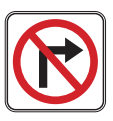
What does this sign mean?
No left turn
No U-turn
No right turn
Q.20.
Since most crashes happen in daylight, you:
Do not need to wear brightly-colored clothing during the day.
Should wear brightly-colored clothing during the day.
Should wear dark clothing during the day.
Q.21.
The human body removes alcohol at a rate of:
About one drink per hour.
About two drinks per hour.
About three drinks per hour.
Q.22.
A sign that your front tire has gone flat is that your steering suddenly feels:
Heavy.
Loose.
Soft.
Q.23.
If you will be carrying a passenger on your motorcycle, you will likely have to:
Reduce the tire pressure.
Make no tire pressure adjustments.
Increase the tire pressure.
Q.24.
Grabbing at the front brake or jamming down on the rear brake:
Can cause the brakes to lock.
Is the best way to stop in an emergency.
Is the best way to slow down when the streets are wet.
Q.25.
Eye protection:
Is not necessary if your motorcycle is equipped with a windshield.
Is only necessary when riding in bad weather.
Should allow the rider a clear view to either side.
Support mcqgeeks.com by disabling your adblocker.
×
Please disable the adBlock and continue.
Thank you.
Reload page