MCQGeeks
CBSE
JEE
NTSE
NEET
English
UK Quiz
Quiz
Driving Test
Practice
Games
Driving Test
Delaware
Delaware Motorcycle Driving Permit Test-8
Answers
Q.1.
If traveling with a load, the load should be:
Secured as low as possible.
Secured as high as possible.
Attached to a sissy bar.
Q.2.
To properly control a motorcycle, you should:
Allow your feet to hang off the footrests.
Sit so your arms hold up your body.
Keep your knees against the gas tank.
Q.3.
An ideal lane position should:
Increase your ability to see and be seen.
Place you in other drivers’ blind spots.
Invite others to share your lane.
Q.4.
Stopping in a turn can be difficult because:
There is decreased traction available for stopping while the bike is leaning.
The rider is usually focused on the turn and not on the braking.
The brake controls do not work in turns.
Q.5.
Under normal riding conditions, one of the best ways to help others see your motorcycle is:
To flash your lights.
To keep your high beam headlight turned on.
To ensure that your motorcycle is painted a dark color.
Q.6.
The best way to help others see your motorcycle is to:
Use your headlight.
Maintain eye contact.
Wave at drivers.
Q.7.
Taking over-the-counter medication before riding:
Is usually fine since over-the-counter medications are never very strong.
Is acceptable all the time.
May affect your riding abilities and should be done with caution.
Q.8.
When riding a motorcycle, you should:
Wear half-fingered gloves.
Wear full-fingered gloves.
Not wear gloves.
Q.9.
Having only one alcoholic drink before riding:
Will not lead to a DUI conviction.
Will never affect your riding skills.
Can affect your ability to operate a motorcycle.
Q.10.
When cars are merging from an entrance ramp:
A motorcyclist should assume the entering drivers see them.
A motorcyclist should never assume the entering drivers see them.
A motorcyclist should stop.
Q.11.
If you are riding behind another vehicle at night, you can determine if there are bumps on the road ahead by:
Listening for the other vehicle scraping against the pavement.
Noticing the other vehicle’s taillights bouncing up and down.
Looking at the rear bumper of the vehicle ahead and trying to determine if it is bouncing.
Q.12.
Which of the following materials provides the best protection for motorcycle riders?
Fleece
Leather
Denim
Q.13.
Increase your following distance if:
It is raining.
There is light traffic.
It is sunny.
Q.14.
Which of the following is not a factor in determining a person's blood alcohol content (BAC)?
The amount of alcohol consumed
How quickly the alcohol is consumed
How often the person consumes alcohol
Q.15.
When riding over scored pavement in a work zone, you should:
Look downward to see the changes in the road surface.
Keep your head and eyes up.
Stay to the left side of the lane.
Q.16.
If you need to react to a hazard in the road, do not:
Avoid communicating with other drivers.
Adjust your speed accordingly.
Make your presence known by sounding your horn and/or using lights or signals.
Q.17.
A motorcycle’s brake light is _________ a passenger vehicle’s brake light.
More noticeable than
Just as noticeable as
Not as noticeable as
Q.18.
What does an integrated braking system do?
It links the front and rear brakes together when the rear brake is applied.
It knows when to brake automatically by understanding your riding habits.
It is connected to the gears and applies the brake when downshifting.
Q.19.
A motorcyclist is usually most easily seen by other drivers when they are riding in which lane position?
The right
The center
The left
Q.20.
Smaller vehicles appear to be ________ and slower than they really are.
Closer
Farther away
Larger
Q.21.
A good way to handle a tailgater is to:
Speed up.
Allow them to get in front of you.
Make gestures at them.
Q.22.
The best lane position for a motorcycle:
Is in the left part of a lane, next to the centerline.
Is in the right part of a lane, next to the curb.
Can vary depending on road and traffic conditions.
Q.23.
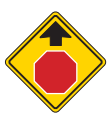
What does this sign mean?
Stop.
Yield to other drivers.
A stop sign is ahead.
Q.24.
Where is the greatest potential for conflict between you and other vehicles?
At intersections
On the highway
On any road
Q.25.
When changing lanes, you should:
Use your mirrors and look over your shoulder.
Use your mirrors. You do not need to look over your shoulder unless you notice something unusual.
Either use your mirrors or look over your shoulder.
Support mcqgeeks.com by disabling your adblocker.
×
Please disable the adBlock and continue.
Thank you.
Reload page