MCQGeeks
CBSE
JEE
NTSE
NEET
English
UK Quiz
Quiz
Driving Test
Practice
Games
Driving Test
District of Columbia
District of Columbia Car Driving Permit Test-14
Answers
Q.1.
This sign means:
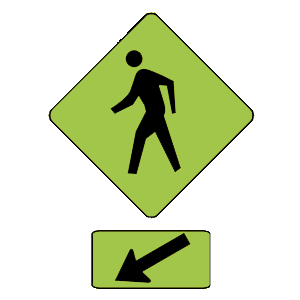
Pedestrian crossing.
Side road.
Railroad ahead.
Q.2.
Your brake lights tell other drivers that you:
Are making a turn.
Have your emergency brake on.
Are changing lanes.
Are slowing down or stopping.
Q.3.
Round signs indicate:
No passing zones.
School zones.
Upcoming railroad crossings.
Hospitals.
Q.4.
To enter a gap in highway traffic:
Watch only the vehicles behind the gap.
Check behind you, then watch the vehicle ahead.
Speed up and let the other vehicles make way.
Q.5.
Which of the following blocks the smooth flow of traffic?
Slowing down to look at collision scene.
Avoiding unnecessary lane changes.
Using public transportation instead of your vehicle.
Q.6.
When you see other drivers around you acting or reacting in anger:
Don’t make eye contact.
Don't react with hand gestures.
Distance yourself from the situation.
All of these.
Q.7.
Which of the following statements is true?
A sudden change in weather calls for a change in driving.
You should slow down when driving in rain and fog.
Be particularly aware of vehicles coming up behind you in inclement weather.
All of the above.
Q.8.
You should allow an extra cushion of space:
When following a station wagon.
When following a driver who cannot see the rear of their vehicle.
When following a small passenger car.
Q.9.
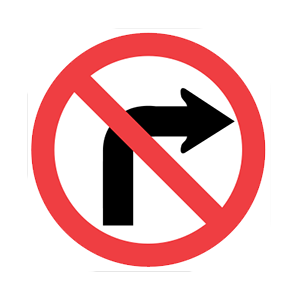
This sign means:
No right turn.
You must turn right.
Watch for traffic on your right.
Don’t park on the right side of the street.
Q.10.
Work zone barriers, drums, cones, and signs are used to:
Make drivers angry about slow traffic.
Inconvenience drivers.
Keep traffic out of hazardous work zones.
Q.11.
It is illegal for a personyears of age or older to drive with a minimum blood alcohol concentration (BAC) of:
0.05 percent.
0.08 percent.
0.02 percent.
0.1 percent.
Q.12.
If you miss your exit on the freeway, you should not:
Continue on the freeway and find an alternate route to your destination.
Proceed to the next exit, leave the freeway, and return to your proper exit.
Back up on the road or shoulder.
Q.13.
If two drivers arrive at the same time to an open intersection:
The driver on the right has the right-of-way.
The driver on the left has the right-of-way.
One driver may continue driving without stopping.
One driver should honk to indicate that they are giving up the right-of-way.
Q.14.
When driving in fog, you should:
Slow down and use your low beam headlights.
Slow down and use your high beam headlights.
Turn your lights on and off to warn other drivers.
Q.15.
You should always travel:
At the speed of vehicles surrounding you.
At the speed limit.
At a speed appropriate for road and weather conditions.
Q.16.
When passing another vehicle on a road with two lanes traveling in opposite directions, you should:
Return to the driving lane when there's enough room between you and the vehicle you passed.
Remain in the left lane if you intend to turn left.
Return to the right side of the roadway immediately.
Drive in either lane.
Q.17.
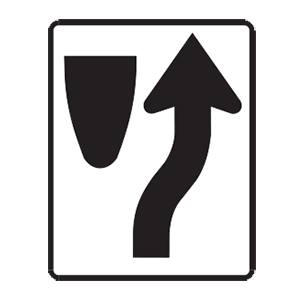
This sign means:
Keep right.
Low shoulder.
No parking at any time.
Lane ends.
Q.18.
Which of the following statements about driving speed is true?
As your speed increases, the chance of a fatality increases.
As your speed increases, so should your following distance.
Both of the above.
Q.19.
On a freeway, you realize you missed your turn or exit. You should:
Make the turn quickly from your lane of travel.
Stop and back up.
Continue driving until you reach the next turn, exit, or other location where you can safely turn around.
Signal other drivers to stop so you can turn.
Q.20.
When a school bus is stopped ahead on your side of the road with its red lights flashing, you must:
Slow to a speed no faster than 10 mph.
Stop until the lights stop flashing.
Change lanes and pass cautiously.
Q.21.
Crossbuck signs indicate:
Railroad crossings.
School zones.
No passing zones.
Hospitals.
Q.22.
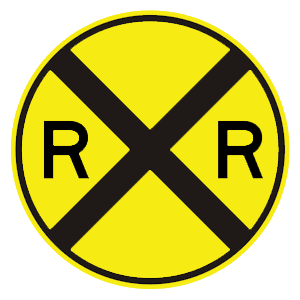
This sign indicates a:
Railroad crossing.
Pedestrian crossing.
No passing zone.
Q.23.
When you see this sign, you must:
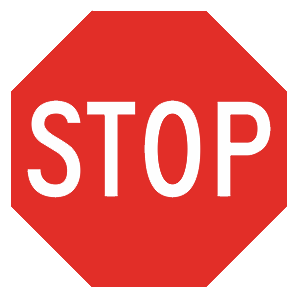
Stop completely and check for pedestrians and cross traffic.
Slow down without coming to a complete stop.
Stop completely and wait for a green light.
Slow down and check for traffic.
Q.24.
When you approach an octagonal sign, you must:

Slow.
Stop.
Turn.
Q.25.
Just like alcohol and other drugs, drowsiness can:
Help you to be a better driver.
Make you feel better.
Impair your judgment.
Support mcqgeeks.com by disabling your adblocker.
×
Please disable the adBlock and continue.
Thank you.
Reload page