MCQGeeks
CBSE
JEE
NTSE
NEET
English
UK Quiz
Quiz
Driving Test
Practice
Games
Driving Test
District of Columbia
District of Columbia Car Driving Permit Test-19
Answers
Q.1.
You must stop for a school bus:
That is parked on the shoulder of the road with no one in it.
When it approaches you, even if its lights are not flashing.
If you are both driving on a two-lane highway and its red lights are flashing.
Whenever the driver waves at you.
Q.2.
When making a right turn, you must:
Yield to pedestrians in the intersecting crosswalk.
Be alert to vehicles ahead that are also turning right.
Yield to bicyclists traveling between you and the side of the road.
All of the above.
Q.3.
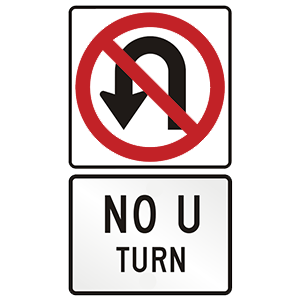
This road sign means:
Do not enter.
No parking.
No U-turn.
Q.4.
When you see or hear an emergency vehicle coming, you should:
Stop immediately and let the vehicle pass.
Drive as far toward the right side of the road as is safe and stop.
Proceed slowly and permit the vehicle to pass.
Keep moving slowly, staying to the right side of the road.
Q.5.
Excessive speed:
Does not increase the chance of a crash.
Increases your ability to react to a hazard.
Often leads to high-risk decision-making.
Q.6.
Stopping distances and the severity of collisions:
Decrease as a vehicle's speed increases.
Are not affected by a vehicle's speed.
Increase as a vehicle's speed increases.
Q.7.
When driving at night on a dimly lit street, you should:
Drive slowly enough that you can stop within the area illuminated by your headlights.
Turn on your high beam headlights to better see the vehicles ahead of you.
Keep the instrument panel lights bright to be more visible to other drivers.
Q.8.
Highway pavement will be particularly treacherous and most slippery:
If it has been raining several hours.
If it has just begun to rain.
If it has been raining for one to two hours.
Q.9.
Pennant-shaped signs indicate:
School zones.
No passing zones.
Speed limits.
Railroad crossings.
Q.10.
Motorists should maintain a safe operating distance when driving near a cyclist.
TRUE
FALSE
Q.11.
The amount of alcohol in the blood is referred to as:
Implied consent (IC).
Blood alcohol concentration (BAC).
Rate of alcohol consumption (RAC).
Q.12.
When you see an emergency vehicle with flashing lights, you must:
Slow down and keep moving in your lane.
Keep driving in your lane.
Pull to the right curb and stop.
Stop exactly where you are.
Q.13.
Your driver license can be revoked in the District of Columbia if you are convicted of a drug offense, even if it is not driving-related.
True
False
Q.14.
You are crossing an intersection and an emergency vehicle is approaching while using its siren and flashing lights. You should:
Stop immediately in the intersection until it passes.
Pull to the right of the intersection and stop.
Continue through the intersection, pull to the right, and stop.
Q.15.
Collisions are more likely to happen when:
All vehicles are traveling at about the same speed.
One lane of traffic is traveling faster than the other lanes.
One vehicle is traveling faster or slower than the flow of traffic.
Q.16.
If weather or light conditions require you to have your lights on while driving:
Use your parking lights.
Use your high beams.
Use your low beams.
Q.17.
In which of the following ways can alcoholic beverages affect you?
It slows your reaction time.
It gives you a feeling of false confidence.
It impairs your thinking ability.
All of the above.
Q.18.
If it feels like your tires have lost contact with the surface of the road, you should:
Slow down by shifting into a lower gear.
Ease your foot off the gas pedal.
Slow down by pumping the brakes quickly and firmly.
Q.19.
You are driving up a hill and are approaching a heavy truck from the rear. You should know that:
The truck may be traveling at a speed slower than the posted speed limit.
You may not be able to safely pass the truck.
You may not be able to legally pass the truck.
All of the above.
Q.20.
Blind spots are:
Spots in your vision when you become fatigued.
Areas of the road that cannot be seen in a vehicle's mirrors.
Traffic control devices.
Q.21.
A steady yellow traffic signal means that a ____ light will soon appear.
Steady red
Flashing yellow
Steady green
Flashing red
Q.22.
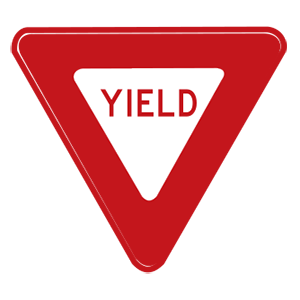
This sign means:
Yield.
Crossroad ahead.
Keep right.
Yield ahead.
Q.23.
When dealing with pedestrians, a driver must:
Make sure the pedestrian is aware of their vehicle.
Always yield the right-of-way, even if the pedestrian is in the wrong.
Yield the right-of-way only when the pedestrian is legally entitled to it.
Slow down and sound their horn near a crosswalk.
Q.24.
At intersections, crosswalks, and railroad crossings, you should always:
Stop, listen, and proceed cautiously.
Look to the sides of your vehicle to see what is coming.
Slowly pass vehicles that seem to be stopped for no reason.
Q.25.
What does a single dashed white line separating traffic mean?
Drivers may pass, even if it could be dangerous.
Lanes move in opposite directions.
Drivers may not pass.
Drivers may pass if it is safe to do so.
Support mcqgeeks.com by disabling your adblocker.
×
Please disable the adBlock and continue.
Thank you.
Reload page