MCQGeeks
CBSE
JEE
NTSE
NEET
English
UK Quiz
Quiz
Driving Test
Practice
Games
Driving Test
District of Columbia
District of Columbia Car Driving Permit Test-21
Answers
Q.1.
You have allowed the wheels of your vehicle to run off the edge of the pavement. What should you do first?
Turn the front wheels slightly to the left to edge the car back onto the pavement.
Hold the steering wheel firmly, release the gas pedal, and gently apply the brakes.
Apply the brakes and turn the front wheels sharply to the left.
Q.2.
Remove all snow, frost, and ice from:
Just the windshield.
All windows.
Just the windshield and passenger window.
Q.3.
To avoid being blinded by the glare of oncoming headlights:
Focus your eyes on the centerline of the road.
Glance to the right side of the road.
Focus your eyes straight ahead.
Q.4.
Is it legal cross a double solid yellow centerline to pass?
Yes.
No.
If there is no oncoming traffic.
If the vehicle ahead of you is driving under the speed limit.
Q.5.
If you are driving in another driver's blind spot, you should:
Move forward or drop back so the other driver can see you.
Keep a steady pace.
Stay in the driver's blind spot.
Honk to let them know you are there.
Q.6.
You may continue carefully through an intersection with a yellow light if:
There is an emergency vehicle crossing your lane.
There are pedestrians crossing.
You are turning right.
You are already within the intersection when the light changes to yellow.
Q.7.
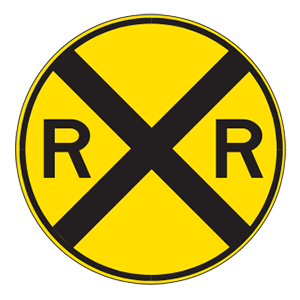
This sign means:
Railroad crossing.
One-way traffic.
Limited parking.
Playground ahead.
Q.8.
If you come to an intersection controlled by a flashing yellow light, you must:
Wait for the green light before proceeding.
Slow down and cross the intersection carefully.
Stop before crossing the intersection.
Q.9.
A solid white line down the center of a two-lane road indicates:
Lanes are moving in opposite directions and drivers are not permitted to pass.
Lanes are moving in opposite directions and drivers are permitted to pass when it is safe to do so.
Lanes are moving in the same direction and drivers are not permitted to pass.
Lanes are moving in the same direction and drivers are permitted to pass when it is safe to do so.
Q.10.
You are entering a freeway. Check traffic on the freeway by:
Using your rearview and side mirrors.
Using your rearview mirror.
Using your side mirror and looking over your shoulder.
Q.11.
Distracted driving may be caused by:
Eating, drinking, or smoking.
Talking or texting on a cellular phone.
Changing a radio station or CD.
All of the above.
Q.12.
All drivers and ____ are required by law to wear seat belts in a moving vehicle while in the District of Columbia.
All passengers
Any front seat passengers
Passengers under the age of 18
Q.13.
Do not pass:
On a hill or curve.
When school bus lights are flashing.
When approaching an intersection.
All of the above.
Q.14.
When entering the interstate on a short entrance ramp where there is no acceleration lane, you should:
Immediately enter the far-right traffic lane on the interstate and speed up to match the flow of traffic.
Use the shoulder of the main road to get up to the speed of traffic.
Speed up and enter the interstate only after you have identified a gap in traffic.
Q.15.
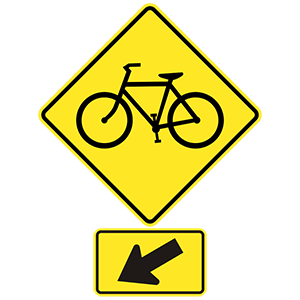
This road sign means:
Bicycle crossing.
Stop only if other cars are approaching.
Bicycle store.
Soft shoulders.
Q.16.
After you have passed a vehicle moving in the same direction, it is safe to move back into the right lane:
After about three seconds.
When you can no longer see the passed vehicle over your right shoulder.
When you can see the entire front of the passed vehicle in your rearview mirror.
Q.17.
A solid yellow line on your side of the centerline means:
Slow down.
Pass with caution.
Do not pass.
Keep right on hills.
Q.18.
After being pulled over by law enforcement, a driver should immediately exit the vehicle and quickly approach the officer’s squad car.
True
False
Q.19.
If a child is riding a bicycle near your vehicle:
Beep your horn.
Expect the child to be in total control of the bicycle.
Expect the unexpected.
Q.20.
The best way to avoid loss of control under wet conditions is to increase your vehicle's speed.
True
False
Q.21.
“Highway hypnosis” is a driving condition that can result from:
Staring at the roadway for long periods of time.
Frequent rest stops.
Too much sleep the night before your trip.
Short trips on expressways.
Q.22.
Which of these statements is true about roadwork zones?
Fines are the same for violations committed in work zones as they are under normal traffic conditions.
You must "Slow for the Cone Zone."
Slow down only if you think workers are present.
Q.23.
If you are getting tired while driving, you should:
Stop and either get rest or change drivers.
Drink something with caffeine.
Open a window.
Q.24.
You must yield to a pedestrian using a white cane or guide dog:
Only when the guide dog is leading the person across the street.
At all times.
Only if a crossing guard is present.
Q.25.
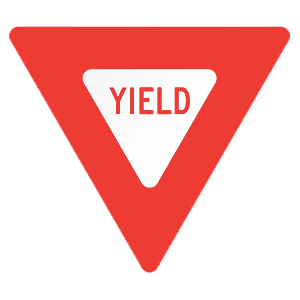
This sign means:
Slow down if an emergency vehicle is approaching.
Look both ways as you cross the intersection.
Always come to a full stop at the intersection.
Slow down and be prepared to stop if necessary.
Support mcqgeeks.com by disabling your adblocker.
×
Please disable the adBlock and continue.
Thank you.
Reload page