MCQGeeks
CBSE
JEE
NTSE
NEET
English
UK Quiz
Quiz
Driving Test
Practice
Games
Driving Test
District of Columbia
District of Columbia Car Driving Permit Test-23
Answers
Q.1.
When driving in traffic, it is safest to:
Fluctuate your speed to keep alert.
Drive faster than the flow of traffic.
Drive slower than the flow of traffic.
Drive with the flow of traffic.
Q.2.
You must stop at an intersection when you see a:
Flashing red light.
Steady yellow light.
Yellow arrow.
Flashing yellow light.
Q.3.
Alcohol in any concentration is:
A stimulant.
A depressant.
Neither of the above.
Q.4.
Before turning, you should:
Use your signal.
Turn the wheel.
Increase your speed.
Change lanes.
Q.5.
The most important thing to remember about speed management and curves is that you must:
Drive at the posted speed limit as you enter the curve, then slow down at the sharpest part of the curve.
Slow down before you enter the curve.
Accelerate gently before you enter the curve.
Drive at the posted speed limit before, throughout, and after the curve.
Q.6.
The most effective safety restraints in a traffic crash are:
Only a lap and shoulder belt.
Only an airbag.
Both a lap/shoulder belt and an airbag.
No safety restraints.
Q.7.
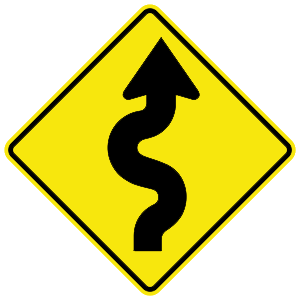
This road sign means:
Sharp turn to the right.
Double curve.
Winding road.
Pavement ends.
Q.8.
You should honk your horn when you:
Are traveling through an intersection.
Are passing a bicyclist.
See a child who is about to run into the street.
Are parallel parking.
Q.9.
When passing on the left of a vehicle, it is safe to move back into the right lane:
After about three seconds.
When you can no longer see the vehicle over your right shoulder.
When you can see the front of the vehicle in your rearview mirror.
Q.10.
Motorcycles, scooters, and mopeds are not easy to see; therefore, you should:
Slow down when driving.
Make constant visual checks.
Share a lane with a motorcycle.
Q.11.
You must stop at a railroad crossing when:
Directed to do so by a flagger.
It is controlled by a stop sign.
Flashing red signals and gates are present and operating.
All of the above.
Q.12.
You come to an intersection with a flashing red light. You must:
Slow down and drive carefully through the intersection.
Turn either right or left, since the road is blocked ahead.
Stop at the intersection and wait for a flashing green light.
Stop at the intersection, then proceed as traffic allows.
Q.13.
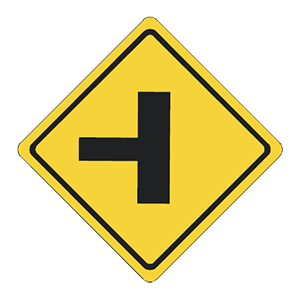
This sign means:
Side road.
Merge.
Yield the right-of-way.
Q.14.
A pedestrian starts to cross in front of your vehicle. You should:
Flash your lights.
Slow down.
Speed up and pass in front of the pedestrian.
Stop and let the pedestrian cross.
Q.15.
The posted maximum speed limit is the fastest you can drive in an area.
True
False
Q.16.
When parking your vehicle downhill on a two-way street:
Turn your wheels to the right.
Turn your wheels to the left.
Keep your wheels pointed straight ahead.
Leave your transmission in neutral.
Q.17.
What can you do to reduce road rage?
Always signal your intention when changing lanes.
Talk on your cell phone while driving.
Use your horn frequently.
Q.18.
If you are driving on a highway next to a single broken white line marking:
You cannot cross the line to pass.
You may cross the line to pass and change lanes.
You may only cross the line to change lanes if you are in the left lane.
Q.19.
If you become drowsy while driving, you should:
Try to fight it.
Take a break.
Take some caffeine pills.
Q.20.
If you begin to feel tired while driving, the best thing to do is to:
Get some coffee.
Open your window.
Stop driving.
Turn on the radio.
Q.21.
Double solid yellow line markings down the center of a road indicate that passing is:
Allowed from both directions.
Allowed only from your direction of travel.
Not allowed from either direction.
Q.22.
Which of the following substances can affect the ability to drive?
Tranquilizers, marijuana, and sedatives.
Cough syrups and cold tablets containing codeine or antihistamines.
All of the above.
Q.23.
A driver entering interstate traffic from an entrance or acceleration ramp:
Should yield to drivers already on the interstate.
Has the right-of-way.
May force their way into traffic.
Can assume that other drivers will change lanes to make room.
Q.24.
When changing lanes on a highway, you should:
Signal a lane change.
Check your rearview and outside mirrors.
Check your blind spot by glancing over your shoulder.
All of the above.
Q.25.
In rainy weather, you should be most careful when turning or stopping:
After it has been raining all day.
One half hour after it stops raining.
During the first half hour of rain.
Support mcqgeeks.com by disabling your adblocker.
×
Please disable the adBlock and continue.
Thank you.
Reload page