MCQGeeks
CBSE
JEE
NTSE
NEET
English
UK Quiz
Quiz
Driving Test
Practice
Games
Driving Test
District of Columbia
District of Columbia Car Driving Permit Test-4
Answers
Q.1.
____ limit your concentration, perception, judgment, and memory.
Only a blood alcohol level greater than the legal limit can
Alcohol does not
Even the smallest amount of alcohol can
Only a blood alcohol level greater than 0.05 percent can
Q.2.
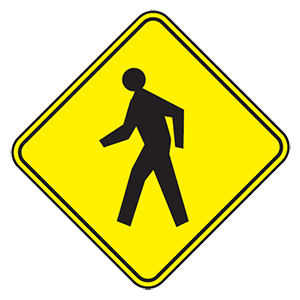
This sign means:
School crossing.
School zone.
Pedestrian crossing.
Q.3.
You are involved in an accident and another person is injured. You should:
Moved the injured away from the scene immediately.
Always leave the injured where they are.
Not move the injured unnecessarily. Keep the injured warm and administer first aid.
Stay away from the injured.
Q.4.
When turning left from a two-way street onto a one-way street, you should:
Turn into any lane.
Turn into first lane.
Turn into second lane.
Q.5.
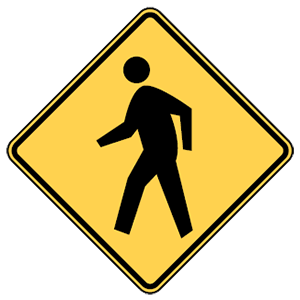
This road sign means:
Pedestrian crossing.
School crossing.
Jogging trail.
Q.6.
When driving in bad weather, drivers should:
Increase their speed to reach their final destination more quickly.
Decrease their following distance.
Increase their following distance.
None of the above.
Q.7.
Drinking alcohol and driving is:
A minor traffic safety problem.
A serious traffic safety problem.
Safe if you have only had a few drinks.
Only dangerous to the driver who drinks.
Q.8.
Having a driver license is a:
Requirement.
Privilege.
Right.
Q.9.
What does this road sign indicate?
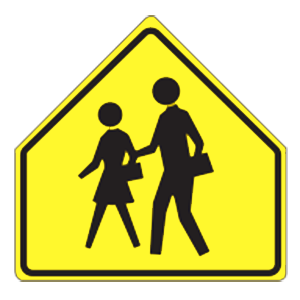
Directions for children
School zone ahead
Playground area ahead
Q.10.
When preparing to make a left turn from a two-way street, you should drive:
Near the right-hand side of the road.
Near the centerline.
On the left of the centerline.
Q.11.
If you need to drive in foggy weather:
Turn on your low beam headlights.
Turn on your hazard lights.
It is okay to drive at the maximum speed limit.
Do not drive at a speed above 10 miles per hour.
Q.12.
You are driving on a busy street and your vehicle’s accelerator sticks open. You should:
Blow your horn.
Slam on your brakes.
Turn on your four-way flashers.
Turn off your ignition, taking care not to engage the steering wheel locking mechanism.
Q.13.
What are the colors of signs that tell you the distance to the next exit on a highway?
Yellow with black letters
Black with white letters
Red with white letters
Green with white letters
Q.14.
"No zones" are areas around trucks where cars:
Disappear into blind spots or are so close that they restrict the truck driver's ability to stop and maneuver safely.
Have sufficient space to travel behind the truck.
Have several car lengths between their vehicle and the truck.
Q.15.
At a light rail intersection, always:
Look both ways before crossing tracks.
Pay attention and obey all traffic signals.
Share the road with pedestrians and bicyclists.
All of these.
Q.16.
When may you proceed through an intersection that has a stop sign but no stop line or crosswalk?
After slowing down to verify that there is no cross traffic
After coming to a complete stop and verifying that it is safe to proceed
After you have stopped at least 20 feet prior to the intersection
After slowing down to a speed of 10 mph
Q.17.
You may drive around or under a gate that is being lowered or raised at a railroad crossing:
As long as an approaching train is not too close.
If your vehicle can do so without damaging the gate.
If you first look carefully in both directions.
Under no circumstances.
Q.18.
An arrow painted on the pavement means:
Drivers in the proper lane may make the movement indicated by the arrow, if they choose to do so.
Drivers in the proper lane must make the movement indicated by the arrow, but only if traffic lights are not working.
Drivers in the proper lane must always come to a complete stop before making the movement indicated by the arrow.
Drivers in the proper lane must make the movement indicated by the arrow while following directions indicated by traffic signals.
Q.19.
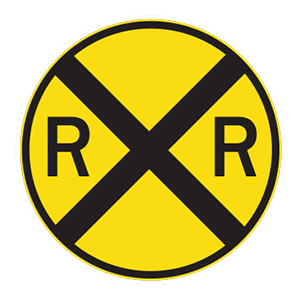
This sign means:
Stop sign ahead.
Railroad crossing ahead.
Construction ahead.
Q.20.
A broken yellow centerline means that:
Passing is not permitted.
Passing on the right is permitted when the way ahead is clear.
Passing on the left is permitted when the way ahead is clear.
Q.21.
How can you help prevent rear-end collisions?
Avoid sudden stops.
Before stopping, check your mirrors and blind spots for traffic.
Release the gas pedal and let your vehicle slow before applying the brakes.
All of the above.
Q.22.
When passing on a multilane highway:
Be sure the passing lane is clear.
Pass only on the right.
Watch for oncoming traffic.
There is no need to signal.
Q.23.
When making a turn, you must ____ your speed.
Increase
Maintain
Vary
Reduce
Q.24.
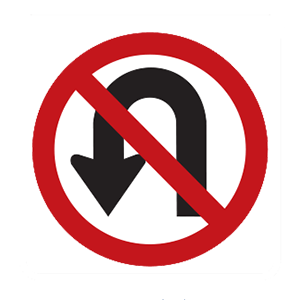
This sign means:
No U-turn.
Two-way left turn.
Minimum speed limit.
No parking.
Q.25.
If you want to pass a pedestrian who is walking along the roadway and an oncoming vehicle is approaching, you should:
Slow down and let the oncoming vehicle pass before you pass the pedestrian.
Keep driving at a steady speed. The oncoming vehicle must stop for you.
Honk your horn to get the pedestrian to move over.
Support mcqgeeks.com by disabling your adblocker.
×
Please disable the adBlock and continue.
Thank you.
Reload page