MCQGeeks
CBSE
JEE
NTSE
NEET
English
UK Quiz
Quiz
Driving Test
Practice
Games
Driving Test
Florida
Florida Car Driving Permit Test-10
Answers
Q.1.
Round signs indicate:
No passing zones.
School zones.
Upcoming railroad crossings.
Hospitals.
Q.2.
You are driving on a narrow road when you meet an oncoming vehicle. You must:
Pull completely off the road and stop.
Allow the oncoming vehicle at least one-half of the main-traveled portion of the road.
Demand the other vehicle pull over to make room.
Turn on your high beam headlights to make sure the other vehicle sees you.
Q.3.
When approaching a traffic signal displaying a steady green arrow, drivers:
Should merge into a lane in the direction of the arrow.
Should slow to a stop, if it is safe to do so.
May turn in the direction of the arrow after yielding to traffic and pedestrians already in the intersection.
May drive straight through the intersection.
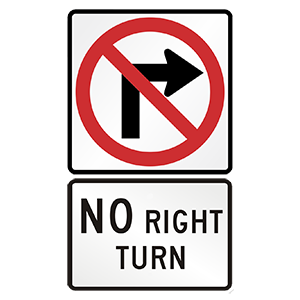
Q.4.
This sign means:
No right turns.
Right turns are permitted.
Stop before turning right.
Sharp curve ahead.
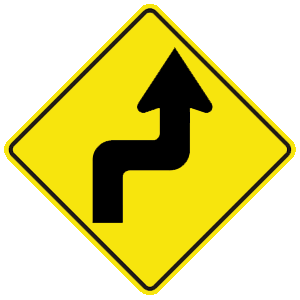
Q.5.
This road sign means:
Sharp right turn.
A road joins from the right.
The road ahead turns sharply right, then sharply left.
Winding road ahead.
Q.6.
When you see a "Drawbridge" sign and you see a flashing yellow light, you should:
Slow down and prepare to stop.
Quickly speed up.
Proceed with caution.
Stop only if you see a boat.
Q.7.
Your brake lights tell other drivers that you:
Are making a turn.
Have your emergency brake on.
Are changing lanes.
Are slowing down or stopping.
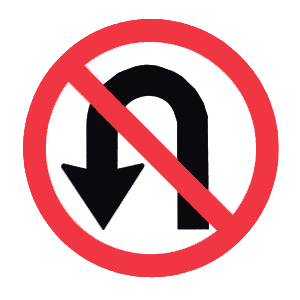
Q.8.
This sign means:
No U-turn.
No turning.
No left turn.
No right turn.
Q.9.
While backing, you should:
Rely only on your mirrors.
Flash your lights.
Open your door to see if it is safe to proceed.
Turn your head and look through the rear window.
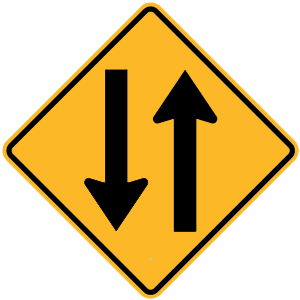
Q.10.
This sign means:
Four-lane traffic ahead.
Divided highway ahead.
Two-way traffic ahead.
Intersection ahead.
Q.11.
If you begin to feel tired while driving, the best thing to do is to:
Get some coffee.
Open your window.
Stop driving.
Turn on the radio.
Q.12.
When driving on roads that may be slippery:
Always drive at the maximum speed limit.
Use cruise control to maintain a steady speed.
Reduce your following distance.
Do not make any sudden changes in speed or direction.
Q.13.
Before switching on the ignition, you should:
Be sure only backseat passengers have buckled their seat belts.
Be sure only adult passengers have buckled their seat belts.
Be sure only child passengers have buckled their seat belts.
Be sure all of the vehicle's occupants have buckled their seat belts.
Q.14.
When driving in traffic, it is safest to:
Fluctuate your speed to keep alert.
Drive faster than the flow of traffic.
Drive slower than the flow of traffic.
Drive with the flow of traffic.
Q.15.
Distracted drivers are at a greater risk of a crash when they are using which of the following?
CD player
Radio
Cell phone
All of the above
Q.16.
Car drivers should know that large trucks:
Have large blind spots.
Can stop more quickly than passenger vehicles.
Do not need more room to maneuver than passenger vehicles.
All of the above.
Q.17.
If you are turning onto a street with more than one lane traveling in your direction, you should:
Turn into the lane closest to your previous lane.
Turn into the lane marked with an arrow.
Turn into the middle lane.
Turn into any lane.
Q.18.
Two solid white lines painted across a traffic lane show the boundaries of a crosswalk. As a driver, you should know that:
Motor vehicles have the right-of-way over pedestrians in crosswalks.
When pedestrians are in crosswalks, they should be given the right-of-way.
No one has the right-of-way in a crosswalk.
Pedestrians are responsible to stay out of the way of all traffic.
Q.19.
This sign means:
One-way traffic.
Divided highway ahead.
Two-way traffic.
Keep left.
Q.20.
You are waiting in the intersection to complete a left turn. You should:
Signal and keep your wheels turned to the left.
Signal and keep your wheels straight.
Flash your headlights so drivers will let you through.
Drive around the rear of a car if it blocks you.
Q.21.
If traffic signals at an intersection are not functioning due to a power outage:
Park your vehicle as far off the road as possible and wait for power to be restored.
Use hand signals to indicate your intentions to other drivers.
Turn on your hazard lights and proceed through the intersection without stopping.
Treat the intersection as a four-way stop.
Q.22.
When passing another vehicle on a road with two lanes traveling in opposite directions, you should:
Return to the driving lane when there's enough room between you and the vehicle you passed.
Remain in the left lane if you intend to turn left.
Return to the right side of the roadway immediately.
Drive in either lane.
Q.23.
Certain highway signs require drivers to obey an indicated instruction. Such signs are known as:
Regulatory signs.
Warning signs.
Information signs.
Guide signs.
Q.24.
You may drive across a dashed white line:
At any time.
Only during daylight hours.
When it is safe to change lanes.
Only when passing a motorcycle.
Q.25.
When parking uphill next to a curb, set the parking brake and:
Keep the rear tires against the curb.
Keep the front tires straight ahead.
Turn your steering wheel away from the curb.
Turn your steering wheel toward the curb.
Q.26.
This road sign means:
One-way road.
No right turn.
Exit.
Sharp right turn in the road ahead.
Q.27.
Drivers must yield to a pedestrian:
Even if the pedestrian crosses the street carelessly.
Only when the pedestrian is in a crosswalk.
Only if the pedestrian is on the same side of the road as the driver.
If the pedestrian uses a hand signal to ask oncoming drivers to stop.
Q.28.
When may a driver pass a vehicle that is stopped at a crosswalk?
When the vehicle does not accelerate quickly enough after the pedestrian has left the crosswalk.
When the pedestrian is directly in front of the vehicle.
When there is no visible pedestrian.
Never.
Q.29.
Stress can affect your driving by:
Lowing your ability to focus on driving.
Decreasing your chances of an accident.
Causing you to fall asleep at the wheel.
Making you more aware of others around you.
Q.30.
If you are driving in another driver's blind spot, you should:
Move forward or drop back so the other driver can see you.
Keep a steady pace.
Stay in the driver's blind spot.
Honk to let them know you are there.
Q.31.
A “No standing” sign at a certain location means:
You may never stop your vehicle there.
You may park there if the driver remains in the vehicle.
You may stop temporarily only to pickup or discharge passengers.
You may stop to load or unload merchandise.
Q.32.
What is the first thing affected by alcohol consumption?
Reaction time.
Judgment.
Slurred speech.
Vision.
Q.33.
Distracted driving is:
Very uncommon.
Extremely risky behavior.
Nothing to be concerned about.
No less safe than driving under any other conditions.
Q.34.
When making a turn, you must ____ your speed.
Increase
Maintain
Vary
Reduce
Q.35.
Signs indicating areas of public recreation are:
Orange.
Red.
Green.
Brown.
Q.36.
Drinking alcohol and driving is:
A minor traffic safety problem.
A serious traffic safety problem.
Safe if you have only had a few drinks.
Only dangerous to the driver who drinks.
Q.37.
Smoking and preparing to smoke while driving:
Do not affect driving abilities.
Help maintain driver alertness.
Are distracting activities.
Are not distracting activities.
Q.38.
A fully loaded tractor-trailer traveling atmph could take up to ____ to come to a complete stop.
50 feet
125 feet
400 feet
750 feet
Q.39.
If two vehicles arrive to a four-way stop at the same time:
The vehicle on the left must yield to the vehicle on the right.
The vehicle on the right must yield to the vehicle on the left.
Drivers must make hand motions to communicate with each other.
One driver should proceed without stopping.
Q.40.
If you see this sign above your lane, you:
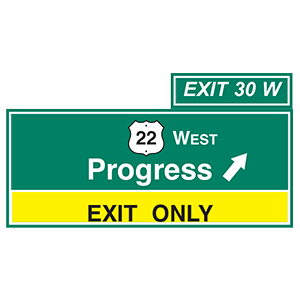
May not exit the freeway.
May either continue through the interchange or exit the freeway from your current lane.
May stay in your lane and continue through the interchange.
Must exit the freeway, if you stay in your current lane.
Q.41.
You must yield to other drivers:
When entering a street from a garage or alley.
When they are on a road to your left and you have reached an unmarked intersection at the same time.
When your traffic signal is a green arrow.
All of the above.
Q.42.
You are coming to an intersection and have a green light. Pedestrians are crossing against the red. You should:
Honk your horn.
Speed up and pass in front of the pedestrians.
Stop to let the pedestrians cross safely.
Drive close to the pedestrians and frighten them so they’ll think twice before crossing against a red light.
Q.43.
This road sign means:
You are about to enter a one-way street from the wrong direction.
U-turns are prohibited.
You may proceed if the way is clear.
Come to a complete stop before proceeding.
Q.44.
Worn or bald tires:
Can make turning more difficult.
Are likely to hydroplane.
Can increase your stopping distance.
All of the above.
Q.45.
If one of your tires blows out as you are driving, you should:
Brake hard immediately.
Try to steer straight while gradually slowing by removing your foot from the gas pedal.
Maintain your current speed and steer straight.
Swerve back and forth to alert traffic behind you.
Q.46.
Crossbuck signs indicate:
Railroad crossings.
School zones.
No passing zones.
Hospitals.
Q.47.
You may cross double solid yellow lines:
To pass a slow-moving truck.
To turn into a driveway.
To pass another car.
Under no conditions.
Q.48.
What are the colors of warning signs indicating upcoming hazards?
Black letters or symbols on a white background
Black letters or symbols on a yellow background
White letters or symbols on a blue background
White letters or symbols on a green background
Q.49.
The correct way to use a freeway exit ramp is to:
Slow down before entering the exit ramp.
Slow down once moving onto the exit ramp.
Keep your speed constant once in the exit ramp.
Pass slower traffic in the exit ramp.
Q.50.
When passing on a multilane highway:
Be sure the passing lane is clear.
Pass only on the right.
Watch for oncoming traffic.
There is no need to signal.
Support mcqgeeks.com by disabling your adblocker.
×
Please disable the adBlock and continue.
Thank you.
Reload page