MCQGeeks
CBSE
JEE
NTSE
NEET
English
UK Quiz
Quiz
Driving Test
Practice
Games
Driving Test
Florida
Florida Car Driving Permit Test-11
Answers
Q.1.
If a transit vehicle is signaling to re-enter the main roadway following a stop, you must:
Honk to let them know you’re there.
Move to the left lane.
Yield.
Speed up to pass.
Q.2.
What should you do if your accelerator sticks while you are driving?
Reach down and attempt to pull it up.
Shift to park.
Shift to neutral and apply steady pressure on the brake.
Turn the engine off.
Q.3.
When you drive through an area where children are playing, you should expect them:
To know when it is safe to cross the street.
To stop at the curb before crossing the street.
To run out in front of you without looking.
Not to cross the street unless they are with an adult.
Q.4.
Alcohol causes:
Loss of concentration.
Poor coordination.
Slower judgment.
All of the above.
Q.5.
What can you do to avoid the need to make emergency stops while driving in traffic?
Honk your horn to make others aware of your presence.
Look ahead and maintain a safe following distance.
Drive in the right lane only.
Drive more slowly than the flow of traffic.
Q.6.
Work zone signs mean:
It is summer.
You must immediately stop and back up.
Less than ideal conditions are present for driving.
You should drive faster to get out of the work zone.
Q.7.
When a drawbridge signal is red, you should:
Come to a complete stop.
Quickly speed up.
Proceed with caution.
Stop only if you see a boat.
Q.8.
This road sign means:
Do not pass.
Do not enter.
No turn on red.
Keep right.
Q.9.
You are driving at night and another vehicle is approaching from the opposite direction. Your headlights:
Should be on their high beam setting.
Should be on their low beam setting.
Should be off. Use your parking lights.
May be on either their high or low beam setting.
Q.10.
A good defensive driver:
Drives slowly at all times.
Looks out for the actions of other drivers.
Travels at a constant speed.
Only drives in familiar areas.
Q.11.
At dusk or on overcast days, you should:
Drive using your four-way flashers.
Drive using your parking lights.
Not turn on any vehicle lights.
Turn on your headlights.
Q.12.
A driver who has been convicted of three traffic offenses that caused accidents over the course of three years:
Must complete a DHSMV-approved driver improvement course.
Must hand in their license.
Will not be permitted to drive on freeways.
May not leave the state.
Q.13.
What do speed limit signs indicate?
Potential driving speeds for the area
The maximum or minimum speed that is legally allowed to be driven
The speed drivers should drive in heavy traffic
The speed drivers should drive under poor conditions
Q.14.
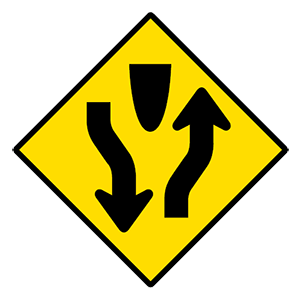
This sign is used to warn drivers about:
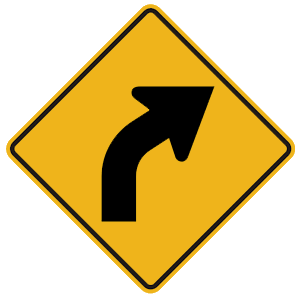
Upcoming intersections.
Road construction.
An upcoming curve in the road.
Changes in traffic lanes.
Q.15.
To enter a freeway:
Signal, yield to existing traffic, and enter at the same speed that traffic is moving.
Signal and enter the freeway. Freeway traffic must yield.
Drive slowly so you can check traffic.
Always come to a complete stop first.
Q.16.
When changing lanes on a highway, you should:
Signal a lane change.
Check your rearview and outside mirrors.
Check your blind spot by glancing over your shoulder.
All of the above.
Q.17.
What is the only way to reduce your blood alcohol concentration (BAC)?
Drink coffee.
Exercise.
Allow your body time to get rid of the alcohol.
Take a cold shower.
Q.18.
A person's ability to drive can be impaired by:
Alcohol.
Any medication.
A lack of sleep.
All of the above.
Q.19.
Which of the following about winter driving is not true?
Winter is the most difficult driving season.
Checking your vehicle's antifreeze and windshield washer fluid levels is especially important during the winter.
Using cruise control in winter weather is a safe thing to do.
It is best to use snow tires on your vehicle.
Q.20.
When entering a street from a driveway, you:
Must drive slowly to allow approaching vehicles and pedestrians time to get out of your way.
Must honk your horn so approaching vehicles and pedestrians know to give you room.
Must stop and proceed only when there are no pedestrians or vehicles approaching.
Can disregard any pedestrians if there is no sidewalk.
Q.21.
Your vehicle strikes an unattended parked vehicle and you cannot locate the vehicle’s owner. You:
Have done as much as you can.
Must stay until the police arrive.
Must leave a written notice containing your name, your address, and the circumstances of the accident.
May go on your way.
Q.22.
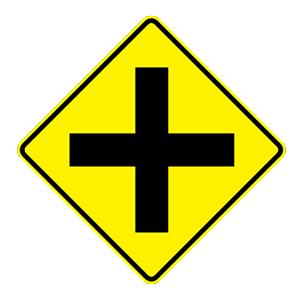
This road sign means:
A steep grade is ahead.
You must turn left ahead.
Do not enter.
A four-way intersection is ahead.
Q.23.
The best way to deal with tailgaters is to:
Speed up to increase the distance between you and the tailgater.
Slam on your brakes to get the other driver to back off.
Change lanes or gradually slow down to encourage them to pass.
Ignore them.
Q.24.
Drivers who have consumed alcohol before getting behind the wheel:
Are always aware of the risks they are taking.
Do not have sufficient control over their bodies and minds or the vehicles being driven.
Are better drivers because they are more careful than sober drivers.
Have quicker reaction times.
Q.25.
When you see this sign, it means:
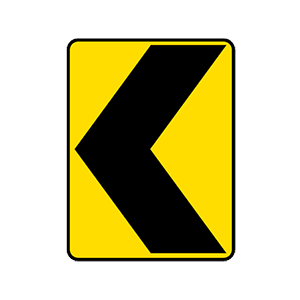
There is an object on the roadway.
Traffic is coming from the right.
The road is curving sharply to the left.
There is a merge point ahead.
Q.26.
A bicyclist who doesn’t obey traffic laws:
Is in the right because bicyclists don’t have to obey traffic laws.
Can be ticketed.
Will always receive a warning from law enforcement.
Will have their bicycle impounded.
Q.27.
If a gate near a drawbridge is about to lower across the road:
Find a way around the gate.
Quickly drive under the lowering gate.
Come to a complete stop and wait for the gate to rise before you proceed.
Stop only if you cannot pass underneath the gate before it lowers completely.
Q.28.
As you drive, you're required to stop your vehicle:
At an intersection with a stop sign.
Where there is a red light.
When a traffic officer orders you to stop.
All of the above.
Q.29.
Driving while being distracted by any activity:
Is never dangerous.
Usually causes the driver to react more slowly to hazards.
Usually causes the driver to drive faster.
Is only dangerous for young drivers.
Q.30.
The effect that alcohol has on your reflexes and judgment:
Is less pronounced when consuming beer instead of wine.
Is less pronounced when consuming wine instead of beer.
Is most pronounced when consuming hard ciders and mixed drinks.
Depends on the amount of alcohol in your bloodstream.
Q.31.
A single broken white line down the center of a two-lane road indicates:
Lanes are moving in opposite directions and drivers are not permitted to pass.
Lanes are moving in opposite directions and drivers are permitted to pass when it is safe to do so.
Lanes are moving in the same direction and drivers are not permitted to pass.
Lanes are moving in the same direction and drivers are permitted to pass when it is safe to do so.
Q.32.
Stop lines are solid white lines painted across traffic lanes:
In curves and on hills.
Next to churches and schools.
At intersections and pedestrian crosswalks.
On freeway on-ramps.
Q.33.
If you are involved in a crash with an unattended vehicle, you:
May leave the scene without attempting to make contact with the vehicle's owner.
Must contact the vehicle's owner or leave a note.
Must stay near the vehicle until its owner comes to move it.
Should call a tow truck.
Q.34.
If someone is driving aggressively behind you, you should:
Try to get out of the aggressive driver’s way.
Stare at the driver as he or she is passing you.
Speed up as he or she is passing you.
Block the passing lane.
Q.35.
When a vehicle with an Anti-Lock Braking System starts to lose traction on a slippery road, drivers should:
Pump the brakes.
Press and hold the brake pedal.
Press and hold the gas pedal.
Lightly tap the brakes.
Q.36.
Larger vehicles have:
Larger blind spots.
Smaller blind spots.
No blind spots.
The same blind spots as smaller vehicles.
Q.37.
On a road which has no sidewalks, a pedestrian should walk on the:
Side of the road which has the lightest traffic.
Same side of the road on which traffic is moving.
Side of the road facing oncoming traffic.
Side of the road which has the heaviest traffic.
Q.38.
This sign means:
One-way traffic.
Intersection ahead.
Merging traffic from the right.
Highway curves ahead.
Q.39.
When exiting the interstate, drivers should begin to decelerate:
As they turn on their blinker to enter the deceleration lane.
When they realize they are nearing their exit.
After turning into the deceleration lane.
When nearing the end of the deceleration lane.
Q.40.
Which of the following recommendations does not promote safe night driving?
Keep your windshield clean.
Be aware that tinted windows reduce visibility in the dark.
Carry a flashlight in your vehicle.
Look into the headlights of oncoming vehicles.
Q.41.
Taking drugs along with alcohol:
Increases the risk of causing a crash.
Is no more dangerous than consuming alcohol by itself.
Lessens the effect of alcohol on your ability to drive.
Has no effect on your general driving ability.
Q.42.
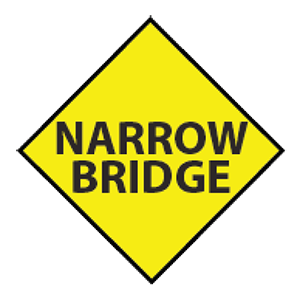
This sign means:
Trucks are permitted on an upcoming narrow bridge.
The bridge ahead is open to one-way traffic only.
The bridge ahead is wide enough for only one car at a time.
The bridge ahead may be too narrow to meet or pass a truck.
Q.43.
Vehicle stopping distances never depend on:
Your own reaction time.
The time of day.
The condition of your vehicle's brakes.
The condition and type of your vehicle's tires.
Q.44.
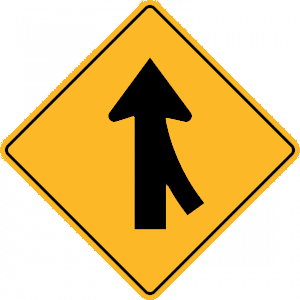
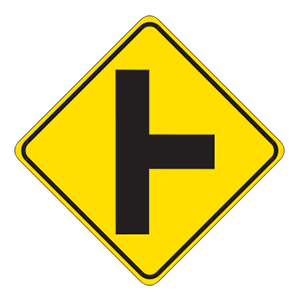
This sign means:
Side road.
Low clearance.
Merging traffic.
Prepare to stop.
Q.45.
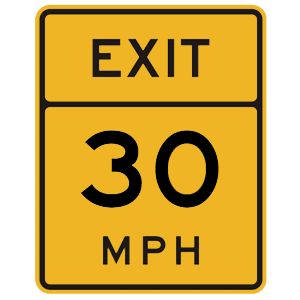
This road sign indicates:
The maximum safe speed for a residential area.
The maximum safe speed for an expressway exit.
The maximum safe speed for an expressway entrance.
The maximum safe speed for a work zone.
Q.46.
Which of the following is a safe way to drive through a curve?
Slow down as you enter, speed up as you exit.
Maintain a constant speed throughout the curve.
Speed up as you enter, slow down as you exit.
Stay near the right edge of your lane.
Q.47.
Defensive driving is:
Identifying dangerous driving situations and taking action to avoid accidents.
Defending yourself against poor drivers by getting ahead of them in traffic.
Following the vehicle ahead of you at a close distance.
Quickly changing lanes and shifting in and out of traffic congestion.
Q.48.
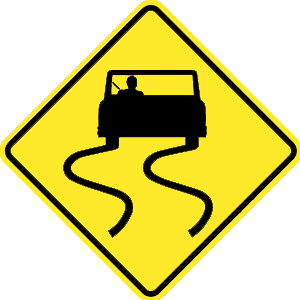
This sign tells you that:
No turns are allowed on this road.
The road narrows ahead.
There are a series of curves ahead.
The road may be slippery when wet.
Q.49.
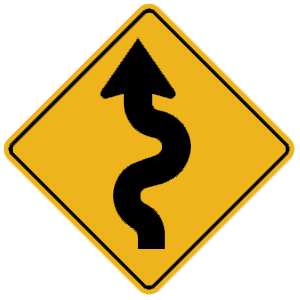
This road sign means:
When pavement is wet, reduce your speed.
The road ahead winds a series of turns or curves.
Traffic increases ahead.
Steep grade ahead.
Q.50.
If you come to a roadway covered in water, you should:
Drive until you think the water is too deep.
Drive through, as it is unlikely the standing water will become too deep.
Turn around and find another way to go.
Walk out into the water to determine its depth.
Support mcqgeeks.com by disabling your adblocker.
×
Please disable the adBlock and continue.
Thank you.
Reload page