MCQGeeks
CBSE
JEE
NTSE
NEET
English
UK Quiz
Quiz
Driving Test
Practice
Games
Driving Test
Florida
Florida Car Driving Permit Test-17
Answers
Q.1.
To safely pass a bicycle, you should:
Honk at the bicyclist to let them know you're trying to pass.
Drive in the bicycle lane until you get a chance to pass.
Slow down and give them as much space as possible.
Rush ahead to pull in front of the bicyclist.
Q.2.
Which of the following statements is true?
A sudden change in weather calls for a change in driving.
You should slow down when driving in rain and fog.
Be particularly aware of vehicles coming up behind you in inclement weather.
All of the above.
Q.3.
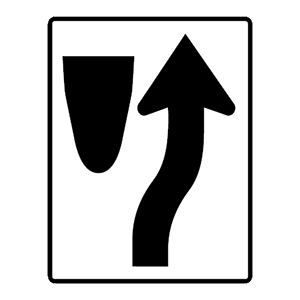
This road sign means:
Side road.
Keep to the side indicated by the arrow.
You may drive in the left lane.
You have the right-of-way.
Q.4.
When stopped for a traffic violation or at an equipment check, the driver must produce:
Proof of insurance.
Their license.
Proof of registration.
All of the above.
Q.5.
A driver who has been convicted of three traffic offenses that caused accidents over the course of three years:
Must complete a DHSMV-approved driver improvement course.
Must hand in their license.
Will not be permitted to drive on freeways.
May not leave the state.
Q.6.
If involved in an accident, a driver should:
Stop their vehicle at or near the scene.
Not stand or walk in traffic lanes.
Turn off the ignitions of wrecked vehicles.
All of the above.
Q.7.
When driving on slippery roads, you should:
Use alternate routes.
Drive as you would on dry roads.
Increase your following distance.
Avoid crossing bridges or intersections.
Q.8.
If someone is driving aggressively behind you, you should:
Try to get out of the aggressive driver’s way.
Stare at the driver as he or she is passing you.
Speed up as he or she is passing you.
Block the passing lane.
Q.9.
To turn left from multilane, one-way streets and highways, you should start from:
The middle of the intersection.
The right lane.
The left lane.
Any lane.
Q.10.
Florida law requires you to use headlights:
To get the attention of vehicles surrounding you.
During a clear day.
Between sunset and sunrise.
If you are driving while tired.
Q.11.
You may drive around or under a gate that is being lowered or raised at a railroad crossing:
As long as an approaching train is not too close.
If your vehicle can do so without damaging the gate.
If you first look carefully in both directions.
Under no circumstances.
Q.12.
Drinking alcohol and driving is:
A minor traffic safety problem.
A serious traffic safety problem.
Safe if you have only had a few drinks.
Only dangerous to the driver who drinks.
Q.13.
You notice that the driver in the vehicle ahead of you is driving with one hand and talking to a passenger. You should:
Give the vehicle extra space.
Know that the driver in the vehicle ahead is reducing their safety margin by being an inattentive driver.
Avoid following the driver's example.
All of the above.
Q.14.
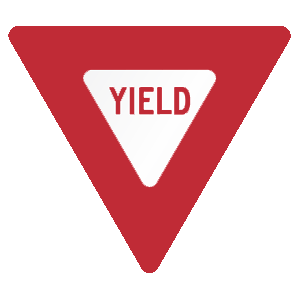
This road sign means:
Drive with caution and be ready to slow down.
Do not drive in this lane.
You must come to a complete stop and yield the right-of-way.
Slow down, be prepared to stop, and, if necessary, yield the right-of-way.
Q.15.
Your brake lights tell other drivers that you:
Are making a turn.
Have your emergency brake on.
Are changing lanes.
Are slowing down or stopping.
Q.16.
A driver can legally pass on the right side of another vehicle:
If the vehicle is waiting to turn left and there is an available passing lane.
Even if it means driving off the pavement.
On a narrow bridge.
At any time.
Q.17.
When a vehicle with an Anti-Lock Braking System starts to lose traction on a slippery road, drivers should:
Pump the brakes.
Press and hold the brake pedal.
Press and hold the gas pedal.
Lightly tap the brakes.
Q.18.
You are driving on a busy street and your vehicle’s accelerator sticks open. You should:
Blow your horn.
Slam on your brakes.
Turn on your four-way flashers.
Turn off your ignition, taking care not to engage the steering wheel locking mechanism.
Q.19.
Posters, signs, and stickers on the windshield and windows:
Are a fun way to personalize your vehicle.
Are permitted if they allow the driver at least a little visibility.
Are prohibited, unless they are otherwise specifically required by law.
Are permitted only if they do not contain offensive language.
Q.20.
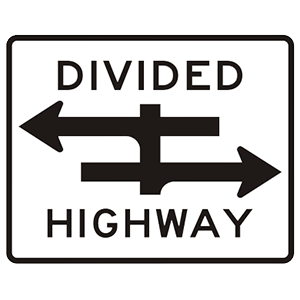
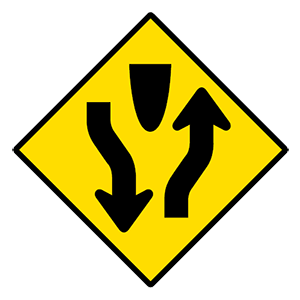
This sign means:
You must turn left or right.
You are approaching a T intersection.
The road that you are on intersects with a divided highway.
You are on an overpass above a divided highway.
Q.21.
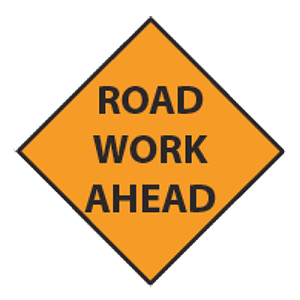
This sign is used to warn drivers:
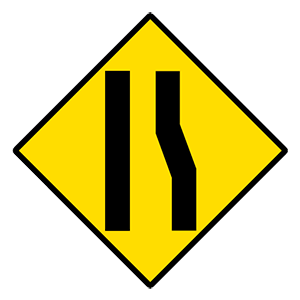
That the right lane ends and traffic should merge left.
That the road curves ahead.
About upcoming intersections.
About road construction.
Q.22.
Two solid yellow lines on the pavement mean:
Passing is allowed for drivers from both directions.
Passing is not allowed.
Passing is allowed if you are at the top a hill.
Passing is allowed during daylight only.
Q.23.
You are driving on the roadway and hear a siren behind you. You should:
Stop where you are.
Pull over to the right and stop.
Speed up to get out of the way.
Slow down.
Q.24.
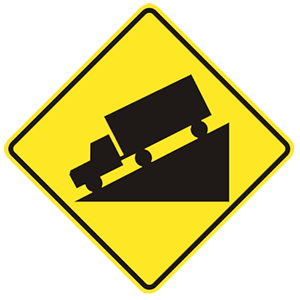
This road sign means:
Intersection ahead.
Steep grade ahead.
Winding road.
Merging traffic.
Q.25.
At a four-way stop:
The driver to arrive first has the right-of-way.
The driver to arrive last has the right-of-way.
One driver should continue driving without stopping.
One driver should wave the other drivers ahead.
Q.26.
How long will a DUI conviction remain on your driving record?
One year.
10 years.
40 years.
75 years.
Q.27.
You should honk your horn when you:
Are traveling through an intersection.
Are passing a bicyclist.
See a child who is about to run into the street.
Are parallel parking.
Q.28.
Driving at night requires increased caution because:
Traffic moves faster at night.
There is a larger volume of traffic at night.
Drivers cannot see as well at night.
Accidents occur more frequently at night.
Q.29.
When you see this black and yellow sign, it means:
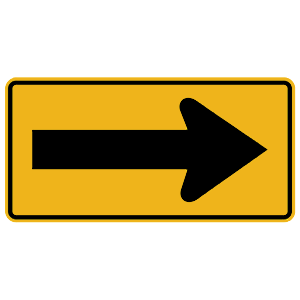
The road to the right is for one-way traffic only.
That due to upcoming roadwork, there is a detour to the right.
Slow down because the road ahead changes direction at an extreme angle.
There is a crossroad to your right.
Q.30.
This road sign means:
Do not pass.
Do not enter.
No turn on red.
Keep right.
Q.31.
If a green arrow turns into a solid green light, you:
May still turn, but you must yield to oncoming traffic.
May no longer turn and must proceed straight.
Still have the right-of-way to turn.
No longer have to turn in the direction that the arrow indicated.
Q.32.
Which of the following is true about driving on a wet roadway?
As you drive faster, your tires become less effective.
Water does not affect cars with good tires.
Deep water is less dangerous than shallow water.
As you decrease your speed, the roadway becomes more slippery.
Q.33.
You may avoid the risks of alcohol-related crashes by:
Deciding before you start drinking that you are not going to drive.
Simply saying, "No thanks, I'm driving," if someone offers you a drink.
Calling a taxi.
Doing any of the above.
Q.34.
When should drivers drive across or park on a median?
When they need to rest.
When they need to make a phone call.
When they want to turn around.
They should never drive into a median.
Q.35.
If you are required to have increased insurance coverage limits but are unable to provide proof of the increased limits, you will:
Have your license and plates suspended for up to three years.
Only be allowed to drive on residential roads.
Be let off with a warning.
Face no negative consequences.
Q.36.
You are making a left turn from a two-way street onto a one-way street. When you have completed the turn, your car should be:
In the right lane of the street.
In the center of the street.
In the left lane of the street.
In the lane with the least traffic.
Q.37.
Signaling your intentions before turning, changing lanes, or driving away from a curb:
Is necessary only if other traffic is present.
Is a good driving habit and is required by law.
Is necessary only during the maneuver, not before.
Is not necessary if the maneuver is done slowly.
Q.38.
If your wheels drop off the pavement and onto the shoulder of the road, you should:
Brake hard and turn sharply back onto the pavement.
Stop your car on the edge of the road.
Slow down and very carefully turn back onto the pavement.
Maintain your speed and turn sharply back onto the pavement.
Q.39.
Downward-facing triangular signs:
Indicate school zones.
Tell drivers to yield.
Indicate construction zones.
Indicate railroad crossings.
Q.40.
To prevent hydroplaning, you should:
Ensure that your tires have good tread depth.
Ensure that your tires are properly inflated.
Reduce your speed when driving in the rain.
All of the above.
Q.41.
A single broken white line down the center of a two-lane road indicates:
Lanes are moving in opposite directions and drivers are not permitted to pass.
Lanes are moving in opposite directions and drivers are permitted to pass when it is safe to do so.
Lanes are moving in the same direction and drivers are not permitted to pass.
Lanes are moving in the same direction and drivers are permitted to pass when it is safe to do so.
Q.42.
This sign means:
There is a detour ahead.
You must stop for flaggers.
The road ahead is closed to traffic.
The highway ahead is undergoing maintenance.
Q.43.
What does a flashing yellow traffic light mean?
Merging traffic
Proceed with caution.
Pedestrian crossing
Come to a full stop.
Q.44.
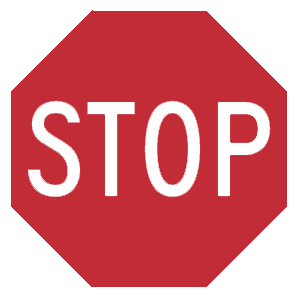
This road sign means:
Slow down or stop.
Stop, if necessary.
You must come to a complete stop.
Drive with caution and be ready to stop.
Q.45.
To help relieve fatigue on a long trip, it is a good idea to:
Stop and rest every two hours.
Do arm exercises every hour.
Drive with one eye open at a time.
Change feet on the gas pedal.
Q.46.
When should you drive in a lane under a lane signal showing a red X?
If there is no visible oncoming traffic.
If you are passing the car in front of you.
Between sunset and sunrise.
Never.
Q.47.
A flashing red traffic signal at an intersection has the same requirements as:
A slow sign.
A yield sign.
A stop sign.
An intersection sign.
Q.48.
When passing a vehicle stopped on the side of the road, drivers should:
Increase their speed.
Vacate the lane closest to the stationary vehicle or slow down.
Pull off the road behind the stationary vehicle.
Move to the lane closest to the stationary vehicle.
Q.49.
When turning left, drivers must yield the right-of-way to:
Other drivers who are already in the intersection.
Oncoming traffic.
Pedestrians who are already in the intersection.
All of the above.
Q.50.
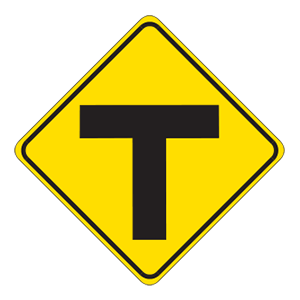
This sign means:
T intersection.
Lane shifting.
Side road.
Do not block intersection.
Support mcqgeeks.com by disabling your adblocker.
×
Please disable the adBlock and continue.
Thank you.
Reload page